
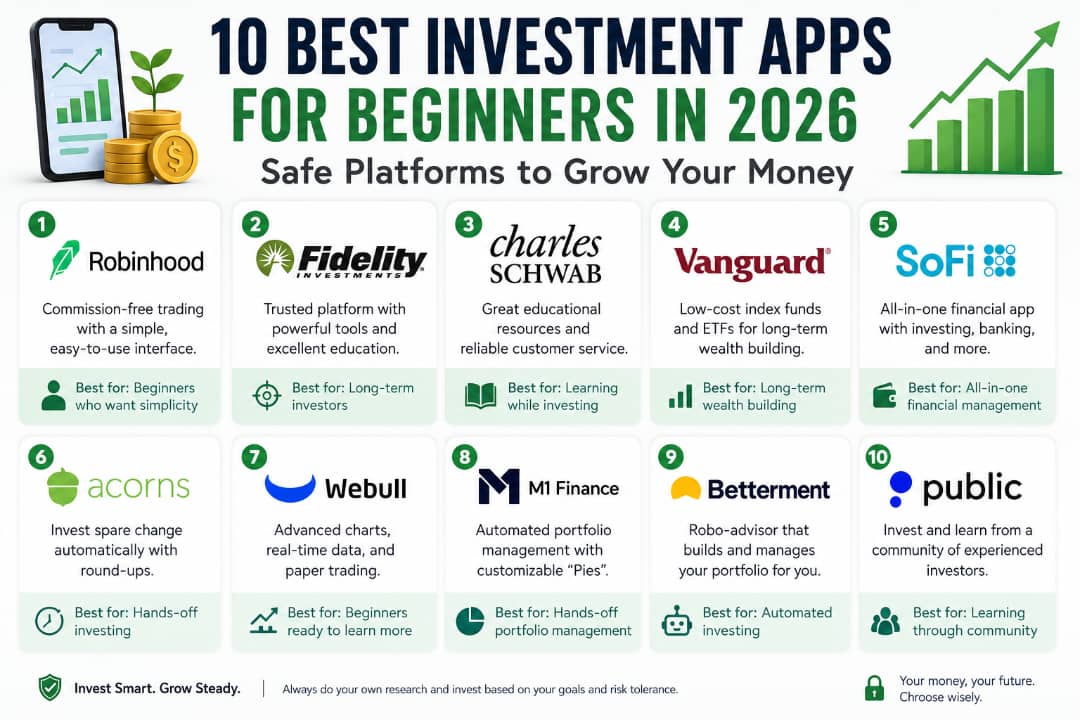
If you’ve ever wanted to start investing but felt overwhelmed by the number of apps available, you’re not alone. Many beginners assume investing is only for wealthy people or financial experts. The truth is quite different. Thanks to modern investment apps, almost anyone can begin building wealth with a small amount of money and a smartphone.
Whether your goal is to save for retirement, build an emergency fund, generate passive income, or simply grow your savings faster than a traditional bank account, choosing the right investment app can make a significant difference.
The best investment apps do much more than allow you to buy stocks or funds. They provide educational resources, user-friendly interfaces, low fees, security features, and investment options designed for people who are just getting started.
However, not every app is created equal. Some charge high fees that eat into your returns, while others may offer limited investment choices or lack the educational tools beginners need. That’s why taking the time to compare investment apps before signing up is one of the smartest financial decisions you can make.
In this guide, we’ll explore the best investment apps for beginners in 2026, explain what each platform offers, discuss their advantages and drawbacks, and help you decide which one best matches your financial goals.
Why More People Are Using Investment Apps in 2026
Investing has changed dramatically over the last decade. Years ago, opening an investment account often meant visiting a brokerage office, completing lengthy paperwork, and meeting minimum investment requirements that many people couldn’t afford.
Today, everything can be done from your phone in just a few minutes.
Investment apps have removed many of the traditional barriers that kept people from investing. Most platforms now allow users to start with little money, automate their investments, monitor their portfolios in real time, and learn about investing through built-in educational content.
Several factors have contributed to the growing popularity of investment apps:
Accessibility
Many apps allow beginners to start investing with as little as $5 or $10. This means you don’t need thousands of dollars before taking your first step toward building wealth.
Simplicity
Modern investment apps are designed for everyday users rather than professional traders. Clean dashboards, guided account setup, and easy-to-understand investment options make the learning curve much less intimidating.
Lower Costs
Traditional investment firms often charged commissions on every trade. Today, many investment apps offer commission-free investing, allowing users to keep more of their returns over time.
Automation
One of the biggest reasons beginners succeed with investment apps is automation. Instead of trying to time the market, users can schedule automatic weekly or monthly investments, helping them build wealth consistently without constantly monitoring the markets.
Education
Many of today’s top investment platforms include articles, videos, market news, investment calculators, and beginner tutorials. These resources help new investors gain confidence while avoiding common mistakes.
What Makes an Investment App Good for Beginners?
Before looking at specific apps, it’s important to understand what separates an excellent beginner-friendly investment app from an average one.
The best investment apps usually have several key characteristics.
Easy-to-Use Interface
A beginner shouldn’t need hours of training to understand how an app works. The best platforms make it easy to open an account, deposit money, browse investments, and monitor performance.
An intuitive design reduces confusion and encourages users to stay invested for the long term instead of giving up because the platform feels too complicated.
Low or No Account Fees
Fees may seem small initially, but they can reduce your investment returns over time.
For example, paying high annual management fees over 20 or 30 years could cost thousands of dollars in lost investment growth.
Many beginner-friendly investment apps now offer commission-free trading and low account maintenance costs, making investing more affordable than ever.
Strong Security Features
Because investment accounts contain sensitive personal and financial information, security should never be overlooked.
Look for platforms that provide features such as:
Two-factor authentication
Data encryption
Biometric login
Fraud monitoring
Insurance protection where applicable
Strong security helps protect both your investments and your personal information from cyber threats.
Educational Resources
The best investment app doesn’t just allow you to invest—it also teaches you how to become a better investor.
Educational articles, market insights, investment guides, webinars, and beginner tutorials can help you make informed decisions rather than relying on guesswork or social media trends.
A platform that invests in your financial education often delivers greater long-term value than one focused only on buying and selling investments.
Top 10 Best Investment Apps for Beginners in 2026 (Quick Comparison)
1. Robinhood – Best for Beginners Who Want a Simple Investing Experience
When people talk about beginner-friendly investment apps, Robinhood is often one of the first names that comes up. The platform helped make commission-free investing popular and has encouraged millions of people to start investing for the first time.
One of Robinhood’s biggest strengths is its simplicity. The app is designed with beginners in mind, making it easy to buy stocks, exchange-traded funds (ETFs), and other investments without feeling overwhelmed by complicated financial terminology.
Opening an account takes only a few minutes, and once you’re set up, you can fund your account and begin investing almost immediately.
Why beginners like Robinhood
Robinhood offers an easy-to-navigate interface that removes much of the complexity associated with investing. Instead of being bombarded with advanced charts and technical analysis, users are presented with a clean dashboard that highlights their portfolio, watchlists, and available investments.
Some of the platform’s key benefits include:
Commission-free stock and ETF trading
Fractional shares, allowing you to invest with small amounts of money
Real-time market data
Automatic recurring investments
Mobile-friendly interface
No account minimum for most users
The ability to buy fractional shares is especially valuable for beginners. Imagine wanting to invest in a company whose stock costs hundreds of dollars per share. Instead of waiting until you can afford a full share, Robinhood lets you purchase a fraction of it, making investing far more accessible.
Things to keep in mind
While Robinhood is excellent for beginners, it may not provide as many educational resources or advanced research tools as some competing platforms. As your investing knowledge grows, you may eventually want access to more detailed analysis and planning tools.
However, if your primary goal is simply to begin investing consistently without unnecessary complications, Robinhood remains one of the strongest choices.
2. Fidelity Investments – Best for Long-Term Investors
If you’re planning to invest for long-term financial goals such as retirement, buying a home, or building generational wealth, Fidelity is one of the most trusted investment companies available.
Unlike platforms that focus mainly on simplicity, Fidelity combines beginner-friendly tools with professional-level investment resources. This means you won’t outgrow the platform as your knowledge and portfolio expand.
Why Fidelity stands out
Fidelity has earned a strong reputation for reliability, customer service, and investor education. Beginners can access thousands of educational articles, webinars, videos, and planning tools that explain investing in clear and practical language.
Some of its advantages include:
No account minimum for many accounts
Commission-free stock and ETF trading
Access to mutual funds and retirement accounts
Excellent educational resources
Strong research and market analysis
High-quality customer support
Many financial experts recommend Fidelity because it encourages long-term investing instead of frequent buying and selling, a strategy that often produces better results over time.
Is Fidelity right for beginners?
Absolutely.
Although Fidelity offers advanced investment options, beginners don’t need to use them immediately. You can start with simple investments such as diversified index funds or ETFs and gradually explore more advanced features as your confidence grows.
This flexibility makes Fidelity a platform that can support you throughout your entire investing journey.
3. Charles Schwab – Best for Learning While Investing
Many beginners worry about making costly mistakes because they lack investing experience.
Charles Schwab addresses this concern by combining a powerful investment platform with some of the best educational resources available.
Instead of simply allowing you to buy investments, Schwab focuses on helping users understand how investing works.
What makes Charles Schwab different?
The platform provides beginner-friendly learning materials covering topics such as:
Stock market basics
Portfolio diversification
Retirement planning
Risk management
Investment strategies
Market updates
These resources help users build confidence before making investment decisions.
Charles Schwab also offers:
Commission-free trading
No minimum balance for many accounts
Excellent customer service
Retirement planning tools
Access to professional financial advice
For someone who wants to learn while gradually building an investment portfolio, Charles Schwab is one of the strongest options available in 2026.
Potential drawback
The platform includes many features designed for experienced investors as well. While beginners can ignore these initially, the large number of available tools may feel slightly overwhelming compared to simpler apps.
Fortunately, most new users become comfortable with the platform after spending a little time exploring its features.
Why Choosing the Right App Matters More Than Chasing High Returns
One mistake many beginners make is selecting an investment platform solely because they believe it will generate the highest returns.
In reality, the app itself doesn’t determine how much money you’ll make. Your investment choices, consistency, time in the market, and financial discipline have a much greater impact on your long-term success.
A good investment app should make it easier for you to develop healthy investing habits. Features like automatic monthly contributions, portfolio tracking, educational resources, and low fees can help you stay committed even during periods of market volatility.
Remember, successful investing is rarely about getting rich overnight. It’s about making smart decisions consistently over many years.
4. Vanguard – Best for Long-Term Wealth Building
If your investment strategy is centered on patience and long-term growth, Vanguard deserves serious consideration. The company is widely respected for promoting low-cost investing and has helped millions of people build wealth through diversified index funds and ETFs.
Unlike some investment apps that encourage frequent trading, Vanguard emphasizes staying invested for years rather than reacting to daily market fluctuations.
Why Vanguard is a great choice
Some of Vanguard’s biggest advantages include:
Low-cost index funds and ETFs
Strong reputation and decades of experience
Retirement planning tools
Long-term investment philosophy
Reliable customer support
For beginners who want to grow their wealth steadily rather than chase quick profits, Vanguard offers a solid foundation.
Best for: Long-term investors, retirement planning, and passive investing.
5. SoFi Invest – Best All-in-One Financial App
If you want more than just an investment platform, SoFi Invest is worth exploring.
Besides investing, SoFi offers banking services, personal loans, credit cards, budgeting tools, and educational resources. Having these services in one app makes it easier to manage your finances without switching between multiple platforms.
Why beginners like SoFi Invest
SoFi is designed to simplify personal finance. New investors can learn about investing while managing other financial goals from one dashboard.
Key features include:
Commission-free investing
Fractional shares
Automated investing options
Educational articles and webinars
User-friendly interface
This makes SoFi particularly appealing to young professionals and first-time investors looking for an all-in-one financial solution.
6. Acorns – Best for Investing Spare Change
One of the biggest excuses people give for not investing is that they don’t have enough money.
Acorns solves this problem with a unique feature called round-ups.
Whenever you make a purchase, the app rounds the amount up to the nearest dollar and automatically invests the spare change.
For example, if you buy coffee for $4.40, Acorns rounds it up to $5.00 and invests the remaining $0.60.
It may seem like a small amount, but over months and years, these automatic investments can add up significantly.
Why Acorns stands out
Acorns is ideal for people who want to develop an investing habit without making large upfront deposits.
Benefits include:
Automatic round-up investing
Recurring investment options
Diversified portfolios
Retirement account options
Beginner-friendly interface
It’s a great choice for anyone who wants investing to happen almost automatically.
7. Webull – Best for Beginners Ready to Learn More
As your investing knowledge grows, you may want access to more detailed market information.
Webull offers a balance between beginner-friendly investing and advanced research tools.
Users can access:
Real-time market data
Interactive charts
Stock screeners
Watchlists
Paper trading (practice investing without risking real money)
The paper trading feature is especially valuable because beginners can test investment strategies before committing actual money.
8. M1 Finance – Best for Hands-Off Portfolio Management
M1 Finance is an excellent choice for beginners who want more control over their investments without having to monitor the market every day.
Instead of manually buying and selling stocks, M1 Finance allows users to build a customized portfolio, known as a “Pie.” Each slice of the pie represents an investment, and whenever you deposit money, the app automatically allocates it according to your chosen percentages.
Why beginners love M1 Finance
M1 Finance combines automation with flexibility, making it ideal for people who want to invest consistently while maintaining control over their portfolio.
Some of its key features include:
Automated portfolio rebalancing
Fractional share investing
No commissions on most investments
Customizable investment portfolios
Automatic recurring deposits
This app is particularly suitable for investors who believe in long-term wealth building and prefer a “set it and forget it” approach.
Best for: Long-term investors who want automation with customization.
9. Betterment – Best Robo-Advisor for Beginners
If choosing individual stocks sounds intimidating, Betterment removes the guesswork.
Betterment is a robo-advisor, meaning it builds and manages a diversified investment portfolio for you based on your goals, age, and risk tolerance.
After answering a few simple questions during registration, the platform recommends an investment strategy and automatically manages your portfolio over time.
Why Betterment stands out
For many beginners, the biggest challenge isn’t opening an account—it’s deciding what to invest in.
Betterment solves this problem by handling portfolio management automatically.
Some benefits include:
Professionally managed portfolios
Automatic portfolio rebalancing
Tax-efficient investing
Goal-based financial planning
Automatic recurring investments
While Betterment charges a management fee, many beginners find the convenience and professional management worth the cost.
Best for: Investors who prefer a fully managed investment experience.
10. Public – Best for Learning Through Community Investing
Public offers a unique approach by combining investing with a community experience.
Users can follow experienced investors, view educational discussions, and learn about investing from others while building their own portfolios.
Unlike many social platforms, Public focuses heavily on financial education rather than encouraging risky speculation.
Why beginners choose Public
Learning from experienced investors can help beginners understand different investment strategies and market trends.
Some standout features include:
Commission-free investing
Fractional shares
Educational community discussions
Easy-to-use mobile app
Investment insights from experienced users
While every investment decision should still be based on your own research, the platform provides a supportive environment for those who are just starting.
Best for: Beginners who enjoy learning through community discussions and shared investment ideas.
How to Choose the Right Investment App
With so many excellent platforms available, choosing one can feel overwhelming.
Instead of asking which app is the “best,” ask which one is the best for your goals.
Consider the following questions:
What are you investing for?
Your objective should influence the platform you choose.
For example:
Building long-term wealth
Retirement planning
Generating passive income
Learning how investing works
Knowing your goal makes it easier to select the right app.
How much money are you starting with?
Some platforms are ideal if you’re investing small amounts, while others offer more advanced tools for larger portfolios.
The good news is that many beginner-friendly apps now allow you to start with very little money.
Do you want to invest actively or passively?
Active investing involves regularly buying and selling investments.
Passive investing focuses on consistently investing in diversified funds over the long term.
For most beginners, passive investing is often the simpler and less stressful approach.
Common Mistakes Beginners Should Avoid
Starting your investment journey is exciting, but it’s easy to make mistakes that can slow your progress.
Here are some common pitfalls to avoid:
Investing without a plan
Never invest simply because everyone else is doing it. Set clear financial goals before putting your money into any investment.
Chasing quick profits
Many beginners are tempted by stories of people making huge profits overnight. Successful investing is usually built on patience, discipline, and consistency—not luck.
Ignoring fees
Small fees may not seem significant today, but they can reduce your investment returns over many years. Always understand what charges apply before opening an account.
Failing to diversify
Putting all your money into one stock or one investment increases your risk. Diversifying your portfolio helps reduce the impact if one investment performs poorly.
Panic selling
Markets naturally rise and fall. Selling investments during temporary downturns often locks in losses that could have recovered over time.
Frequently Asked Questions (FAQs)
1. Which investment app is best for complete beginners?
Robinhood, Fidelity, and Acorns are among the most beginner-friendly platforms because they offer simple interfaces, low barriers to entry, and educational resources.
2. Can I start investing with very little money?
Yes. Many investment apps allow you to begin with as little as $5 or $10 through fractional shares or recurring investments.
3. Are investment apps safe?
Reputable investment apps use strong security measures such as encryption and two-factor authentication. Always choose well-established, regulated platforms.
4. Do investment apps charge fees?
Many offer commission-free trading, but some may charge subscription fees, fund management fees, or other service fees. Review the fee structure before opening an account.
5. Should I invest every month?
Many financial experts recommend investing consistently through regular monthly contributions. This approach can help smooth out market fluctuations over time.
Conclusion
Choosing the best investment app isn’t about finding the platform with the flashiest features—it’s about finding one that helps you invest consistently, keeps your costs low, and supports your long-term financial goals.
Remember that every successful investor started as a beginner. The most important step is not finding the “perfect” app but developing the habit of investing regularly and continuing to learn along the way.
Whether you choose Robinhood, Fidelity, Charles Schwab, Vanguard, SoFi Invest, Acorns, or Webull, consistency, patience, and smart financial decisions will have a far greater impact on your success than trying to time the market.
Start small if necessary, stay focused on your goals, and let time work in your favor.
Disclaimer
This article is for informational and educational purposes only and should not be considered financial or investment advice. Investment values can rise or fall, and you may lose money. Always conduct your own research or consult a qualified financial advisor before making investment decisions. Past performance does not guarantee future results.