
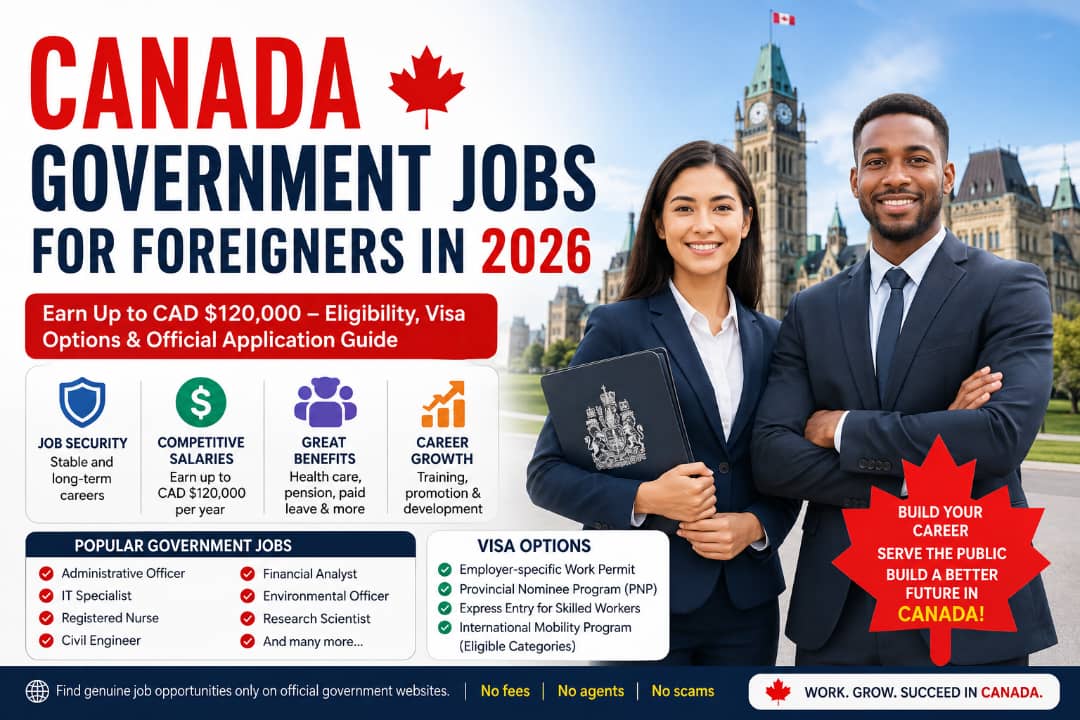
Have you ever imagined working for the Canadian government instead of a private company? For many job seekers around the world, government jobs are seen as among the most secure and rewarding careers because they often offer competitive salaries, excellent employee benefits, opportunities for career growth, and a stable work environment.
This has led many people to search for Canada government jobs for foreigners in 2026, hoping to find opportunities that could help them build a successful career while living in one of the world’s most desirable countries.
But here’s the reality: there is a lot of misinformation online. Some websites and social media posts claim that the Canadian government is offering thousands of jobs with guaranteed visa sponsorship for foreigners. While Canada does recruit skilled workers from around the world, government hiring follows strict rules and not every government position is open to applicants living outside Canada.
That doesn’t mean international applicants should give up. In fact, government departments, public agencies, healthcare institutions, research organizations, and Crown corporations may recruit foreign talent when specialized skills are needed or when applicants already have legal authorization to work in Canada.
Understanding how the system works is the key to avoiding scams and focusing on genuine opportunities.
In this comprehensive guide, you’ll learn everything you need to know about Canada government jobs for foreigners in 2026, including who can apply, the types of government jobs available, salary expectations, eligibility requirements, visa options, official websites to search for vacancies, and practical tips that can improve your chances of getting hired.
Whether you’re a skilled professional, a healthcare worker, an engineer, an IT specialist, or someone planning a long-term career in Canada, this guide will help you understand where the real opportunities exist.
Why Canada Government Jobs Are in High Demand in 2026
Government jobs have always been popular, but in recent years, demand has grown even stronger. One of the biggest reasons is job security. While private companies may expand or reduce their workforce depending on market conditions, government organizations often provide more stable employment with structured career progression.
Beyond stability, government employees usually enjoy competitive salaries, comprehensive health benefits, paid leave, retirement pension plans, and access to professional development programs. These benefits make government careers attractive not only to Canadians but also to qualified professionals from around the world.
Let’s look at some of the factors driving this demand.
Excellent Job Security
Many people prefer government employment because it offers greater stability than many private-sector jobs. Employees often have clear career paths, structured promotions, and long-term employment opportunities based on performance and organizational needs.
For someone planning to build a future in Canada, this level of stability can be very appealing.
Competitive Salaries and Benefits
Government jobs are known for offering attractive compensation packages. In addition to salaries, employees may receive health insurance, dental coverage, paid vacation, parental leave, pension contributions, and various workplace benefits.
For many professionals, these benefits are just as valuable as the salary itself because they provide long-term financial security.
Retirement of Experienced Workers
Canada’s workforce is changing. As many experienced public servants reach retirement age, government departments and public institutions continue to recruit new employees to replace them.
While many of these opportunities are filled by Canadian citizens or permanent residents, certain specialized positions may also be available to qualified foreign professionals, depending on the employer and applicable hiring policies.
Increasing Demand for Skilled Professionals
Modern government departments rely on professionals from a wide range of fields. Beyond administrative roles, they require healthcare workers, engineers, IT specialists, cybersecurity experts, accountants, researchers, policy analysts, environmental scientists, and many other professionals.
As technology continues to evolve and public services expand, the need for highly skilled workers is expected to remain strong.
Can Foreigners Apply for Canada Government Jobs?
This is one of the most common questions people ask, and the answer is yes—but with important conditions.
Many government positions in Canada give preference to Canadian citizens or permanent residents. Some roles, especially those involving national security or sensitive government information, are restricted to citizens only.
However, not every government-related job has the same requirements.
Some public institutions, healthcare organizations, universities, research centres, municipalities, and Crown corporations may consider qualified foreign workers, particularly for positions experiencing labour shortages or requiring specialized skills.
If you already have legal authorization to work in Canada—such as a valid work permit or permanent resident status—you may also be eligible to apply for a wider range of government positions than someone applying directly from overseas.
The most important thing is to carefully read each job posting. Employers clearly state who is eligible to apply, whether the position is open to international candidates, and any citizenship or residency requirements.
Understanding these requirements before applying will save you time and help you focus on genuine opportunities instead of vacancies that you’re not eligible for.
Types of Canada Government Jobs Available
When people hear the words government jobs, they often imagine office workers sitting behind desks all day. In reality, the Canadian public sector is one of the country’s largest employers, offering careers in healthcare, technology, engineering, environmental protection, public safety, finance, transportation, education, research, administration, and many other fields.
Whether you’re a recent graduate or an experienced professional, there are many different career paths available depending on your qualifications and experience.
Types of Canada Government Jobs Available
One of the biggest misconceptions about government employment is that all government workers spend their day behind office desks. In reality, the Canadian public sector employs hundreds of thousands of people in different professions, many of which involve working directly with communities, maintaining public infrastructure, providing healthcare, protecting the environment, conducting research, and delivering essential services.
Whether you’re an experienced professional or someone with specialized technical skills, there may be opportunities that match your qualifications.
Let’s look at some of the most common government-related careers in Canada.
Administrative Officer
Administrative officers help government departments run efficiently by managing records, preparing reports, organizing meetings, responding to enquiries, and supporting day-to-day operations.
Although this role may seem straightforward, it requires excellent organizational skills, attention to detail, and the ability to communicate professionally with colleagues and members of the public.
For people who enjoy office work and administration, this position can provide excellent career growth within the public sector.
Information Technology (IT) Specialist
Technology has become one of the most important parts of modern government operations.
Government departments depend on IT professionals to maintain computer systems, strengthen cybersecurity, manage networks, develop digital services, and protect sensitive information.
Because cyber threats continue to increase worldwide, experienced IT professionals remain among the most sought-after employees in Canada’s public sector.
Candidates with experience in software development, cloud computing, cybersecurity, systems administration, or data management often enjoy strong employment prospects.
Registered Nurse and Healthcare Professional
Healthcare is one of Canada’s largest public sectors.
Government-funded hospitals, public health agencies, and healthcare institutions regularly require qualified nurses, laboratory professionals, pharmacists, therapists, and other healthcare workers to serve Canada’s growing population.
Healthcare professionals are particularly valuable because many provinces continue to experience shortages in certain medical occupations.
If you have internationally recognized qualifications and meet Canadian licensing requirements, this sector can offer rewarding long-term career opportunities.
Engineer
Government departments employ engineers in a wide range of fields, including civil engineering, environmental engineering, electrical engineering, mechanical engineering, and transportation infrastructure.
Engineers contribute to building safer roads, bridges, water systems, airports, public facilities, and sustainable energy projects.
As Canada continues investing in infrastructure and environmental initiatives, skilled engineers remain in demand across several government agencies.
Environmental Officer
Protecting Canada’s natural resources is an important government responsibility.
Environmental officers help monitor pollution, inspect industrial activities, conduct environmental assessments, and ensure businesses comply with environmental regulations.
This career is ideal for professionals with backgrounds in environmental science, biology, ecology, geology, or related disciplines.
Financial Analyst and Accountant
Government organizations manage large public budgets and financial programs.
Financial analysts and accountants help prepare budgets, monitor spending, conduct financial reporting, and ensure public funds are managed responsibly.
Candidates with accounting qualifications, financial analysis experience, or professional certifications often have opportunities in this field.
Research Scientist
Canada invests heavily in research across healthcare, agriculture, climate science, technology, and innovation.
Government laboratories and research organizations employ scientists to conduct studies, analyze data, and develop solutions to national challenges.
Professionals with postgraduate qualifications and specialized research experience are often well suited for these positions.
Public Safety and Emergency Management Officer
Public safety professionals help communities prepare for emergencies, natural disasters, and public security challenges.
These roles involve planning emergency responses, coordinating disaster recovery efforts, and working closely with different government agencies.
Strong decision-making abilities and leadership skills are especially valuable in this field.
Salary Expectations for Canada Government Jobs in 2026
One of the reasons government jobs remain highly competitive is the attractive combination of salary, stability, and employee benefits.
Unlike some private-sector positions where salaries can vary significantly, government organizations often use structured pay scales. This means employees know how their salary can increase over time based on experience, performance, and promotions.
While salaries differ depending on the department, province, qualifications, and level of responsibility, many government careers provide excellent long-term earning potential.
Below are estimated salary ranges for some common government-related occupations.
Job Position Estimated Annual Salary
Administrative Officer CAD $55,000–$85,000
IT Specialist CAD $75,000–$120,000
Registered Nurse CAD $70,000–$110,000
Civil Engineer CAD $80,000–$125,000
Environmental Officer CAD $65,000–$100,000
Financial Analyst CAD $70,000–$115,000
Research Scientist CAD $80,000–$130,000
Emergency Management Officer CAD $70,000–$115,000
These figures are estimates and may vary depending on the employer, province, qualifications, years of experience, and collective bargaining agreements.
More Than Just a Salary
One reason many professionals choose government careers is that the total compensation package often goes beyond the annual salary.
Depending on the employer and position, employees may receive benefits such as:
Comprehensive health and dental insurance.
Paid annual leave and public holidays.
Pension and retirement savings plans.
Paid parental and family leave.
Professional development and training opportunities.
Flexible work arrangements for eligible positions.
Opportunities for promotion within the public service.
For many employees, these additional benefits make government careers financially attractive over the long term.
Requirements for Canada Government Jobs for Foreigners in 2026
Before applying, it’s important to understand that government employers carefully assess whether candidates meet the qualifications for each position.
The exact requirements vary depending on the role, but most employers look for applicants who possess the appropriate education, relevant work experience, and the skills needed to perform the job effectively.
Here are some of the common requirements.
1. Educational Qualifications
Most government positions require applicants to have qualifications related to the job.
For example, an accountant will usually need an accounting qualification, while an engineer will need an engineering degree or an equivalent credential recognized in Canada.
Entry-level administrative roles may have lower educational requirements than specialized professional positions.
2. Relevant Work Experience
Many government employers value practical experience because it demonstrates that applicants can perform the responsibilities of the role.
The amount of experience required depends on the position. Some entry-level roles welcome recent graduates, while senior positions may require several years of professional experience.
3. Language Skills
Strong English or French communication skills are essential for most government jobs, especially positions involving interaction with the public or collaboration with colleagues.
In some provinces or departments, bilingual candidates may have an advantage.
4. Legal Eligibility to Work
Some government positions are open only to Canadian citizens or permanent residents, while others may accept applicants who already have valid authorization to work in Canada.
Always check the eligibility section of each job posting before applying.
Skills That Can Increase Your Chances of Getting Hired
Having the right degree or work experience is important, but it’s often your skills that convince an employer you’re the right person for the job. Government departments don’t just look for people who can perform tasks—they want professionals who can work responsibly, solve problems, and serve the public effectively.
If you’re hoping to stand out from other applicants, these are some of the skills worth developing.
Whether you’re preparing reports, responding to emails, assisting members of the public, or working with colleagues from different departments, communication plays a major role in government work.
Employers appreciate candidates who can express themselves clearly, listen carefully, and communicate professionally in both written and spoken English or French.
Problem-Solving Skills
Government employees deal with new challenges every day. An administrative officer may need to resolve a documentation issue, while an IT specialist could be responsible for fixing a system outage that affects thousands of users.
Employers value applicants who can remain calm under pressure, think critically, and find practical solutions instead of waiting for others to solve problems.
Teamwork
Government projects often involve people from different departments working toward a common goal.
Being able to cooperate with colleagues, respect different opinions, and contribute positively to a team is an important quality employers look for during the recruitment process.
Attention to Detail
Small mistakes can sometimes have significant consequences in government work.
Whether you’re preparing official documents, managing financial records, or reviewing reports, accuracy is extremely important.
Employers are more likely to trust candidates who consistently produce careful and high-quality work.
Adaptability
Government organizations continue to adopt new technologies, improve public services, and update workplace procedures.
Applicants who are willing to learn, adapt to change, and develop new skills are often viewed as valuable long-term employees.
Visa Options for Foreign Workers
One question many readers ask is:
“Can I get a visa through a government job?”
The answer depends on the employer and the specific position.
Unlike private companies that may hire through programs such as the Temporary Foreign Worker Program, many government positions require applicants to already have the legal right to work in Canada. However, some public institutions, research organizations, healthcare employers, and Crown corporations may recruit internationally for specialized roles where labour shortages exist.
Depending on your situation, possible pathways to working in Canada may include:
Employer-specific work permits.
Provincial Nominee Programs (PNPs).
Express Entry for eligible skilled workers.
The International Mobility Program (for eligible categories).
Before applying, always review the eligibility requirements in the job advertisement to understand whether international applicants are being considered.
How to Apply for Canada Government Jobs for Foreigners in 2026
Applying for a government job requires patience and careful preparation. Because these positions are highly competitive, a strong application can make a significant difference.
Step 1: Search for Genuine Vacancies
Start by looking for vacancies on official government career websites rather than relying on social media advertisements or unofficial recruitment pages.
Official websites provide accurate information about eligibility requirements, qualifications, and application deadlines.
Step 2: Prepare a Professional Resume
Your resume should clearly demonstrate how your education, work experience, and skills match the position you’re applying for.
Instead of using the same resume for every application, tailor it to each specific job.
Step 3: Write a Strong Cover Letter
A well-written cover letter allows you to explain why you’re interested in the position and how your experience makes you a suitable candidate.
Keep it professional, concise, and focused on the employer’s needs.
Step 4: Submit Your Application Before the Deadline
Government recruitment processes usually have strict closing dates.
Submitting your application early also gives you time to correct any errors if necessary.
Step 5: Prepare for Assessments and Interviews
Depending on the role, shortlisted candidates may complete written assessments, competency tests, or multiple interview stages.
Research the department beforehand and be prepared to explain how your skills and experience relate to the position.
Official Websites Where You Can Apply for Canada Government Jobs for Foreigners in 2026
To avoid recruitment scams, always search for opportunities through official government websites.
Government of Canada Jobs
https://www.canada.ca/en/services/jobs/opportunities/government.html
GC Jobs (Federal Public Service)
https://www.canada.ca/en/services/jobs/opportunities/government.html
Government of Ontario Careers
https://www.gojobs.gov.on.ca
Government of British Columbia Careers
https://www2.gov.bc.ca
Government of Alberta Careers
https://www.alberta.ca
Government of Saskatchewan Careers
https://www.saskatchewan.ca
Government of Manitoba Careers
https://www.gov.mb.ca
These websites regularly publish vacancies across different government departments and agencies.
Common Mistakes to Avoid
Many qualified applicants are unsuccessful—not because they lack the necessary skills, but because they make avoidable mistakes during the application process.
Applying Without Checking Eligibility
Some government jobs are open only to Canadian citizens or permanent residents. Applying without reading the eligibility requirements can waste valuable time.
Sending a Generic Resume
Recruiters can quickly identify resumes that have been copied and pasted for every vacancy.
Take the time to customize your resume so it reflects the skills and experience requested in the job advertisement.
Ignoring Application Instructions
Government employers often provide detailed instructions about how applications should be submitted.
Missing required documents or failing to answer mandatory questions can result in automatic disqualification.
Believing Fake Recruitment Offers
Unfortunately, scammers often target people searching for Canadian government jobs.
Remember:
The Canadian government does not guarantee jobs through social media.
Genuine employers do not ask applicants to pay recruitment or visa sponsorship fees.
Always verify vacancies through official government websites.
Giving Up Too Soon
Government recruitment can take longer than private-sector hiring.
It’s normal for the selection process to take several weeks or even months, depending on the position. Continue improving your skills and applying for suitable opportunities rather than becoming discouraged.
Frequently Asked Questions (FAQs)
Can foreigners apply for Canada government jobs?
Yes, but eligibility depends on the employer and the position. Some roles are open to international applicants, while others require Canadian citizenship or permanent residency.
Do government jobs provide visa sponsorship?
Some government-related employers may recruit internationally for specialized positions, but many government jobs require applicants to already have legal authorization to work in Canada.
What is the average salary?
Depending on the position, qualifications, and level of experience, government employees can earn anywhere from CAD $55,000 to over CAD $130,000 per year, along with additional employee benefits.
Do I need work experience?
It depends on the role. Entry-level positions may require little experience, while specialized and senior roles often require several years of relevant professional experience.
Where should I apply?
Always use official government career websites and trusted recruitment portals rather than unofficial websites or social media advertisements.
Conclusion
A career in the Canadian public sector can offer much more than a competitive salary. It provides stability, professional growth, valuable employee benefits, and the opportunity to contribute to services that make a real difference in people’s lives.
However, it’s important to approach your job search with realistic expectations. While some government-related organizations may consider qualified foreign professionals, many positions have citizenship or work authorization requirements. Taking the time to understand these requirements, preparing a strong application, and applying through official channels will greatly improve your chances of success.
If working in Canada is your long-term goal, continue building your qualifications, develop in-demand skills, and monitor official recruitment websites for opportunities that match your background.
Disclaimer
This article is for informational purposes only. Employment policies and eligibility requirements vary between government departments and public-sector employers. Job availability, citizenship requirements, work authorization, and recruitment processes are determined solely by the hiring organization and applicable Canadian laws. Always verify vacancies through official Canadian government career websites before applying.