
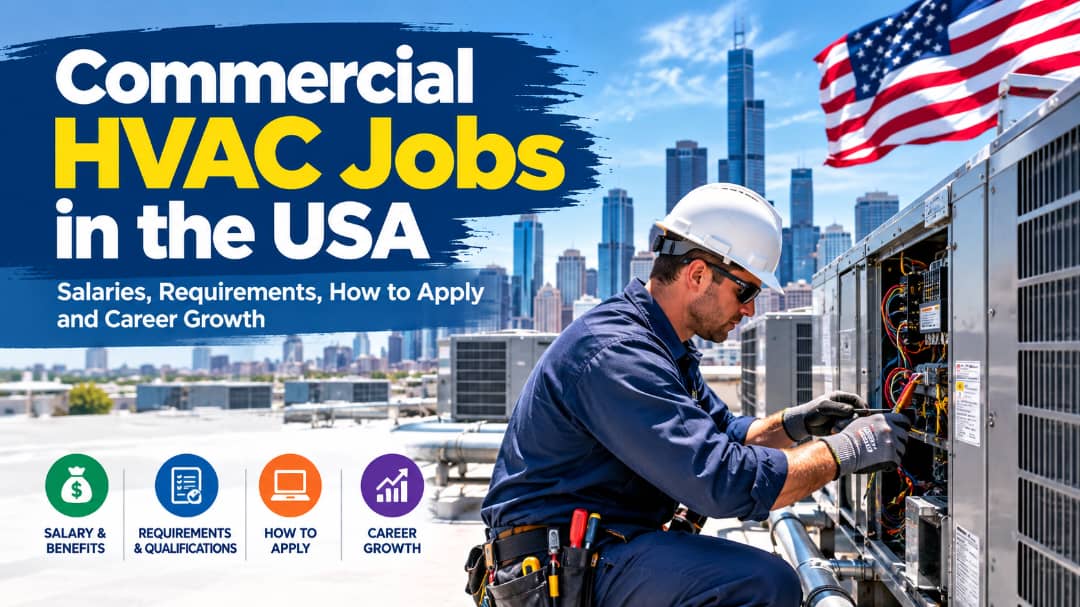
Commercial HVAC jobs are a practical career path for those who want to work in the skilled trades while gaining technical experience in heating, ventilation, air conditioning, and refrigeration. Unlike residential HVAC work, which mainly involves homes and smaller properties, commercial HVAC technicians work on climate-control and mechanical systems in offices, hospitals, hotels, schools, shopping centers, warehouses, manufacturing facilities, and other large buildings.
The work goes beyond just fixing air conditioners. Commercial HVAC workers might install equipment, do regular maintenance, solve electrical and mechanical issues, service rooftop units, work with boilers and chillers, maintain air-handling systems, or focus on areas like refrigeration, controls, or building automation.
This guide explains what commercial HVAC jobs involve, the types of positions available, the qualifications employers look for, where to find legitimate opportunities, and how to prepare for an application.
What Are Commercial HVAC Jobs?
Commercial HVAC jobs involve installing, maintaining, inspecting, troubleshooting, and repairing heating, ventilation, air conditioning, and related mechanical systems used in commercial or institutional buildings.
Rooftop HVAC units
Air-handling units
Chillers
Boilers
Cooling towers
Pumps and motors
Fan-coil units
Heat pumps
Commercial refrigeration equipment
Exhaust and ventilation systems
Variable air volume systems
Building automation and HVAC controls
For example, a current commercial HVAC apprenticeship position with ABM involves preventive and corrective maintenance and troubleshooting on equipment including rooftop units, air-handling units, fan-coil units, pumps, cooling towers, boilers and chillers.
This illustrates an important difference between commercial HVAC and residential HVAC: commercial technicians may need to understand a wider range of mechanical, electrical, refrigeration, and building-control systems.
What Does a Commercial HVAC Technician Do?
The exact duties depend on the position and the employer, but commercial HVAC technicians commonly work on four major areas: installation, maintenance, troubleshooting, and repair.
Installation
The work may involve assembling equipment, connecting ductwork, installing piping, connecting electrical components, and preparing systems for testing and commissioning.
Some positions specialize specifically in commercial HVAC installation and sheet-metal work. Current job listings, for example, include commercial HVAC apprentices who help install and assemble ductwork and HVAC systems on commercial construction projects.
Preventive maintenance
Commercial buildings depend heavily on reliable HVAC systems. A failure in a large office building, hospital or manufacturing facility can affect employees, customers, equipment, and business operations.
Technicians therefore perform scheduled maintenance designed to identify problems before equipment fails.
This can include inspecting equipment, checking operating conditions, cleaning components, testing systems, and replacing worn parts.
Troubleshooting and repair
When a commercial HVAC system stops working properly, technicians investigate the cause rather than simply replacing parts.
They may diagnose:
Electrical faults
Refrigerant problems
Airflow problems
Mechanical failures
Sensor problems
Motor issues
Control-system faults
Leaks
Abnormal operating conditions
Commercial HVAC technicians therefore need more than basic knowledge of air conditioning. They need the ability to understand how different components work together and systematically identify the source of a problem.
Working with building systems
Experienced commercial HVAC technicians may also work with building automation and control systems.
These systems can allow building operators to monitor and control temperature, ventilation, and equipment performance across large facilities.
As technicians gain experience, this can open additional career paths in HVAC controls, building automation, energy management, and facilities maintenance.
Types of Commercial HVAC Jobs
One of the most important things to understand before applying is that “commercial HVAC technician” is not the only job available in this field.
The commercial HVAC sector contains several career levels and specializations.
Commercial HVAC Apprentice
Apprentices may assist experienced technicians with installation, maintenance, and troubleshooting while gradually taking on more technical responsibilities.
Current U.S. listings show commercial HVAC apprenticeships offering paid employment and, in some cases, benefits and education assistance.
This makes apprenticeship particularly important for people who do not yet have years of HVAC experience.
Commercial HVAC Service Technician
Service technicians respond to equipment problems, diagnose faults, and perform repairs and maintenance.
They may travel between commercial properties rather than working permanently at one facility.
Commercial HVAC Maintenance Technician
These workers focus heavily on scheduled inspections, preventive maintenance, and keeping equipment operating efficiently.
Large facilities may employ maintenance technicians as part of an in-house facilities team.
Commercial HVAC Installer
Installers focus primarily on putting new HVAC systems and components into buildings.
Depending on the project, the work can involve ductwork, piping, equipment installation, and system setup.
Refrigeration Technician
Some commercial HVAC professionals specialize in refrigeration systems used by supermarkets, restaurants, food-processing facilities, and other businesses.
This specialization can require additional technical knowledge beyond conventional heating and air conditioning.
HVAC Controls or Building Automation Technician
Technicians in this area work with sensors, controllers, automation systems, and software used to monitor and control building HVAC equipment.
This can be an attractive specialization for technicians who enjoy the combination of mechanical systems, electrical work, and technology.
Chiller or Boiler Technician
Large commercial and institutional buildings can use chillers and boilers as part of their heating and cooling infrastructure.
Technicians who develop specialized experience with these systems can move into more advanced commercial HVAC roles.
How to Apply for Commercial HVAC Jobs
Applying for a commercial HVAC job is easier when you prepare your application around the specific position rather than sending the same resume to every employer. Follow these steps:
1. Choose the right commercial HVAC position
Start by identifying the position that matches your current experience.
If you are new to HVAC, search for HVAC apprentice, HVAC helper, or entry-level HVAC technician positions. If you already have field experience, you can target jobs such as commercial HVAC service technician, maintenance technician, refrigeration technician, chiller technician, or HVAC controls technician.
Choosing positions that match your actual skill level increases the likelihood that you will meet the employer’s requirements.
2. Prepare a targeted HVAC resume
Your resume should show employers what you can actually do.
If you have commercial experience, identify the equipment and systems you have worked with, such as rooftop units, air-handling units, chillers, boilers, refrigeration systems, electrical controls, or building automation systems.
3. Check the job requirements before submitting your application
Read the entire vacancy carefully and separate the required qualifications from preferred qualifications.
Check whether the employer asks for previous commercial HVAC experience, EPA Section 608 certification, a driver’s license, specific equipment experience, a state or local license, or particular educational qualifications.
Do not assume that failing to meet one preferred qualification automatically disqualifies you. The employer’s actual requirements should determine whether you apply.
4. Submit your application through the correct channel
Follow the application instructions provided by the employer. Some companies accept applications through their own career websites, while others use established employment platforms.
For apprenticeships, the U.S. Department of Labor’s Apprenticeship.gov provides a search tool for apprenticeship opportunities. Registered apprenticeships combine paid employment with structured on-the-job learning and related instruction.
Avoid anyone who asks you to pay a recruitment fee in exchange for guaranteeing you a commercial HVAC job.
Where to Apply for Commercial HVAC Jobs
There is no single U.S. government website containing every commercial HVAC vacancy. You should search several legitimate sources depending on the type of position you want.
1. Apprenticeship.gov
Apprenticeship.gov is particularly useful for people who are entering the HVAC trade or want a structured apprenticeship.
Its Apprenticeship Job Finder allows career seekers to search for apprenticeship opportunities by occupation, employer, and location.
This is one of the best places to start if you have limited professional experience.
2. Employer career websites
Large HVAC contractors, mechanical contractors, facilities-management companies, hospitals, universities, hotels and other organizations regularly recruit maintenance and HVAC personnel.
This approach can be particularly useful because you are applying directly to the organization offering the position.
3. Reputable employment websites
Commercial HVAC vacancies are also advertised on major employment platforms.
Use several search terms rather than searching only for “commercial HVAC jobs.” Try:
Commercial HVAC technician
Commercial HVAC service technician
HVAC maintenance technician
Commercial HVAC apprentice
HVAC installer
Refrigeration technician
Chiller technician
HVAC controls technician
Using different job titles can uncover opportunities that would otherwise be missed.
4. Local HVAC and mechanical contractors
Do not limit your search to large national companies.
Smaller commercial HVAC and mechanical contractors can provide opportunities for apprentices, helpers, and experienced technicians. Search for contractors operating in the city or state where you intend to work, then check whether they have current vacancies or accept applications.
Qualifications for Commercial HVAC Jobs
The qualifications required depend heavily on the position and your level of experience.
1. High school diploma or GED
Some employers require a high school diploma or GED, particularly for apprenticeship and entry-level positions.
However, requirements vary, so applicants should always check the individual vacancy.
2. HVAC training
Completing HVAC training through a trade school, technical college, community college, or apprenticeship can help demonstrate that you understand the fundamentals of the trade.
The BLS identifies a postsecondary nondegree award as the typical entry-level education for heating, air conditioning, and refrigeration mechanics and installers, although some workers enter through other routes.
3. Practical HVAC experience
Experience becomes increasingly important as you move toward higher-level commercial positions.
Employers may want applicants who can troubleshoot and repair equipment without constant supervision.
For beginners, an apprenticeship or entry-level position can provide the supervised experience needed to progress.
4. EPA Section 608 certification
If your commercial HVAC work involves servicing equipment covered by EPA refrigerant regulations, Section 608 certification is an important requirement.
The EPA requires technicians who maintain, service, repair or dispose of covered appliances in ways that could release regulated refrigerants to be certified.
The EPA recognizes:
Type I: Small appliances
Type II: High- and very-high-pressure appliances
Type III: Low-pressure appliances
Universal: All equipment covered by Types I, II, and III
The appropriate certification depends on the equipment and work being performed. Universal certification is broad, but we should not claim that every commercial HVAC position requires it.
5. State or local licensing
Some HVAC work can be subject to state or local licensing requirements.
These rules are not identical across the United States, so an applicant should check the requirements for the specific state and locality where the job is located.
This is separate from EPA Section 608 certification.
6. Driver’s license
A valid driver’s license is commonly relevant to commercial HVAC service positions because technicians may travel between customer sites and commercial properties.
However, this is employer-specific, so applicants should check the individual job description.
Requirements for Commercial HVAC Jobs
Before applying, make sure you understand what the employer actually expects from applicants.
Common requirements can include:
Technical knowledge: You may need an understanding of heating, cooling, refrigeration, electrical systems, airflow and mechanical components.
Troubleshooting ability: Commercial technicians need to identify the cause of equipment problems rather than simply replace components without diagnosing the fault.
Physical ability: HVAC work can involve climbing ladders, lifting equipment, working in mechanical rooms, spending time outdoors, and working in confined or uncomfortable environments.
Safety awareness: Technicians work around electrical equipment, moving machinery, refrigerants, elevated work areas and other hazards, making safe working practices essential.
Communication skills: Commercial technicians may interact with customers, facility managers, building owners, contractors, and other tradespeople.
Not every position will require all of these abilities at the same level.
Eligibility for Commercial HVAC Jobs
Eligibility varies according to the position.
Entry-level applicants
People with limited professional experience can look for apprenticeships, helper positions, and entry-level HVAC jobs.
These positions can provide an opportunity to develop practical skills while working under experienced technicians.
Experienced HVAC technicians
Applicants with residential HVAC experience may be able to move into commercial work, particularly if they develop experience with larger equipment, electrical troubleshooting, refrigeration and commercial maintenance.
Those already experienced in commercial HVAC can apply for specialized or senior positions depending on their qualifications.
International applicants
International applicants must consider two separate issues:
1. Whether they have the technical qualifications required for the job.
2. Whether they have legal authorization to work in the United States.
HVAC training or EPA certification does not by itself provide U.S. work authorization. An international applicant must have the appropriate authorization to legally work for the employer.
Benefits of Commercial HVAC Jobs
Commercial HVAC employment can provide more than a regular paycheck, although benefits vary by employer.
Depending on the position and company, workers may receive:
Competitive wages: Experienced technicians and specialized workers may have opportunities to earn more as their skills develop.
Overtime: Some commercial HVAC positions involve emergency, weekend, or after-hours work, which can create additional earning opportunities when overtime is available.
Health insurance: Some employers provide medical and other insurance benefits.
Retirement plans: Larger employers may offer retirement savings programs and employer contributions.
Paid time off: Vacation, sick leave, and holidays may be included depending on the employer.
Paid training: Some employers invest in continuing technical education and certification.
Career advancement: An HVAC technician can progress toward senior technician, lead technician, supervisor, project management, controls, refrigeration, or other specialized roles.
Apprenticeship benefits: Registered apprenticeships provide paid work while the apprentice receives structured training and works toward an industry-recognized credential.
Because benefits differ considerably, applicants should always read the employer’s offer and job description rather than assuming a particular benefit is guaranteed.
Commercial HVAC Salary in the USA
Commercial HVAC technicians can earn a solid income, but there is no single national salary figure specifically for commercial HVAC technicians. Pay varies according to experience, location, employer, specialization, and the type of HVAC equipment a technician works with.
The closest official national benchmark comes from the U.S. Bureau of Labor Statistics (BLS), which reports that heating, air conditioning and refrigeration mechanics and installers had a median annual wage of $61,010 in May 2025. The lowest 10% earned less than $40,050, while the highest 10% earned more than $95,210.
The industry in which a technician works can also affect earnings. In May 2025, BLS reported median wages of:
Wholesale trade: $71,190 per year
Retail trade: $62,830
Educational services: $62,520
Plumbing, heating and air-conditioning contractors: $60,030
These figures cover the broader HVACR occupation rather than commercial HVAC technicians alone, so they should be used as a benchmark rather than a guaranteed commercial HVAC salary.
What can increase commercial HVAC technicians’ earnings?
Several factors can push earnings higher:
Experience: Technicians who can independently diagnose and repair complex commercial systems generally have access to more advanced positions.
Specialization: Skills involving chillers, refrigeration, controls, building automation and other specialized systems can make a technician more valuable to employers.
Location: HVAC wages vary significantly between states and metropolitan areas.
Overtime: Some commercial HVAC positions involve evening, weekend, or emergency work, creating opportunities for additional earnings.
Industry: Working in certain commercial or industrial environments can provide different earning opportunities than smaller service operations.
The BLS notes that HVAC technicians may work evenings or weekends, be on call for emergencies, and work overtime or irregular schedules during busy heating and cooling periods.
Advantages of Commercial HVAC Work
Commercial HVAC can offer several advantages for people who enjoy skilled technical work.
Strong demand: Businesses, hospitals, schools, hotels, warehouses, and other facilities depend on functioning heating, cooling, and ventilation systems.
Multiple career paths: You can remain a field technician or eventually move into controls, refrigeration, facilities management, supervision or project management.
No four-year degree as the standard entry route: The BLS identifies a postsecondary nondegree award as the typical entry-level education for the broader HVAC occupation, although requirements vary and some workers enter through other routes.
Paid apprenticeship opportunities: Registered apprenticeships can combine paid employment with structured training and progressive wage increases.
Transferable technical skills: Electrical troubleshooting, refrigeration, mechanical systems, and controls can be useful across different employers and industries.
What to Watch Out for Before Accepting a Commercial HVAC Job
Not every commercial HVAC position will be the right opportunity, even if the advertised salary looks attractive.
Check the following before accepting an offer:
1. Confirm the actual pay
Find out whether the advertised figure is an hourly wage, annual salary, estimated earnings including overtime, or a range dependent on experience.
2. Check the schedule
Ask whether the position requires:
On-call work
Night shifts
Weekend work
Emergency service
Frequent overtime
Travel between locations
Commercial HVAC service positions can involve irregular schedules, particularly when equipment failures occur outside normal working hours.
3. Understand the certification requirements
If the job involves refrigerant-related work covered by Section 608, make sure you understand what certification the employer expects.
EPA rules require covered technicians to hold the appropriate Section 608 certification, while apprentices can work under the applicable supervised apprenticeship exemption.
4. Check state and local requirements
Don’t assume that a federal EPA certification automatically satisfies every licensing requirement.
If the position requires a state or local HVAC license, verify the requirements for that specific location before accepting the position.
How to Avoid Commercial HVAC Job Scams
Job seekers should be particularly careful with online advertisements that promise unusually high salaries with little experience.
Be cautious when someone:
Requests money before you can start work
Guarantees employment without a normal hiring process
Asks you to purchase expensive equipment from them before hiring
Requests sensitive financial information unnecessarily
Uses an unofficial email address while claiming to represent a major employer
Offers a job without a proper interview or verification process
A legitimate employer should be able to provide identifiable company information and a clear explanation of the position, compensation, and application process.
When possible, verify the vacancy through the employer’s official website rather than relying solely on a message or social-media advertisement.
Frequently Asked Questions About Commercial HVAC Jobs
Can I get a commercial HVAC job with no experience?
Yes. Apprenticeships and some entry-level positions are designed for people who are still developing their professional HVAC experience. Experienced positions, however, normally have higher technical and field-experience requirements.
Do I need a college degree to become a commercial HVAC technician?
No four-year college degree is normally required. The BLS identifies a postsecondary nondegree award as the typical entry-level education for the broader HVACR occupation, although some workers enter through other training routes.
Is EPA 608 certification required for commercial HVAC work?
It is required when a technician performs covered work that could release regulated refrigerants. EPA Section 608 has different certification types depending on the equipment being serviced.
How much does a commercial HVAC technician make?
There is no single official national salary specifically for commercial HVAC technicians. As a benchmark, the BLS reported a $61,010 median annual wage in May 2025 for the broader heating, air conditioning and refrigeration mechanics and installers occupation.
Is commercial HVAC a good career?
It can be a strong skilled-trade career for people who enjoy technical, hands-on work. The broader HVACR occupation is projected to grow 11% from 2025 to 2035, with approximately 40,600 openings annually.
Where can I find commercial HVAC jobs?
Start with registered apprenticeship opportunities through Apprenticeship.gov if you are new to the trade. For experienced workers, search employer career pages, reputable job platforms, and commercial HVAC/mechanical contractors for positions matching your qualifications.
Conclusion
Commercial HVAC offers a practical route into a skilled technical career without requiring the traditional four-year college pathway. However, getting hired is not simply about finding an advertisement and submitting a resume.
The strongest approach is to build the appropriate training and experience, obtain the certifications relevant to your work, identify legitimate employers, and apply for positions that match your actual skill level.
If you are starting from zero, an apprenticeship can provide a structured way to gain paid experience. If you already have HVAC experience, developing commercial skills in areas such as refrigeration, chillers, controls and building automation can help you pursue more specialized opportunities.
The key is to treat commercial HVAC as a career path rather than just another job opening. Start with the qualifications you can obtain now, search for legitimate employers, and gradually build the technical experience that can move you into higher-level commercial HVAC positions.