
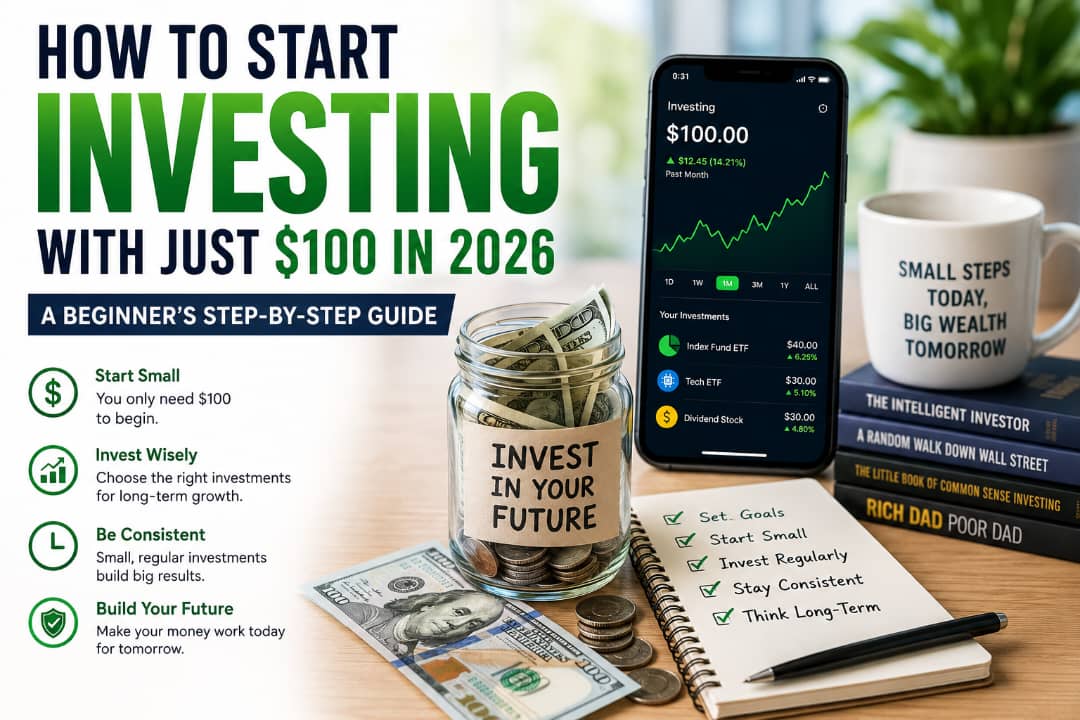
For many people, investing seems like something reserved for the wealthy. Social media often showcases investors buying expensive stocks or owning large portfolios, making it easy to believe you need thousands of dollars before you can start building wealth.
The reality is very different.
In 2026, technology has made investing more accessible than ever before. Thanks to online brokerages, investment apps, and fractional shares, you can begin your investment journey with as little as $100—and in some cases, even less.
While $100 won’t make you rich overnight, it can do something far more valuable: help you develop the habit of investing. That habit, combined with patience and consistency, is what has helped countless people build significant wealth over time.
The biggest mistake many beginners make is waiting until they have “more money” before investing. Unfortunately, waiting often means missing valuable years of potential growth.
Whether you’re a student, a young professional, or simply someone looking to improve your financial future, learning how to invest your first $100 is one of the smartest financial decisions you can make.
In this guide, you’ll learn where to invest, how to minimize risk, common mistakes to avoid, and practical strategies that can help your money grow steadily over the long term.
Can You Really Start Investing with Only $100?
Absolutely.
One of the biggest myths about investing is that you need a large amount of money before you can get started.
Years ago, that may have been true. Traditional brokerage firms often required large minimum deposits before allowing customers to open investment accounts.
Today, things have changed dramatically.
Many modern investment platforms allow beginners to buy fractional shares, meaning you don’t need enough money to purchase an entire share of an expensive company. Instead, you can buy a small portion of that share based on the amount you want to invest.
For example, imagine a company’s stock costs $500 per share. Instead of waiting until you’ve saved $500, you can invest your $100 and own a fraction of that stock.
This innovation has made investing accessible to millions of people who previously believed it was out of reach.
The important thing to remember is that successful investing isn’t determined by how much money you start with. It’s determined by how consistently you invest and how long you allow your investments to grow.
Why Starting Early Matters More Than Starting Big
Many people spend years trying to save a large amount of money before they begin investing.
Unfortunately, time is one of the most valuable assets an investor has.
The earlier you begin, the more opportunity your investments have to benefit from compound growth.
Imagine two friends:
One begins investing $100 today and continues adding small amounts every month.
The other waits five years until they have several thousand dollars saved before making their first investment.
Even if the second person starts with more money, the first investor may end up with a larger portfolio because their investments had more time to grow.
This is why many financial experts encourage people to start now rather than wait for the perfect moment.
Consistency almost always beats perfection.
Before You Invest: Build a Strong Financial Foundation
Although investing is an excellent way to grow your wealth, it’s not the very first financial step everyone should take.
Before putting your money into investments, consider these important areas.
1. Build an Emergency Fund
Unexpected expenses can happen at any time.
Medical emergencies, car repairs, job loss, or urgent home expenses can force people to sell investments at the worst possible time if they don’t have emergency savings.
Many financial professionals recommend building an emergency fund that can cover at least three to six months of essential living expenses.
Even if you cannot save that much immediately, having a small emergency fund provides financial stability and reduces stress.
2. Pay Off High-Interest Debt
If you’re paying very high interest on credit cards or personal loans, paying down that debt may provide a better financial return than investing.
For example, paying off debt with a 25% annual interest rate is often a smarter financial decision than investing in an asset expected to return 8–10% per year.
Reducing expensive debt frees up more money for investing later.
3. Set Clear Investment Goals
Many beginners invest without knowing exactly why they’re investing.
Ask yourself questions like:
Are you saving for retirement?
Do you want to buy a home?
Are you building passive income?
Do you want long-term wealth?
Are you investing for your children’s future?
A Beginner’s Step-by-Step Guide
Having a clear goal helps you choose investments that match your time horizon and risk tolerance.
Step 1: Choose the Right Investment Platform
Your investment journey begins with selecting a reliable platform.
A good investment platform should make investing simple, secure, and affordable.
When comparing platforms, consider:
Low Fees
High fees can reduce your investment returns over time. Choose platforms with transparent pricing and low or no trading commissions.
Strong Security
Your investments and personal information should be protected with features such as encryption, two-factor authentication, and secure account verification.
Easy-to-Use Interface
Beginners benefit from platforms that make buying investments straightforward without overwhelming users with unnecessary complexity.
Educational Resources
Some platforms provide tutorials, articles, investment calculators, and market insights that help beginners become more confident investors.
Choosing a platform that supports your learning journey can make a significant difference over time.
Step 2: Decide What to Invest In
Once your account is ready, the next question becomes:
What should you actually buy with your first $100?
Many beginners think they must pick the next big company that will make them rich.
In reality, successful investing is usually built on diversification rather than trying to predict the next market winner.
Some of the most beginner-friendly investment options include:
Exchange-Traded Funds (ETFs)
Fractional Shares
Mutual Funds
Dividend Stocks
Robo-Advisors
Each of these investment options has its own advantages, level of risk, and potential return.
Understanding how they work before investing your money can help you make more informed financial decisions and avoid costly mistakes.
Step 3: Invest in Low-Cost Index Funds
If you ask experienced investors what they wish they had done when they first started investing, many will give the same answer:
“I wish I had started investing in index funds earlier.”
An index fund is a type of investment that tracks the performance of a group of companies instead of relying on the success of just one business.
For example, rather than investing your entire $100 in a single company, an index fund allows you to own small pieces of dozens or even hundreds of companies at the same time.
This approach reduces risk because your money isn’t dependent on the performance of one company.
Why index funds are ideal for beginners
Index funds have become one of the most recommended investment options because they offer several advantages:
Instant diversification
Lower management fees
Less risk than buying individual stocks
Strong long-term growth potential
Suitable for hands-off investors
Instead of trying to predict which company will become the next big success, an index fund lets you benefit from the overall growth of the market.
For beginners who don’t have much investing experience, this can be a safer and less stressful way to build wealth.
Step 4: Consider Exchange-Traded Funds (ETFs)
Another excellent option for beginners is an Exchange-Traded Fund (ETF).
ETFs are similar to index funds because they allow investors to own a collection of different assets in one investment.
The difference is that ETFs trade on stock exchanges just like regular company shares, giving investors more flexibility to buy and sell during market hours.
Many popular ETFs include hundreds of well-established companies from different industries, helping investors spread their risk.
Why ETFs are popular
ETFs have gained popularity because they combine simplicity with flexibility.
Benefits include:
Low investment costs
Wide diversification
Easy to buy and sell
Suitable for long-term investing
Available across many industries and regions
If you’re starting with only $100, investing in an ETF can provide exposure to a broad range of companies without needing a large amount of capital.
Step 5: Buy Fractional Shares of Quality Companies
One reason many people delayed investing in the past was the high price of certain stocks.
Fortunately, that’s no longer a major obstacle.
Today, many investment platforms allow you to purchase fractional shares, meaning you can own a small portion of a company’s stock instead of buying an entire share.
For example, if a company’s stock trades for several hundred dollars, you don’t have to save the full amount before investing. Your $100 can still give you ownership in that company.
Why fractional investing is helpful
Fractional shares make investing more accessible because they allow beginners to:
Start with small amounts
Diversify across multiple companies
Invest consistently regardless of stock prices
Build a portfolio gradually
This flexibility removes one of the biggest barriers that prevented many people from investing in the past.
Step 6: Explore Robo-Advisors
Not everyone enjoys researching investments or monitoring the stock market every day.
If you prefer a simpler approach, a robo-advisor may be a good option.
A robo-advisor is an automated investment service that creates and manages a diversified portfolio based on your goals, age, and risk tolerance.
After answering a few questions, the platform recommends an investment strategy and automatically manages your portfolio over time.
Advantages of robo-advisors
Many beginners appreciate robo-advisors because they eliminate much of the guesswork.
Some benefits include:
Automatic portfolio management
Diversified investments
Portfolio rebalancing
Goal-based investing
Minimal effort required
Although some robo-advisors charge management fees, many investors find the convenience worthwhile, especially during the early stages of their investment journey.
Step 7: Set Up Automatic Investments
One habit separates successful investors from those who struggle:
Consistency.
Instead of trying to invest only when you have extra money, consider setting up automatic monthly or weekly contributions.
Even if you invest only $25 or $50 each month, your portfolio can grow significantly over time.
Automatic investing also removes emotions from the process.
Rather than trying to guess the best time to invest, you continue building your portfolio regardless of whether markets are rising or falling.
Over the long term, this disciplined approach has helped many investors achieve their financial goals.
Don’t Try to Time the Market
One of the biggest mistakes beginners make is waiting for the “perfect” moment to invest.
They often think:
“I’ll wait until prices fall.”
“I’ll invest when the economy improves.”
“I’ll start next year.”
Unfortunately, predicting short-term market movements is extremely difficult—even for professional investors.
Many people spend months waiting for the perfect opportunity while missing valuable periods of market growth.
A better strategy is to invest consistently over time rather than trying to predict what the market will do next.
Remember, time in the market is generally more important than trying to time the market.
How Your First $100 Can Grow Over Time
Although $100 may not seem like much today, investing is about building momentum.
Imagine you invest your first $100 today and continue adding a small amount every month.
Over the years, those regular contributions, combined with investment growth and compound returns, can create a portfolio far larger than many people expect.
The secret isn’t making one huge investment.
The secret is building the habit of investing consistently and allowing your money enough time to grow.
That’s why many successful investors say the hardest part isn’t choosing investments—it’s simply getting started.
Common Mistakes New Investors Should Avoid
Starting your investment journey is exciting, but it’s also easy to make mistakes that can slow your progress or cost you money. The good news is that most of these mistakes are avoidable if you understand them early.
1. Investing Without a Plan
One of the biggest mistakes beginners make is investing simply because they heard someone on social media recommend a stock or cryptocurrency.
Before investing, ask yourself:
What is my financial goal?
How long can I leave this money invested?
Am I comfortable with short-term market ups and downs?
Having a clear plan helps you make decisions based on your goals rather than emotions.
2. Trying to Get Rich Overnight
The internet is full of stories about people making huge profits in a short period, but those stories rarely tell the whole picture.
Successful investing is usually built through:
Patience
Consistency
Diversification
Long-term thinking
Instead of chasing unrealistic returns, focus on steady growth over many years.
3. Putting All Your Money Into One Investment
Imagine investing your entire $100 in one company, only for its share price to fall sharply.
That is why diversification is so important.
Spreading your investments across different companies, industries, or funds reduces risk because poor performance in one investment may be balanced by stronger performance in others.
As the saying goes:
“Don’t put all your eggs in one basket.”
4. Investing Money You’ll Need Soon
The stock market can rise and fall over short periods.
If you invest money that you’ll need next month for rent, school fees, or emergencies, you might be forced to sell during a market downturn.
Only invest money you can comfortably leave untouched for the long term.
5. Ignoring Investment Fees
Fees may seem small, but they can have a significant impact over time.
Always check for:
Account maintenance fees
Management fees
Trading commissions
Withdrawal charges
Choosing low-cost investment platforms helps more of your money stay invested and continue growing.
Tips to Become a Successful Long-Term Investor
While no investment can guarantee profits, following good habits can improve your chances of achieving your financial goals.
Invest Regularly
Consistency is one of the most powerful tools available to investors.
Instead of waiting until you have a large amount of money, invest smaller amounts regularly. This approach helps you build discipline and may reduce the impact of market fluctuations over time.
Continue Learning
Financial markets constantly evolve.
Read books, follow trusted financial news sources, and learn about different investment strategies. The more you understand investing, the more confident you’ll become when making financial decisions.
Stay Calm During Market Downturns
Markets don’t move upward every day.
Temporary declines are a normal part of investing.
Many successful investors stay focused on their long-term goals rather than reacting to short-term market movements.
Making emotional decisions during periods of volatility often leads to poor investment outcomes.
Review Your Portfolio Periodically
You don’t need to check your investments every hour.
Instead, review your portfolio every few months to ensure it still aligns with your financial goals and risk tolerance.
This approach helps you stay informed without becoming distracted by daily market fluctuations.
Frequently Asked Questions (FAQs)
1. Is $100 enough to start investing?
Yes. Many investment platforms allow beginners to start with as little as $100 or even less through fractional shares and low-cost investment funds.
2. What is the safest investment for beginners?
Diversified investments such as index funds and ETFs are often considered suitable for beginners because they spread risk across many companies rather than relying on the performance of a single stock.
3. Can I lose money when investing?
Yes. All investments carry some level of risk, and market values can rise or fall. Investing with a long-term perspective and maintaining a diversified portfolio can help manage risk, but losses are still possible.
4. Should I invest all my savings?
No. It’s generally wise to keep an emergency fund and only invest money that you won’t need for essential expenses in the near future.
5. How often should I invest?
Many investors choose to invest regularly—such as weekly or monthly—because it encourages consistency and reduces the temptation to try to time the market.
Conclusion
Starting your investment journey with just $100 may seem like a small step, but every successful investor begins somewhere.
The amount you invest today is less important than the habits you build. By investing consistently, keeping your costs low, diversifying your portfolio, and staying patient, you give yourself the opportunity to benefit from long-term market growth.
Remember, investing is not about finding the perfect stock or timing the market perfectly. It’s about making informed decisions, remaining disciplined, and allowing time to work in your favor.
The sooner you start, the sooner your money has the chance to grow.
Disclaimer
This article is for educational and informational purposes only and does not constitute financial, investment, or legal advice. Investing involves risk, and the value of investments can rise or fall. You may lose some or all of your invested capital. Always conduct your own research and consider consulting a qualified financial advisor before making any investment decisions. Past performance is not a guarantee of future results.