
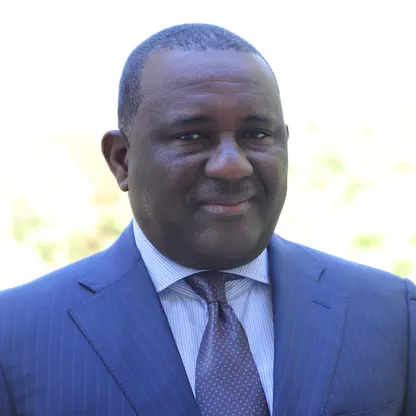
Abdul Samad Rabiu was born on August 4, 1960, in Kano State, Nigeria, into a wealthy and commercially active family, whose strong foothold in trading and manufacturing was established by his father, Khalifah Isyaku Rabiu.
Growing up in Kano, a historic commercial hub, meant that business was not an abstract concept but something he saw daily, from large-scale commodity trading to supply chain negotiations that shaped entire industries.
He later traveled to the United States, where he studied economics at Capital University in Columbus, Ohio, and that exposure to structured markets and corporate systems would quietly influence how he later approached business in Nigeria.
However, the turning point came earlier than expected, when his father was detained during Nigeria’s military era, forcing a young Abdul Samad Rabiu to return home and take over parts of the family business at a time when most people his age were still figuring out their careers.
That moment did not just test his ability; it accelerated his maturity in business.
Taking Over The Family Business Under Pressure
Stepping into leadership in his early twenties, Rabiu had to navigate a volatile Nigerian economy, shifting government policies, and unstable import regulations that could destroy margins overnight.
Instead of playing it safe, he leaned into calculated risk.
He focused on importing essential commodities such as rice, sugar, and edible oils, understanding that demand for these goods would remain constant regardless of economic conditions.
At a time when many traders relied on short-term gains, Rabiu began thinking long term, studying how global supply chains worked and how local production could eventually replace imports.
This thinking would later become the backbone of his industrial empire.
The Birth And Growth Of BUA Group
BUA Group was officially founded in 1988, starting as a trading company but quickly evolving into something much bigger.
Rabiu saw a pattern early: Nigeria was spending billions importing products it could produce locally, and he positioned himself to fill that gap.
Instead of remaining a middleman, he began investing in manufacturing, a move that required significantly more capital, infrastructure, and patience.
This transition was not smooth.
There were regulatory battles, competition from established players, and infrastructure challenges, especially in energy and transportation, but Rabiu stayed consistent.
Today, BUA Group operates across multiple sectors, including:
- Cement manufacturing
- Sugar refining
- Flour milling
- Real estate and infrastructure
Each sector was not chosen randomly; they were all tied to essential economic needs, ensuring consistent demand regardless of market cycles.
Breaking Into The Cement Industry
Nigeria’s cement industry has long been dominated by powerful players, making it extremely difficult for new entrants to survive, let alone compete.
Rabiu entered this space through BUA Cement, gradually building capacity and expanding operations in states such as Edo and Sokoto.
Instead of trying to dominate overnight, he focused on efficiency and strategic expansion.
BUA Cement eventually became one of the largest cement producers in Nigeria, competing directly with industry giants and contributing significantly to infrastructure development across the country.
What made his approach different was his focus on reducing production costs through vertical integration, controlling everything from raw material sourcing to distribution channels.
This allowed him to remain competitive even when market prices fluctuated.
Sugar, Food Processing, and Industrial Expansion
Rabiu understood that relying on a single industry could be risky, especially in an economy like Nigeria’s, where policies can change rapidly.
Through BUA Foods, he expanded into sugar refining and food processing, building one of the largest sugar refineries in Africa.
BUA Foods plays a critical role in Nigeria’s food supply chain, producing sugar, flour, and pasta products that are consumed daily by millions of Nigerians.
This move was strategic.
Food is a non-negotiable necessity, meaning demand remains steady even during economic downturns.
By focusing on essential goods, Rabiu built a business model that is both resilient and scalable.
Strategic Thinking That Set Him Apart
Rabiu’s success is not accidental; it is the result of a few consistent principles that show up across his decisions.
First, he focuses on industries with guaranteed demand, ensuring that his investments are not dependent on trends or hype.
Second, he invests heavily in local production, reducing reliance on imports and positioning his companies to benefit from government policies that favor domestic manufacturing.
Third, he builds infrastructure around his businesses, whether it is ports, logistics systems, or power solutions, to reduce operational bottlenecks.
This approach turns challenges into competitive advantages.
Net Worth And Financial Influence
Abdul Samad Rabiu has consistently ranked among the richest individuals in Africa, with a net worth that fluctuates based on market conditions but remains firmly in the billionaire category.
His wealth is largely tied to his stakes in BUA Cement and BUA Foods, both of which are publicly listed and have shown significant growth over the years.
Unlike many wealthy individuals whose assets are tied to volatile sectors, Rabiu’s wealth is rooted in essential industries, which provides a level of stability that is rare.
Philanthropy And Social Impact
Through the Abdul Samad Rabiu Africa Initiative, he has committed hundreds of millions of dollars to social development projects across Africa.
Abdul Samad Rabiu Africa Initiative focuses on areas such as:
- Education
- Healthcare
- Social development
One of the standout aspects of his philanthropy is its scale and structure, as it is not just about donations but about measurable impact.
For example, significant funds have been allocated to improving healthcare infrastructure and supporting universities across Nigeria.
This approach ensures that his wealth contributes to long-term development rather than short-term relief.
Challenges And Controversies
Operating in Nigeria means dealing with regulatory complexities, competition, and public scrutiny.
Rabiu has faced challenges ranging from policy changes to industry competition, particularly in sectors like cement, where market dynamics are intense.
However, what stands out is his ability to navigate these challenges without losing focus on long-term goals.
Instead of reacting impulsively, he adapts strategically, often turning obstacles into opportunities for growth.
Legacy In Nigerian And African Business
The life and legacy of Abdul Samad Rabiu is not just about personal wealth; it is about industrial transformation.
He has played a key role in reducing Nigeria’s dependence on imports by investing in local manufacturing.
This has ripple effects across the economy, including:
- Job creation
- Infrastructure development
- Increased local production capacity
His businesses contribute significantly to Nigeria’s GDP, and his investments continue to shape the country’s industrial landscape.
His ability to see beyond immediate challenges and build for the future is what defines his success. And that is where the real legacy lies, not just in what he has achieved, but in what will continue to grow long after him.