
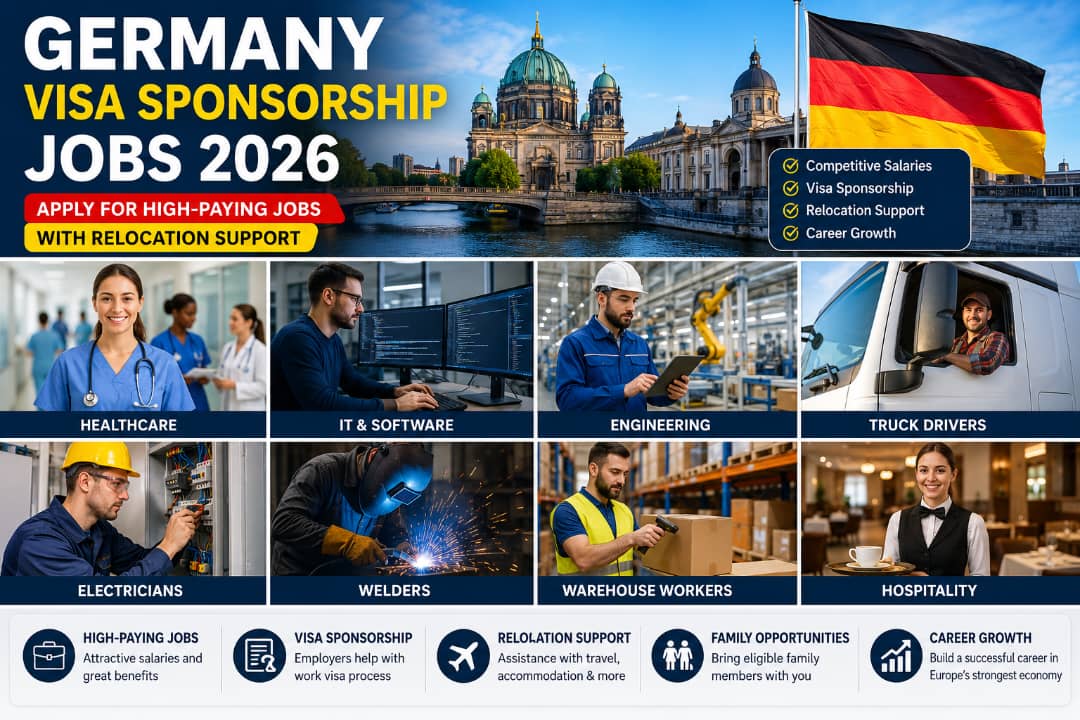
Germany remains one of the best destinations for skilled professionals seeking international employment opportunities. As Europe’s largest economy continues to face labor shortages across multiple industries, many German employers are actively recruiting qualified foreign workers and offering visa sponsorship packages to fill critical positions.
For job seekers from Nigeria, Ghana, Kenya, India, Pakistan, the Philippines, and other countries, Germany presents an exciting opportunity to secure stable employment, earn competitive salaries, and build a long-term career in one of the world’s strongest economies.
Visa sponsorship jobs are particularly attractive because employers assist qualified candidates with the legal process required to work in Germany. Depending on the employer and the role, sponsorship may include assistance with work permits, relocation support, accommodation, language training, and onboarding.
Whether you are a healthcare professional, software developer, engineer, truck driver, electrician, welder, warehouse worker, or hospitality employee, there are thousands of vacancies available throughout Germany in 2026.
In this guide, you’ll learn everything you need to know about Germany visa sponsorship jobs in 2026, including eligibility requirements, industries hiring international workers, expected salaries, application tips, and how to improve your chances of getting hired.
Why Work in Germany?
Germany consistently ranks among the best countries for skilled workers due to its excellent working conditions and high quality of life.
Some of the benefits include:
Competitive monthly salaries
Strong employee rights and labor protection
Modern healthcare system
Opportunity to bring eligible family members
Paid annual leave
Career development opportunities
Pathways to long-term residence for eligible workers
Access to one of Europe’s strongest economies
These advantages make Germany one of the most attractive destinations for international professionals looking to relocate.
What Are Germany Visa Sponsorship Jobs?
Germany visa sponsorship jobs are positions offered by employers who are willing to hire qualified foreign workers and support them through the necessary employment and immigration processes.
Depending on the employer and occupation, sponsorship may include:
Employment contract
Assistance with work visa applications
Relocation support
Temporary accommodation
Airport pickup (for some employers)
Language support
Training and orientation
Not every employer provides the same level of support, so applicants should carefully review job offers before accepting them.
Who Can Apply?
International applicants from many countries may qualify, provided they meet the employer’s requirements and Germany’s work authorization rules.
Typical requirements include:
Valid international passport
Relevant educational qualifications or work experience
Basic English or German language skills (depending on the role)
Good health
Clean background where required
Ability to meet visa requirements
Some positions require professional licensing or recognition of qualifications before employment.
Industries Hiring Foreign Workers in Germany
Several sectors continue to experience labor shortages, creating opportunities for qualified international applicants.
Some of the most in-demand industries include:
Healthcare
Information Technology (IT)
Engineering
Manufacturing
Construction
Logistics and Transportation
Hospitality and Tourism
Agriculture
Warehouse Operations
Skilled Trades
Many employers in these industries actively recruit international talent and may provide visa sponsorship to successful candidates.
Highest-Paying Germany Visa Sponsorship Jobs in 2026
Germany’s labor shortage spans several industries, creating opportunities for international professionals with the right qualifications and experience. Below are some of the highest-paying occupations where employers may sponsor foreign workers.
1. Registered Nurses
Healthcare remains one of Germany’s most in-demand sectors. Hospitals, nursing homes, rehabilitation centers, and private healthcare providers are actively recruiting qualified nurses from around the world.
Average Salary: €3,200–€5,000 per month
Common responsibilities include:
Providing patient care
Administering medication
Monitoring patients’ health
Supporting doctors during treatments
Maintaining medical records
Many healthcare employers also provide language training and relocation assistance for successful applicants.
2. Software Developers and IT Specialists
Germany’s growing technology industry continues to create thousands of vacancies for experienced software engineers, cybersecurity specialists, cloud engineers, data analysts, and AI professionals.
Average Salary: €4,500–€8,500 per month
Popular IT roles include:
Software Developer
Web Developer
Data Scientist
Cloud Engineer
Cybersecurity Analyst
DevOps Engineer
Mobile App Developer
Technology companies often recruit internationally due to the shortage of qualified professionals.
3. Engineers
Engineering professionals remain highly sought after across Germany.
Fields with strong demand include:
Mechanical Engineering
Civil Engineering
Electrical Engineering
Automotive Engineering
Chemical Engineering
Industrial Engineering
Average Salary: €4,000–€7,500 per month
Germany’s automotive, manufacturing, and industrial sectors continue to offer attractive career opportunities for skilled engineers.
4. Truck Drivers
The logistics industry continues to experience a shortage of qualified drivers.
International applicants with the necessary licenses may find opportunities with transport companies willing to sponsor eligible candidates.
Average Salary: €2,800–€4,500 per month
Additional benefits may include:
Overtime pay
Accommodation support
Performance bonuses
Paid annual leave
5. Electricians
Germany’s construction and manufacturing industries require experienced electricians for residential, commercial, and industrial projects.
Average Salary: €3,000–€5,500 per month
Applicants with recognized certifications and relevant work experience often have a competitive advantage.
6. Welders and Fabricators
Skilled welders remain in high demand due to ongoing industrial expansion and infrastructure development.
Average Salary: €2,900–€5,000 per month
Experience with modern welding techniques and international certifications can improve employment prospects.
7. Warehouse Workers
Warehouse and distribution centers continue hiring international workers to support Germany’s growing e-commerce and logistics sectors.
Responsibilities often include:
Picking and packing orders
Loading and unloading goods
Inventory management
Operating warehouse equipment
Preparing shipments
Average Salary: €2,300–€3,800 per month
Some employers provide training, accommodation assistance, and overtime opportunities.
8. Hospitality Workers
Hotels, restaurants, and tourism businesses regularly recruit foreign workers, especially during peak seasons.
Available positions include:
Hotel Receptionists
Housekeepers
Chefs
Kitchen Assistants
Restaurant Supervisors
Waiters and Waitresses
Average Salary: €2,200–€4,000 per month
Top Companies Hiring International Workers in Germany
Many well-known companies recruit qualified international professionals throughout the year. While visa sponsorship depends on the specific role and the candidate’s eligibility, opportunities can be found with employers in sectors such as automotive, engineering, healthcare, logistics, technology, and manufacturing.
Examples include:
BMW Group
Mercedes-Benz Group
Siemens
Bosch
Deutsche Bahn
SAP
Bayer
Continental
Job openings vary throughout the year, so applicants should regularly monitor company career pages and reputable job portals.
Where to Find Germany Visa Sponsorship Jobs
Finding legitimate opportunities is an important step in your job search.
Some of the best places to search include:
Official company career websites
Germany’s Federal Employment Agency portal
LinkedIn Jobs
StepStone
Glassdoor
EURES (European Employment Services)
Always verify that job offers come from legitimate employers, and never pay money to secure employment or visa sponsorship.
Tips to Increase Your Chances of Getting Hired
Competition for international jobs can be strong. These strategies can improve your chances of success:
Prepare a professional CV tailored to German employers.
Write a personalized cover letter for each application.
Highlight relevant work experience and certifications.
Improve your English and, where possible, learn basic German.
Apply for multiple suitable positions instead of relying on a single application.
Keep copies of your educational and professional documents ready for verification.
Research each employer before attending interviews.
Applicants who demonstrate strong communication skills, relevant experience, and a willingness to adapt often stand out during the recruitment process.
Germany Work Visa Application Process
After receiving a job offer from a German employer, the next step is applying for the appropriate work visa or residence permit. While the exact process may vary depending on your nationality and occupation, most applicants follow these general steps.
Step 1: Secure a Job Offer
Your journey begins with obtaining a valid employment offer from a German employer. Carefully review the employment contract, including salary, benefits, job responsibilities, and any relocation or visa support offered.
Step 2: Gather the Required Documents
Applicants are typically required to prepare documents such as:
A valid international passport
Signed employment contract or job offer letter
Completed visa application form
Recent passport-sized photographs
Educational certificates
Professional licenses (where applicable)
Updated CV or résumé
Proof of accommodation (if required)
Proof of health insurance (if applicable)
Any additional documents requested by the German embassy or consulate
Ensure that all documents are accurate and, where necessary, translated into the required language.
Step 3: Submit Your Visa Application
Book an appointment with the German embassy or consulate responsible for your country of residence. Submit your application along with the required supporting documents and pay any applicable visa fees.
Step 4: Attend the Visa Interview
Some applicants may be invited for an interview to discuss their employment, qualifications, and travel plans. Be honest, confident, and ensure your answers match the information provided in your application.
Step 5: Wait for a Decision
Processing times vary depending on your location, the type of visa, and the completeness of your application. Once approved, you can make arrangements to relocate to Germany and begin your new job.
Common Reasons Why Applications Are Rejected
While many applicants are successful, some applications are refused due to avoidable mistakes.
Common reasons include:
Submitting incomplete documents
Providing false or misleading information
Applying for jobs that do not match your qualifications
Failing to meet visa requirements
Insufficient supporting documents
Inability to demonstrate relevant work experience where required
Preparing your application carefully can significantly improve your chances of approval.
Frequently Asked Questions (FAQs)
Can foreigners get visa sponsorship jobs in Germany?
Yes. Many German employers recruit qualified international workers, particularly in industries experiencing labor shortages. Eligibility depends on your qualifications, experience, and the employer’s requirements.
Do I need to speak German?
Not always. Some multinational companies and IT roles primarily use English. However, learning German can improve your employment prospects and make daily life easier.
What is the average salary in Germany?
Salaries vary by industry, location, and experience. Skilled professionals generally earn higher salaries than entry-level workers, while healthcare, engineering, and technology roles often offer some of the highest pay.
Can I bring my family to Germany?
In many cases, eligible workers may be able to apply for family reunification, allowing certain family members to join them after meeting the relevant immigration requirements.
Is Germany a good country for international workers?
Germany is widely regarded as one of the best destinations for skilled professionals due to its strong economy, excellent working conditions, high quality of life, and career development opportunities.
Conclusion
Germany continues to be one of the most attractive destinations for international job seekers in 2026. With thousands of employers facing labor shortages, qualified professionals across healthcare, engineering, information technology, logistics, manufacturing, hospitality, and other sectors have excellent opportunities to build rewarding careers.
The key to success is preparing a strong application, applying through legitimate channels, and ensuring you meet the requirements for your chosen occupation. Taking time to improve your CV, develop relevant skills, and understand the visa process can significantly increase your chances of securing employment.
Whether you are looking for a fresh start, higher earnings, or long-term career growth, Germany offers a welcoming environment for many international professionals willing to contribute their skills and experience.
Start your job search today, stay persistent, and apply only through trusted employers and official recruitment platforms. With careful preparation and determination, your dream of working in Germany could become a reality.
Disclaimer
CareerOpportune is an independent informational platform and is not affiliated with the Government of Germany, any German embassy, or any employer mentioned in this article. Job vacancies, visa sponsorship availability, salaries, and immigration policies may change over time. Readers are encouraged to verify all information through official employer websites and the relevant German government authorities before submitting applications or making relocation decisions. Never pay money to secure a job offer or visa sponsorship.