
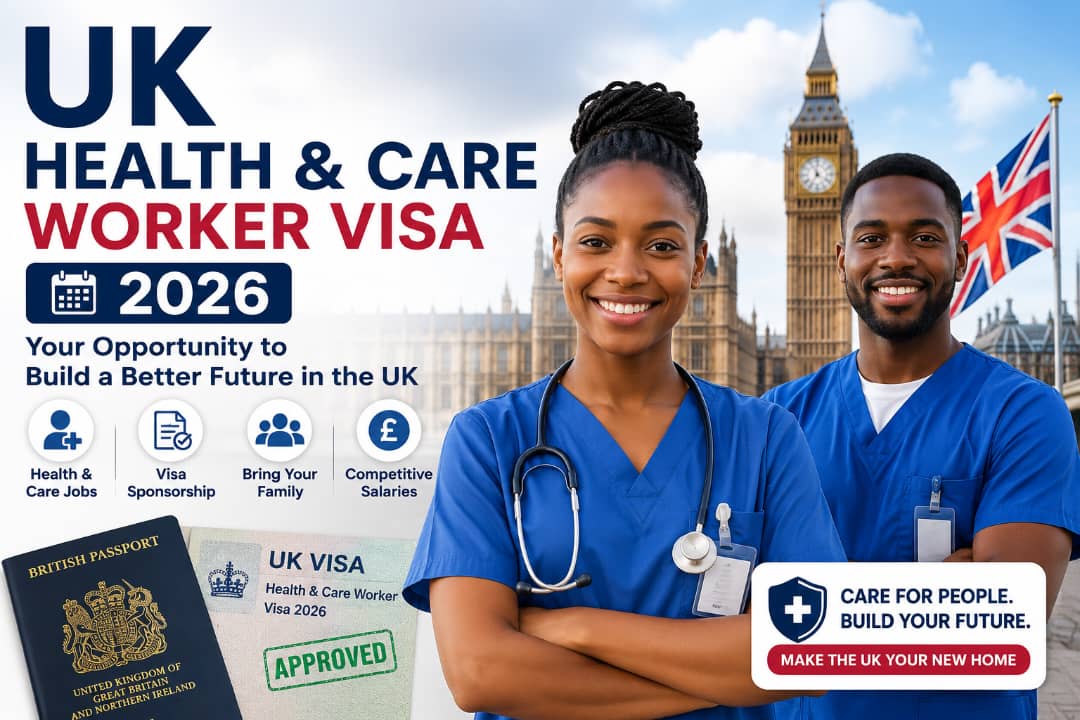
The United Kingdom remains one of the world’s most attractive destinations for healthcare professionals seeking better career opportunities, competitive salaries, and a high standard of living. Due to the continued demand for qualified healthcare workers across the National Health Service (NHS) and the adult social care sector, the UK Government has maintained the Health and Care Worker Visa as one of the primary immigration routes for eligible overseas professionals.
If you are planning to move to the UK in 2026 as a healthcare professional, understanding how this visa works is essential. From eligibility requirements and sponsorship rules to salary thresholds and application procedures, every stage of the process requires careful preparation.
This comprehensive guide explains everything you need to know about the UK Health and Care Worker Visa 2026, including who qualifies, the documents required, how to apply, visa fees, processing times, and practical tips to improve your chances of approval.
What Is the UK Health and Care Worker Visa?
The UK Health and Care Worker Visa is a work visa designed for qualified healthcare professionals and eligible adult social care workers who have secured a job offer from an approved UK employer.
The visa forms part of the UK’s Skilled Worker immigration system and is specifically intended to help address shortages within the country’s healthcare sector. Eligible employers include the NHS, organisations providing medical services to the NHS, and approved employers in the adult social care sector that are licensed to sponsor overseas workers.
Unlike many other UK work visas, the Health and Care Worker Visa offers several advantages, including lower application fees and exemption from the Immigration Health Surcharge for eligible applicants. These benefits make it one of the most affordable and attractive routes for qualified healthcare professionals wishing to relocate to the UK.
Why Is the UK Recruiting Healthcare Workers?
Like many developed countries, the UK continues to experience workforce shortages across hospitals, care homes, community healthcare services, and other medical settings. Factors such as an ageing population, increasing demand for healthcare services, and staff shortages have created ongoing recruitment needs.
To address these challenges, the UK continues to recruit qualified healthcare professionals from around the world. International workers play an important role in supporting patient care and filling critical vacancies in many regions of the country.
Healthcare employers actively recruit overseas professionals for positions such as nurses, doctors, physiotherapists, radiographers, pharmacists, senior care workers, and several other healthcare occupations.
Benefits of the UK Health and Care Worker Visa
The Health and Care Worker Visa offers several important benefits compared with many other UK visa categories.
1. Lower Visa Fees
Applicants generally pay lower visa application fees than those applying under the standard Skilled Worker route.
2. Immigration Health Surcharge Exemption
Eligible Health and Care Worker Visa holders are exempt from paying the Immigration Health Surcharge, which can represent a significant financial saving.
3. Opportunity to Bring Family Members
Eligible applicants may be able to bring their spouse or partner and dependent children, provided they meet the relevant immigration requirements.
4. Pathway to Permanent Residence
After meeting the required period of lawful residence and satisfying the relevant immigration rules, eligible visa holders may apply for Indefinite Leave to Remain (ILR), often referred to as permanent settlement.
5. Career Growth
The UK healthcare system offers structured career progression, access to professional development, specialist training opportunities, and internationally recognised work experience.
Who Can Apply for UK Health and Care Worker Visa
To qualify for the UK Health and Care Worker Visa in 2026, applicants generally need to meet several key requirements.
These include:
– Receiving a genuine job offer from a UK employer licensed by the Home Office.
– Working in an eligible healthcare or adult social care occupation.
– Obtaining a valid Certificate of Sponsorship (CoS) from the employer.
– Meeting the applicable salary requirement for the role.
– Demonstrating the required level of English language proficiency.
– Complying with UK immigration rules and providing all required supporting documents.
Meeting these basic requirements does not automatically guarantee visa approval. Applicants must also provide accurate information and submit complete documentation during the application process.
Eligible Occupations
Many healthcare professions qualify under the Health and Care Worker Visa route.
Examples include:
– Medical Doctors
– Registered Nurses
– Midwives
– Physiotherapists
– Occupational Therapists
– Pharmacists
– Biomedical Scientists
– Radiographers
– Clinical Psychologists
– Speech and Language Therapists
– Paramedics
– Senior Care Workers
– Social Workers
– Laboratory Professionals
– Certain Adult Social Care Professionals
The exact list of eligible occupations is determined by the UK’s immigration rules and Standard Occupational Classification (SOC) codes. Applicants should always confirm that both their occupation and prospective employer qualify before accepting a job offer.
Understanding Sponsorship
One of the most important parts of the application process is employer sponsorship.
Unlike visitor visas, applicants cannot simply travel to the UK and begin working. Instead, they must first secure employment with a UK organisation that holds a valid sponsor licence.
Once employed, the sponsoring organisation issues a Certificate of Sponsorship (CoS), which contains information about the job, salary, occupation code, and employer. Applicants use the CoS reference number when submitting their visa application.
Because sponsorship is central to the application process, choosing a genuine employer is essential. Applicants should avoid recruitment scams, unofficial agents promising guaranteed visas, or employers requesting illegal recruitment fees.
Salary Requirements for the UK Health and Care Worker Visa 2026
One of the most important requirements for obtaining a UK Health and Care Worker Visa is meeting the salary threshold for your role. The UK Government sets minimum salary requirements to ensure overseas workers are paid fairly and in line with UK employment standards.
The salary you receive must normally meet the minimum requirement for your occupation or the applicable “going rate” for your job, whichever is higher. The exact salary depends on factors such as your occupation code, employer, NHS pay band, and the type of healthcare role you have been offered.
Before accepting a job offer, carefully review your employment contract to ensure your salary meets the immigration requirements. Your employer should also explain the salary package and any additional benefits before issuing your Certificate of Sponsorship.
Remember that salary thresholds may change over time. Always confirm the latest requirements before submitting your application.
English Language Requirement
Applicants must demonstrate that they can communicate effectively in English.
You can usually meet this requirement by:
– Passing an approved Secure English Language Test (SELT).
– Holding a degree taught in English that is recognised by the UK authorities.
– Being a national of a country that automatically satisfies the English language requirement.
– Meeting another approved exemption under the immigration rules.
Healthcare professionals such as doctors, nurses, and certain allied health workers may also need to meet English language requirements set by their professional regulator before they can practise in the UK.
Good communication skills are essential when working with patients, colleagues, and healthcare teams, so preparing well for any required language test is important.
Documents Required
Preparing your documents before starting your application can save time and reduce the risk of delays.
Most applicants will need:
– A valid passport.
– Certificate of Sponsorship (CoS) reference number.
– Job title and occupation code.
– Employer’s sponsor licence details.
– Proof of English language ability.
– Evidence of personal savings if required.
– Tuberculosis (TB) test certificate if applicable.
– Criminal record certificate for certain healthcare roles.
– Marriage certificate if applying with a spouse.
– Birth certificates for dependent children.
– Certified translations for documents not written in English.
Depending on your circumstances, the UK authorities may request additional documents. Ensure every document is accurate, genuine, and up to date.
Step-by-Step Application Process
Applying for a UK Health and Care Worker Visa becomes much easier when you understand each stage of the process.
Step 1: Secure a Job Offer
The first step is finding employment with a UK employer licensed to sponsor overseas workers.
Many vacancies are advertised by NHS organisations, private hospitals, care homes, and healthcare recruitment agencies.
Do not pay large sums of money to anyone promising guaranteed jobs or visas. Genuine employers follow legal recruitment procedures.
Step 2: Receive Your Certificate of Sponsorship
Once your employer confirms your employment, they will issue you a Certificate of Sponsorship.
The CoS contains:
– Your occupation code
– Salary details
– Employer information
– Sponsorship reference number
This document is essential for your visa application.
Step 3: Gather Your Documents
Collect every required document before starting your online application.
Double-check spellings, passport validity, and supporting evidence to avoid unnecessary delays.
Step 4: Submit Your Online Application
Complete the online application carefully.
Ensure all information matches your passport and Certificate of Sponsorship exactly.
Incorrect information can delay processing or lead to refusal.
Step 5: Pay the Visa Fee
Applicants must pay the applicable visa fee unless exempt.
The Health and Care Worker Visa usually costs less than many other UK work visas, making it one of the most affordable immigration routes for eligible healthcare professionals.
Step 6: Book Your Biometrics Appointment
After submitting your application, you will normally attend a visa application centre to provide:
– Fingerprints
– Photograph
– Identity verification
Some applicants may be eligible to complete identity verification digitally, depending on their circumstances.
Step 7: Wait for a Decision
Once your biometrics have been completed and all supporting documents submitted, UK immigration authorities will assess your application.
Processing times vary depending on the country from which you apply and individual circumstances. Applicants should avoid making travel arrangements until they receive a decision on their visa.
How Much Does the UK Health and Care Worker Visa Cost?
One of the biggest advantages of this visa is its relatively low application cost compared with other UK work visas.
Applicants may also benefit from:
– Reduced visa application fees.
– Exemption from the Immigration Health Surcharge if eligible.
– Lower overall relocation costs compared with other immigration routes.
In addition to the visa fee, applicants should budget for expenses such as English language tests, document translations, TB testing (where required), police clearance certificates, and travel costs.
Processing Time for the UK Health and Care Worker Visa
One of the biggest advantages of the UK Health and Care Worker Visa is its relatively fast processing time. Once you have submitted your online application, proved your identity, and provided all required documents, a decision is usually made within three weeks for applications made outside the UK. Many in-country Health and Care Worker applications are also prioritised. Priority services may be available in some locations for an additional fee.
Although many applications are processed within the standard timeframe, delays can occur if:
– Additional documents are requested.
– Your application contains incorrect or inconsistent information.
– Background or security checks take longer than expected.
– Your supporting documents require further verification.
For this reason, applicants should submit complete and accurate applications and avoid making irreversible travel arrangements until a decision has been received.
How to Find Genuine UK Sponsorship Jobs
The first step towards obtaining a Health and Care Worker Visa is securing employment with an approved UK employer that holds a Home Office sponsor licence.
Many applicants lose money to recruitment scams because they rely on unofficial agents or social media advertisements promising guaranteed jobs. Genuine UK employers do not guarantee visas before assessing your qualifications, and recruitment practices must comply with UK employment laws.
The safest places to search for sponsorship opportunities include:
– NHS Jobs
– Find a Job (UK Government)
– Care home providers licensed to sponsor overseas workers
– Reputable UK healthcare recruitment agencies
– Official careers pages of NHS Trusts and hospitals
Before accepting any offer, confirm that the employer is authorised to sponsor overseas workers and carefully review your employment contract.
Tips for Getting a UK Healthcare Job Faster
Competition for healthcare jobs can be high, so taking the following steps can improve your chances of success:
1. Prepare a Professional CV
Your CV should clearly highlight your qualifications, work experience, professional registrations, certifications, and relevant healthcare skills.
2. Gain Relevant Experience
Employers often prefer candidates with practical experience in hospitals, clinics, nursing homes, or community healthcare settings.
3. Improve Your English
Strong English communication skills can improve both your interview performance and your ability to meet professional registration requirements.
4. Apply for Multiple Vacancies
Avoid relying on a single application. Applying to several suitable employers increases your chances of receiving a job offer.
5. Prepare for Online Interviews
Many UK employers conduct interviews through video conferencing. Practice answering questions about patient care, safeguarding, teamwork, communication, and handling emergencies.
Common Reasons Health and Care Worker Visa Applications Are Refused
Although many applications are approved, some are refused because applicants fail to meet the immigration requirements.
Common reasons include:
Incomplete Documentation
Missing documents remain one of the leading causes of delays and refusals.
Incorrect Information
Providing inaccurate information—whether intentional or accidental—can result in refusal and may affect future visa applications.
Failure to Meet Salary Requirements
Applicants whose salary does not meet the required threshold for their occupation may not qualify for the visa. Salary rules vary depending on the role and occupation code.
Invalid Certificate of Sponsorship
A Certificate of Sponsorship must be valid and issued by an approved sponsor. Applicants generally need to apply before the certificate expires.
English Language Requirement Not Met
Applicants who fail to provide acceptable evidence of English language ability may have their application refused.
Expert Tips to Increase Your Chances of Approval
If you want your application to be successful, consider these practical recommendations:
– Apply only after receiving a genuine Certificate of Sponsorship.
– Double-check every document before submission.
– Ensure your passport has sufficient validity.
– Keep copies of every document you submit.
– Never submit false documents or misleading information.
– Respond quickly if UK Visas and Immigration requests additional information.
– Keep records of your employment contract, salary details, and communication with your sponsor.
Following these steps can reduce mistakes and help your application move through the process more smoothly.
Can You Bring Your Family?
Many Health and Care Worker Visa holders may be able to bring eligible family members, such as a spouse, civil partner, unmarried partner, or dependent children, if they meet the applicable immigration requirements. However, dependent eligibility is more restricted for some care worker and senior care worker applications, so applicants should check the latest rules before applying.
Family members who are granted permission to join you may be able to live, study, and, in many cases, work in the UK, subject to the conditions of their visas.
Frequently Asked Questions (FAQs)
1. What is the UK Health and Care Worker Visa?
The UK Health and Care Worker Visa is a work visa for eligible healthcare professionals and certain adult social care workers who have a job offer from a UK employer that is licensed to sponsor overseas workers. It allows successful applicants to live and work in the UK while meeting the conditions of their visa.
2. Who is eligible for the UK Health and Care Worker Visa?
Eligibility depends on several factors, including:
– Having a confirmed job offer from an approved sponsor.
– Working in an eligible occupation.
– Receiving a valid Certificate of Sponsorship (CoS).
– Meeting the required salary threshold.
– Satisfying the English language requirement.
– Providing all required supporting documents.
Always check the latest official UK immigration guidance before applying, as requirements can change.
3. Can I bring my family to the UK?
Some applicants can bring eligible dependants, such as a spouse or partner and children, if they meet the applicable immigration rules. However, eligibility for dependants varies depending on the occupation and current immigration policies.
4. How long can I stay in the UK?
The length of your visa generally depends on the duration of your employment and the information contained in your Certificate of Sponsorship. Many visas are granted for several years and may be extended if you continue to meet the requirements.
5. Can I change employers?
Yes, but you cannot simply move to another employer. Your new employer must be licensed to sponsor overseas workers, and you may need to apply to update your permission before starting the new job.
6. Can this visa lead to permanent residence?
Yes. Many Health and Care Worker Visa holders may become eligible to apply for Indefinite Leave to Remain (ILR) after meeting the required period of lawful residence and all other immigration requirements.
Can I stay in the UK?
The length of your visa generally depends on the duration of your employment and the information contained in your Certificate of Sponsorship. Many visas are granted for several years and may be extended if you continue to meet the requirements.
5. Can I change employers?
Yes, but you cannot simply move to another employer. Your new employer must be licensed to sponsor overseas workers, and you may need to apply to update your permission before starting the new job.
6. Can this visa lead to permanent residence?
Yes. Many Health and Care Worker Visa holders may become eligible to apply for Indefinite Leave to Remain (ILR) after meeting the required period of lawful residence and all other immigration requirements.
Mistakes to Avoid During Your Application
Thousands of healthcare professionals apply for UK work visas every year. While many applications are successful, avoid these common mistakes:
Applying Without a Genuine Sponsor
Never apply for the visa without first securing a genuine job offer from an employer licensed by the UK Home Office.
Paying Recruitment Scammers
Be cautious of individuals or agencies promising guaranteed jobs or visas in exchange for large upfront payments. Verify every employer and recruitment agency before making any payment.
Submitting Incorrect Documents
Ensure all documents are accurate, complete, and consistent. Missing or incorrect information can delay processing or lead to refusal.
Ignoring Email Requests
If UK immigration authorities ask for additional information, respond promptly to avoid unnecessary delays.
Failing to Research Your Employer
Before accepting an offer, learn about the employer, read reviews where appropriate, and confirm that the organisation is authorised to sponsor overseas workers.
Life in the UK as a Health and Care Worker
Working in the UK’s healthcare sector offers opportunities for professional development, competitive salaries, and exposure to internationally recognised standards of care.
Healthcare professionals may benefit from:
– Structured career progression.
– Continuing professional development.
– Modern healthcare facilities.
– Opportunities to specialise in different areas of practice.
– A multicultural working environment.
The cost of living varies across the UK. Cities such as London are generally more expensive than many towns and smaller cities, so consider housing, transport, and everyday expenses when choosing where to work.
Final Tips Before You Apply
Before submitting your application, make sure you:
– ✔️ Have a valid job offer.
– ✔️ Receive your Certificate of Sponsorship.
– ✔️ Meet the salary requirement.
– ✔️ Meet the English language requirement.
– ✔️ Prepare all required documents.
– ✔️ Complete the application carefully.
– ✔️ Check every detail before submitting.
Taking time to prepare your application properly can reduce mistakes and improve your chances of a smooth process.
Conclusion
The UK Health and Care Worker Visa continues to provide an excellent opportunity for qualified healthcare professionals and eligible adult social care workers who wish to build a career in the United Kingdom.
Although the application process requires careful preparation, obtaining a genuine job offer, meeting the eligibility requirements, and submitting a complete application can significantly improve your chances of success.
Before applying, always rely on the latest official guidance from the UK Government, as immigration policies, salary thresholds, and eligibility requirements may change over time.
If you are committed to working in the UK healthcare sector, now is the perfect time to begin preparing your qualifications, improving your English language skills where necessary, and searching for opportunities with licensed UK employers. Careful planning and accurate information can help you take the next step toward a rewarding international healthcare career.