
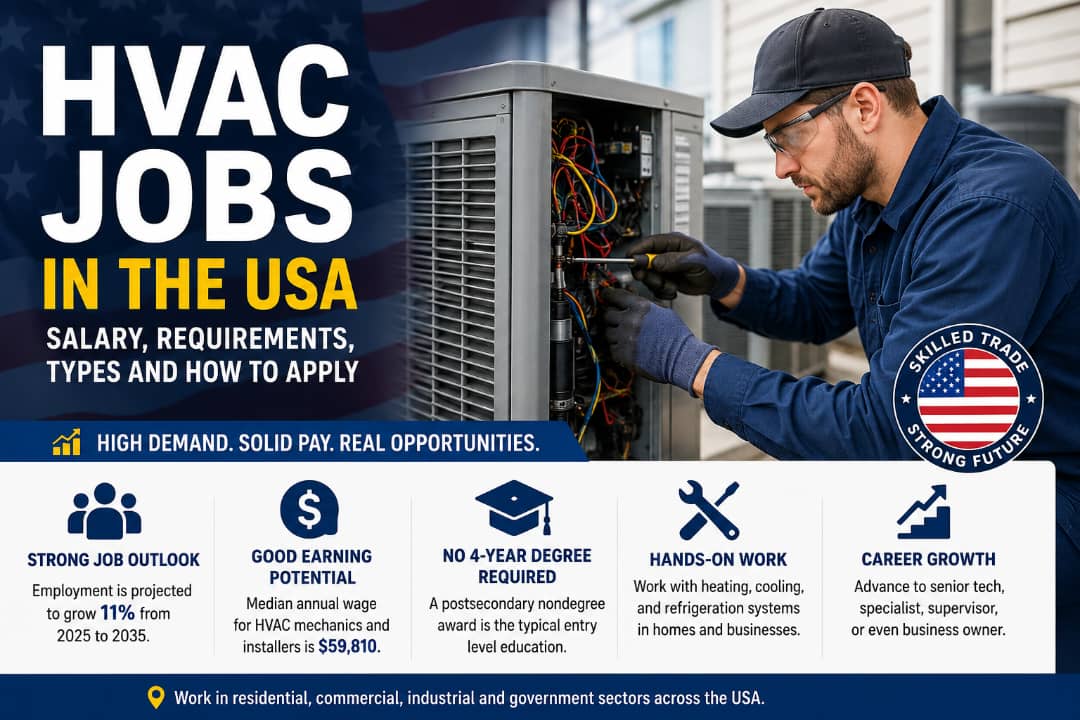
If you are looking for a hands-on career with strong demand, multiple entry routes, and opportunities for advancement, HVAC jobs in the USA are worth considering. HVAC technicians install, maintain, and repair the heating, ventilation, air conditioning, and refrigeration systems used in homes, offices, hospitals, factories, schools, and stores.
This guide explains what HVAC technicians do, how much they can earn, which certifications they need, how to start without extensive experience, and where to find legitimate HVAC jobs and apprenticeships.
What Does an HVAC Technician Do?
HVAC technicians work with systems that control temperature, humidity, ventilation, and air quality. Their responsibilities can vary depending on whether they work in residential, commercial, industrial, or refrigeration environments.
Typical duties include:
– Installing furnaces, air conditioners, heat pumps, boilers, and ventilation systems.
– Inspecting equipment for faults and safety problems.
– Testing electrical components, motors, controls, and thermostats.
– Repairing or replacing worn-out parts.
– Measuring airflow, pressure, temperature, and refrigerant levels.
– Cleaning coils, filters, ducts, and other system components.
– Explaining repairs and maintenance recommendations to customers.
– Completing service records and complying with safety requirements.
Residential technicians often travel from home to home, while commercial and industrial technicians may work at one facility or across several business locations.
Types of HVAC Jobs in the USA
The HVAC industry includes several career paths. Choosing a specialty can help you target the right training and employers.
Residential HVAC Technician
Residential technicians service heating and cooling systems in houses, apartments, and small buildings. They commonly work on central air conditioners, furnaces, heat pumps, ductless mini-split systems, and indoor air-quality equipment.
This is one of the most accessible entry points for new technicians because many contractors hire helpers and apprentices.
Commercial HVAC Technician
Commercial technicians work on larger systems in offices, shopping centers, restaurants, hotels, schools, and medical facilities. The equipment may include rooftop units, chillers, building automation systems, and large ventilation systems.
Commercial work often requires stronger electrical, controls, and troubleshooting skills.
Industrial HVAC Technician
Industrial technicians maintain climate-control and process-cooling systems in manufacturing plants, warehouses, laboratories, and other specialized facilities. These positions may involve strict safety procedures, rotating shifts, and advanced equipment.
Refrigeration Technician
Refrigeration technicians service equipment used by supermarkets, restaurants, food distributors, cold-storage facilities, and manufacturing companies. Their work may involve walk-in coolers, freezers, ice machines, display cases, and industrial refrigeration systems.
HVAC Installer
Installers put new systems into homes and buildings. They may connect ductwork, refrigerant lines, electrical wiring, thermostats, condensate drains, and equipment controls.
Installation work can be a good starting point for people who enjoy physical work and want to build practical experience quickly.
HVAC Maintenance Technician
Maintenance technicians perform scheduled inspections and preventive repairs. They are commonly employed by property-management companies, hospitals, universities, hotels, factories, and large commercial facilities.
Are HVAC Jobs in Demand?
HVAC work is needed wherever people live and businesses operate. Equipment eventually requires installation, maintenance, repairs, replacement, or upgrades, creating demand for qualified technicians.
The U.S. Bureau of Labor Statistics projects employment for heating, air conditioning, and refrigeration mechanics and installers to grow by 11% from 2025 to 2035, which is faster than the average for all occupations. The BLS also provides official information about HVAC duties, employment, wages, education, and job prospects by state and metropolitan area.
Demand can be especially strong in areas with:
– Hot summers or very cold winters.
– Rapid residential construction.
– Large commercial buildings.
– Manufacturing and logistics facilities.
– Hospitals and healthcare campuses.
– Food distribution and cold-storage operations.
How Much Do HVAC Technicians Earn?
One of the biggest reasons people consider HVAC careers is the potential to earn a solid income without following the traditional four-year college route.
The lowest 10% earned less than $40,050, while the highest 10% earned more than $95,210 annually. Actual earnings vary according to experience, specialization, employer, location, overtime, and the type of HVAC work performed.
HVAC Salary by Industry
Where an HVAC professional works can make a difference in earning potential.
BLS reported the following median annual wages for HVAC mechanics and installers in major industries in May 2025:
Industry| Median annual wage
Wholesale trade| $71,190
Retail trade| $62,830
Educational services; state, local and private| $62,520
Plumbing, heating and air-conditioning contractors| $60,030
These figures are occupation-wide industry medians rather than guaranteed salaries for every technician. A particular job can pay more or less depending on experience, responsibilities, location, and employer.
HVAC technicians may also increase their earnings through overtime, emergency or on-call work, specialized skills, and progression into more advanced positions. BLS notes that schedules can include evenings and weekends, and some technicians may be on call for emergencies.
What Qualifications Do You Need?
Many HVAC employers do not require a four-year college degree. However, they usually expect applicants to have a high school diploma or equivalent, basic mechanical ability, and a willingness to learn.
Common requirements include:
– High school diploma or GED.
– Valid driver’s license.
– Basic mathematics and reading ability.
– Mechanical and electrical aptitude.
– Physical ability to lift equipment and work in confined spaces.
– Willingness to work outdoors or in uncomfortable temperatures.
– Clean and dependable work history.
– Ability to pass an employer’s background or drug screening, where applicable.
Some states and municipalities require additional licenses for HVAC contractors or technicians. Requirements can differ significantly, so applicants should check the licensing authority in the state where they plan to work.
EPA Section 608 Certification
EPA Section 608 certification is one of the most important credentials for HVAC technicians who work with refrigerants. The U.S. Environmental Protection Agency requires technicians to pass an exam administered by an EPA-approved certifying organization.
The certification types are:
– Type I: Servicing small appliances.
– Type II: Servicing high-pressure appliances.
– Type III: Servicing low-pressure appliances.
– Universal: Servicing all types of covered equipment.
EPA states that Section 608 certification credentials do not expire, although technicians must still comply with current regulations and employer requirements. Apprentices may perform certain work under the close and continual supervision of a certified technician, but the exact duties must follow EPA requirements and applicable workplace rules.
The EPA does not issue certification cards itself; certification comes through an EPA-approved testing organization.
How to Become an HVAC Technician
You can enter the industry through trade school, community college, apprenticeship, or employer training.
Step 1: Learn the Basics
Start by studying electrical safety, refrigeration principles, tools, HVAC components, airflow, and basic mathematics. Online lessons can help, but hands-on practice is extremely valuable.
Step 2: Choose a Training Route
A trade-school program may prepare you for entry-level work in a relatively short period. A community-college program may provide broader technical education. An apprenticeship allows you to earn income while learning under experienced workers.
Step 3: Earn EPA Certification
If your intended job involves refrigerant circuits, prepare for and pass the appropriate EPA Section 608 examination. [3]
Step 4: Apply for Entry-Level Roles
Search for HVAC helper, installer assistant, maintenance technician, or apprentice positions. These jobs allow you to build experience while learning how professional service calls and installations are handled.
Step 5: Build a Professional Tool Kit
Start with essential tools recommended by your employer or training program. Avoid buying expensive specialty tools until you understand which equipment your role requires.
Step 6: Continue Developing Your Skills
As you gain experience, consider training in commercial equipment, refrigeration, heat pumps, building automation, indoor air quality, or energy-efficient systems.
Can You Get an HVAC Job With No Experience?
Yes. Many technicians begin as helpers, apprentices, installers, or maintenance assistants. Employers may be willing to train candidates who are dependable, safety-conscious, physically capable, and comfortable learning technical skills.
To improve your chances without experience:
– Complete a basic HVAC course.
– Obtain EPA Section 608 certification if appropriate.
– Apply to contractor apprenticeships.
– Emphasize mechanical, construction, electrical, or maintenance experience.
– Show that you have a valid driver’s license.
– Be prepared to start with installation, maintenance, or warehouse support.
– Contact local contractors directly instead of relying only on online applications.
A short, practical resume is often more effective than one filled with unrelated information.
Where to Apply for HVAC Jobs
Use official government websites and established employer career pages when searching for opportunities.
USAJOBS
The federal government posts HVAC, facilities-maintenance, boiler-plant, refrigeration, and mechanical-system positions on USAJOBS.
Apply here: [USAJOBS.gov] (https://www.usajobs.gov/)
Useful search terms include:
– HVAC mechanic.
– Air conditioning equipment mechanic.
– Refrigeration mechanic.
– Facilities maintenance technician.
– Heating plant mechanic.
Apprenticeship.gov
Apprenticeship.gov provides information about registered apprenticeship programs and helps job seekers locate earn-while-you-learn opportunities.
Find an apprenticeship: [Apprenticeship.gov] (https://www.apprenticeship.gov/)
Search by occupation and location, then review the sponsor’s requirements, wage progression, training structure, and application instructions.
CareerOneStop
CareerOneStop, sponsored by the U.S. Department of Labor, offers job-search tools, training information, career profiles, and state workforce resources.
Search jobs and training: [CareerOneStop.org] (https://www.careeronestop.org/)
Find state resources: [CareerOneStop state resources] (https://www.careeronestop.org/LocalHelp/StateResources/find-state-resources.aspx)
Bureau of Labor Statistics
The BLS is not primarily a job board, but it is the best official source for researching HVAC wages, job duties, education, and employment outlook.
Review HVAC career data: [BLS HVAC occupation page] (https://www.bls.gov/ooh/installation-maintenance-and-repair/heating-air-conditioning-and-refrigeration-mechanics-and-installers.htm)
Company Career Pages
Many HVAC contractors, property-management companies, hospitals, manufacturers, universities, and facilities-management providers post jobs directly on their websites. Search for phrases such as:
– HVAC technician careers.
– Refrigeration technician jobs.
– Commercial HVAC installer.
– Building maintenance technician.
– Facilities HVAC mechanic.
Applying through an employer’s official career page can help you avoid fake vacancies and unnecessary application fees.
How to Apply for HVAC Jobs in the USA
Applying successfully requires more than sending the same resume to every employer. Follow these steps.
Step 1: Prepare Your Resume
Create a one- or two-page resume that clearly shows your technical background.
Include:
– Your full name and contact details.
– A professional summary.
– HVAC certifications.
– Trade-school or apprenticeship training.
– Mechanical, electrical, plumbing, construction, or maintenance experience.
– Tools and equipment you can use.
– Safety training.
– Driver’s license information.
– Availability for travel, overtime, or shift work.
If you have no direct HVAC experience, highlight related skills such as automotive repair, electrical work, plumbing, carpentry, machine maintenance, or construction.
Step 2: Gather Your Documents
You may need:
– Resume.
– Cover letter.
– EPA Section 608 certification.
– Training certificates.
– Driver’s license.
– Proof of work authorization.
– Professional references.
– School or apprenticeship records.
Never provide sensitive financial information or pay a recruiter simply to access a job application.
Step 3: Search Through Official Websites
Use these legitimate resources:
– USAJOBS: Apply for federal HVAC, refrigeration, and facilities-maintenance positions at [USAJOBS.gov] (https://www.usajobs.gov/).
– Apprenticeship.gov: Find registered earn-while-you-learn programs at [Apprenticeship.gov] (https://www.apprenticeship.gov/).
– CareerOneStop: Search for jobs and training through [CareerOneStop.org] (https://www.careeronestop.org/).
– State workforce agencies: Find local employment support through [CareerOneStop State Resources] (https://www.careeronestop.org/LocalHelp/StateResources/find-state-resources.aspx).
– Company career pages: Apply directly to HVAC contractors, hospitals, manufacturers, hotels, universities, property-management firms, and facilities-service companies.
Step 4: Use the Right Search Terms
Search for multiple job titles instead of using only “HVAC technician.” Try:
– HVAC apprentice.
– HVAC helper.
– Entry-level HVAC technician.
– HVAC installer.
– Commercial HVAC technician.
– Refrigeration technician.
– Facilities maintenance technician.
– Building engineer.
– Air conditioning mechanic.
– Heating plant mechanic.
– HVAC controls technician.
Add a city or state to improve the results, such as “HVAC apprentice jobs in Texas” or “commercial HVAC technician jobs in Florida.”
Step 5: Tailor Each Application
Read the job description carefully and adjust your resume to match the employer’s requirements. If the posting requests refrigeration experience, electrical troubleshooting, rooftop-unit service, or a valid driver’s license, place those qualifications where the hiring manager can see them quickly.
Step 6: Follow Up Professionally
If the employer provides contact information, send a short follow-up message after applying. Mention the position, your relevant certification or training, and your interest in an interview.
How to Search for HVAC Jobs Near You
Use a combination of job title, location, and experience level. Examples include:
– HVAC jobs in Texas.
– Entry-level HVAC jobs in Florida.
– Commercial HVAC technician jobs in California.
– HVAC apprentice jobs near me.
– Refrigeration mechanic jobs in New York.
– HVAC maintenance jobs with housing.
– Union HVAC apprenticeship programs.
What to Include on Your HVAC Resume
Your resume should make it easy for an employer to see what you can do.
Include:
– A clear job title, such as “Entry-Level HVAC Technician.”
– EPA Section 608 certification, if earned.
– Trade-school or apprenticeship training.
– Electrical, plumbing, construction, or mechanical experience.
– Tools and equipment you can use.
– Safety training.
– Driver’s license and willingness to travel.
– Examples of troubleshooting or maintenance work.
– Relevant customer-service experience.
Sample Resume Summary
Reliable entry-level HVAC technician with hands-on training in electrical troubleshooting, refrigeration fundamentals, preventive maintenance, and residential equipment installation. EPA Section 608 certified, safety-focused, physically capable, and eager to develop skills in commercial HVAC service.
Common HVAC Interview Questions
Prepare for questions that test both technical thinking and workplace behavior.
Employers may ask:
– Why do you want to work in HVAC?
– What HVAC training have you completed?
– Do you have EPA Section 608 certification?
How would you approach a system that is not cooling?
– What safety steps do you take before working on equipment?
– Are you comfortable working in attics, crawl spaces, rooftops, or outdoor conditions?
– Can you work overtime or respond to emergency service calls?
– How would you explain a repair to a customer?
If you do not know the answer to a technical question, explain how you would safely investigate the problem rather than guessing.
HVAC Career Advancement Opportunities
HVAC does not have to remain an entry-level job. Technicians can advance into technical, supervisory, sales, or business roles.
Potential career paths include:
– Senior service technician.
– Commercial refrigeration specialist.
– Building automation technician.
– HVAC estimator.
– Service manager.
– Project manager.
– Facilities supervisor.
– HVAC instructor.
– Independent HVAC contractor.
Technicians who understand both equipment and customer needs can become particularly valuable. Communication, accurate diagnosis, good documentation, and dependable service often matter as much as technical knowledge.
Frequently Asked Questions
Is HVAC a good career in the USA?
HVAC can be a strong career for people who enjoy practical work, troubleshooting, and working with tools. The occupation has multiple entry routes and an official BLS projection of 11% employment growth from 2025 to 2035.
Do HVAC technicians need a college degree?
A four-year degree is usually not required for entry-level HVAC work. Many people enter through trade school, community college, an apprenticeship, or employer-based training.
Is EPA certification required for HVAC work?
EPA Section 608 certification is required for technicians who maintain, service, repair, or dispose of covered appliances in a way that could release refrigerants. The exact certification type depends on the equipment involved.
Can immigrants apply for HVAC jobs in the USA?
Applicants must have legal authorization to work in the United States. Employers may also require a valid driver’s license, relevant certification, English communication skills, and state or local licensing where applicable.
What is the difference between HVAC and HVACR?
HVAC refers to heating, ventilation, and air conditioning. HVACR includes refrigeration, which covers equipment such as commercial freezers, supermarket systems, walk-in coolers, and industrial cooling systems.
Where can I find legitimate HVAC apprenticeships?
Start with Apprenticeship.gov, local trade unions, community colleges, state workforce agencies, and established HVAC contractors. [Apprenticeship.gov] (https://www.apprenticeship.gov/)
Conclusion
The fastest practical route into HVAC is usually to combine basic technical training, EPA Section 608 certification where required, and applications for helper or apprenticeship roles. Focus on legitimate sources, verify every employer, and never pay a supposed recruiter to guarantee employment.
Start your research with the official BLS career information, look for registered apprenticeships through Apprenticeship.gov, and check USAJOBS and CareerOneStop for current openings and training resources.
Recommended Call to Action
Ready to start your HVAC career? Review the official resources above, search for apprenticeships in your preferred state, prepare a focused resume, and apply for entry-level HVAC, refrigeration, maintenance, and installation positions today.