
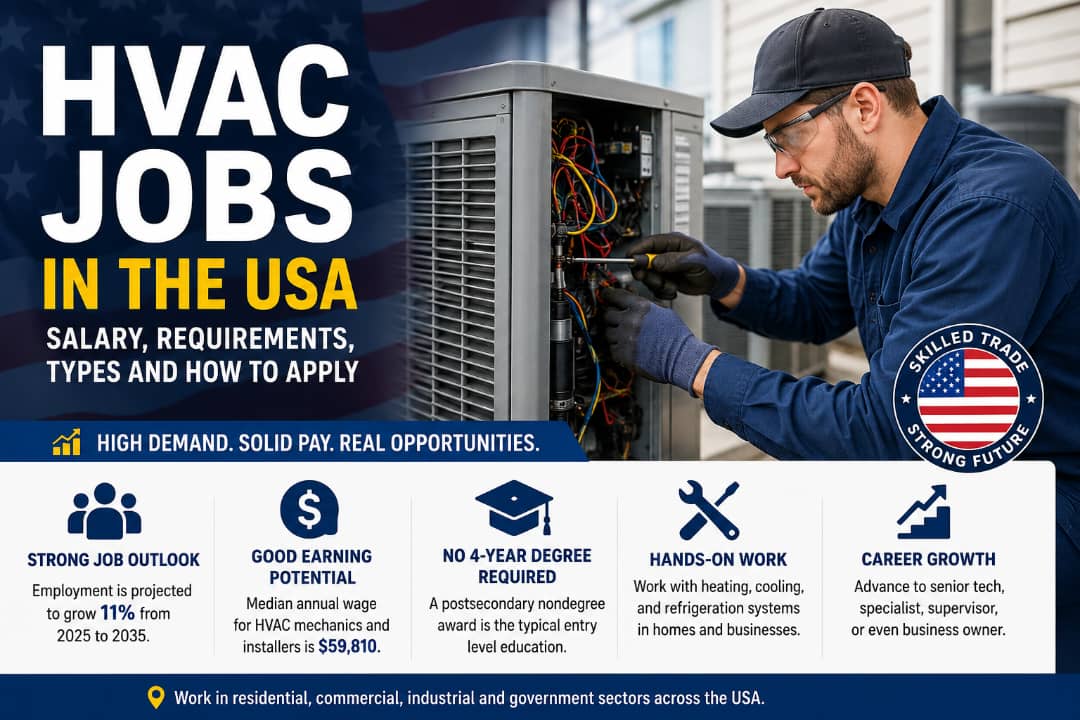
HVAC technicians install, maintain, and repair heating, ventilation, air conditioning and refrigeration systems in homes, commercial buildings, hospitals, factories, and other facilities. Employers hire workers to install, maintain, troubleshoot, and perform specialist refrigeration work.
For anyone considering HVAC jobs in the United States, two important factors are the pay and the qualifications required. Entry routes vary: some workers complete technical training before applying, while others enter through apprenticeships or receive additional on-the-job training.
How Much Do HVAC Technicians Earn in the USA?
According to the U.S. Bureau of Labor Statistics (BLS), the median annual wage for heating, air conditioning, and refrigeration mechanics and installers was $61,010 in May 2025, equivalent to approximately $29.33 per hour.
The BLS reported the following wage figures for the occupation:
| Wage measure Annual | l earnings |
|---|---|
| Lowest 10% earned less than | $40,050 |
| Median annual wage | $61,010 |
| Highest 10% earned more than | $95,210 |
These are national figures, not guaranteed starting salaries. Actual pay depends on experience, location, employer, specialization and working hours. Overtime and emergency call-outs may increase earnings, but they are not guaranteed.
The BLS also reported median wages by industry in May 2025:
- Wholesale trade: $71,190 per year.
- Retail trade: $62,830 per year.
- Educational services: $62,520 per year.
- Plumbing, heating and air-conditioning contractors: $60,030 per year.
These figures describe workers across the occupation in each industry; they should not be interpreted as entry-level salary offers.
Before accepting a job, compare the hourly rate, overtime policy, benefits, expected work schedule, and local cost of living. You can also use the BLS’s state and local employment data to compare opportunities in different parts of the country.
Types of HVAC Jobs in the USA
HVAC employers recruit for different positions depending on the equipment, building type, and work involved. Search for the job title that matches your training and experience.
1. HVAC installation technician
Installation technicians fit heating and cooling equipment, connect components, install ductwork where required, and test systems after installation. Employers may look for experience with tools, electrical components, safety procedures, and manufacturer instructions.
2. HVAC service technician
Service technicians inspect systems, diagnose faults, and repair or replace defective components. They may visit homes, offices, shops and other buildings to carry out repairs and routine maintenance.
3. Commercial HVAC technician
Commercial technicians work on systems used in offices, hospitals, hotels, schools, shopping centers and industrial facilities. Some positions involve larger or more complex equipment and may require experience with building controls, rooftop units or commercial refrigeration.
4. Refrigeration technician
Refrigeration technicians maintain and repair equipment used in supermarkets, restaurants, food storage facilities and industrial settings. Employers may require specific refrigeration knowledge and the appropriate refrigerant-handling certification.
5. HVAC maintenance technician
Maintenance technicians inspect equipment, replace filters, check system performance, and identify problems before they cause breakdowns. These positions may suit applicants with relevant technical training who want to develop further diagnostic experience.
6. HVAC controls technician
Controls technicians work with thermostats, sensors, control panels and building automation systems. Employers may seek additional knowledge of electrical systems, digital controls or building management technology.
The job titles can overlap, and employers do not all use them in the same way. Read the actual duties and qualifications in each vacancy before applying.
Requirements for HVAC Jobs in the USA
There is no single qualification that applies to every HVAC position. The BLS states that technicians typically need a postsecondary nondegree award, although some enter the occupation with less formal education. Employers generally provide additional on-the-job training.
Common requirements include:
- Technical training: HVAC, refrigeration or related technical education can help applicants understand system components, installation methods, and troubleshooting.
- Practical skills: Employers may expect experience using tools, testing equipment, electrical components and diagnostic procedures.
- Mechanical and electrical knowledge: Technicians need to understand how system components work together and identify faults safely.
- Safety awareness: The job may involve electrical hazards, pressurized systems, refrigerants, ladders, heavy equipment, and confined spaces.
- Communication skills: Technicians often explain problems to customers, complete service records and communicate with supervisors or dispatch teams.
- Physical ability: Work may involve lifting equipment, climbing, standing for long periods and working in hot, cold or cramped environments.
Some employers accept entry-level applicants and train them. Others require previous field experience, a driving license, specific technical qualifications or familiarity with particular equipment.
Is EPA Section 608 Certification Required?
EPA Section 608 certification is required for technicians performing work that could release regulated refrigerants from covered stationary refrigeration and air-conditioning equipment. The requirement applies to relevant refrigerant-handling work, not simply to every person whose job title contains “HVAC.”
Technicians must pass an examination administered through an EPA-approved certifying organization. Certification types include Type I, Type II, Type III, and Universal, depending on the equipment covered. Section 608 credentials do not expire.
Applicants should check the specific work involved and the employer’s requirements before paying for a course or examination.
Official information: U.S. Environmental Protection Agency – Section 608 Technician Certification.
Can You Become an HVAC Technician Through an Apprenticeship?
Yes. Registered apprenticeship programs combine paid work with structured instruction. They can provide a route into the trade for people who want practical training while earning an income.
Availability and entry requirements vary by program and employer. Some apprenticeships require a high school diploma or equivalent, a minimum age, aptitude testing or other conditions.
Search the official Apprenticeship.gov occupation directory for heating, air conditioning and refrigeration mechanics and installers. You can also check local technical colleges, trade associations and HVAC contractors for training opportunities.
Is Demand for HVAC Technicians Growing in the USA?
The BLS projects 11% employment growth from 2025 to 2035 for heating, air conditioning and refrigeration mechanics and installers, which is much faster than the projected average for all occupations.
The agency projects approximately 40,600 job openings per year, on average, over that period. These openings include positions arising when workers leave the occupation or retire, not just newly created jobs.
Demand is supported by the need to install, maintain, repair and replace heating and cooling systems. However, employment prospects and wages vary by state, metropolitan area, and employer.
Review the official BLS occupational outlook for the latest national data and links to state and local statistics.
Where to Find HVAC Jobs in the USA
If you are looking for HVAC technician jobs in the United States, start with employers that install, maintain, and service heating, cooling, and refrigeration equipment. Apply through their official career websites, and search for positions that match your experience.
1. Official HVAC Employer Career Websites
Trane Technologies – HVAC Technician Jobs
Trane recruits technicians for installation, maintenance, service and related technical work. Its technician careers page also discusses training and apprenticeship opportunities. Search for open positions and check the qualifications listed for each location.
Carrier operates in heating, air conditioning, refrigeration, and building climate solutions. Search its careers portal for HVAC service, field technician, refrigeration, and related technical vacancies. Not every advertised position will be a technician role.
Johnson Controls works with building systems, including heating, ventilation, air conditioning and building automation. Search for HVAC service technicians, field service technicians, controls technicians, and related positions.
These are legitimate employer recruitment websites, but their inclusion here does not mean they currently have a suitable vacancy in every location or offer visa sponsorship for HVAC technicians.
2. Search Major Job Websites
You can broaden your search through established job platforms:
- Indeed – HVAC Technician Jobs: Search by state, city, experience level and job type.
- LinkedIn Jobs – HVAC Technician: Find vacancies and review employer profiles.
- CareerOneStop Job Finder: Use this U.S. Department of Labor-sponsored resource to explore job opportunities.
Search using different titles because employers do not always use the same wording. Useful terms include HVAC technician, HVAC installer, HVAC service technician, commercial HVAC technician, refrigeration technician, and HVAC apprentice.
Before applying, check that the advert is current and confirm the vacancy on the employer’s own website whenever possible.
How to Apply for HVAC Technician Jobs in the USA
Step 1: Choose positions that match your skills
If you have experience repairing residential air conditioners, prioritize residential service and installation jobs. If you have worked with chillers, commercial refrigeration, building controls or large commercial systems, search for those specializations.
For entry-level applicants, look for trainee positions, helper roles and apprenticeships that accept candidates with limited experience.
Step 2: Prepare a technical CV
Your CV should show employers what you can actually do. Include:
- HVAC, refrigeration or electrical training.
- Previous employers and dates of employment.
- Equipment you have installed, serviced, or repaired.
- Experience diagnosing faults and carrying out preventive maintenance.
- Relevant certifications, including EPA Section 608 if you hold it.
- Experience with electrical testing, controls, refrigerants, and safety procedures, where applicable.
Describe your actual responsibilities rather than listing skills you have not used. If you are applying from another country, explain your qualifications clearly and state where you gained your experience.
Step 3: Gather supporting documents
Depending on the employer and position, you may need:
- An updated CV or résumé.
- Technical school certificates or training records.
- Employment reference letters or other evidence of experience.
- Relevant trade certifications.
- A driving license, if the role involves travelling between customer sites.
- Proof of work authorization at the stage requested by the employer.
Do not assume that a foreign technical certificate automatically satisfies every U.S. employer’s requirements. Ask whether the employer accepts your qualification and whether additional training or testing is required.
Step 4: Apply through the official recruitment portal
Create an account if required, complete the application accurately and upload the requested documents. Tailor your CV to the vacancy instead of sending the same application to every employer.
If the advert asks for commercial HVAC experience, for example, make your relevant commercial work clear. If it requires a particular certification, confirm whether you already hold it or whether the employer accepts candidates who can obtain it later.
Step 5: Prepare for the interview
Employers may ask you how you diagnose cooling problems, check electrical components, identify refrigerant-related issues, perform preventive maintenance or work safely around equipment.
Prepare examples from your experience. You may also be asked to complete a technical assessment or practical test.
Step 6: Check the offer before accepting
Confirm the job location, duties, hourly wage or salary, working hours, overtime arrangements, benefits and any relocation support. If you need immigration sponsorship, obtain clear confirmation of the employer’s position before spending money on travel or relocation.
HVAC Jobs in the USA With Visa Sponsorship
International applicants should understand that a job vacancy does not automatically mean an employer will sponsor a foreign worker. Many HVAC employers require candidates to already have authorization to work in the United States.
The appropriate immigration route depends on the job, the employer, and the applicant’s circumstances.
Could an HVAC job qualify for an H-2B visa?
The H-2B program allows eligible U.S. employers to hire foreign workers for qualifying temporary, non-agricultural jobs. The employer must demonstrate a qualifying temporary need and complete the required labor-certification and immigration procedures.
However, H-2B is not a general visa for permanent HVAC employment. A regular, year-round technician vacancy does not automatically qualify. Whether a particular HVAC position can use this program depends on the circumstances and applicable rules.
Read the official U.S. Department of Labor H-2B program guidance and the U.S. government guide to temporary work visas.
What should applicants outside the USA do?
Before applying, check the advert for statements such as “must be authorized to work in the United States” or “sponsorship is not available.” If the position does not explain its policy, contact the employer’s official recruitment team and ask whether it considers applicants living outside the country.
Do not assume that your HVAC training, experience, or EPA certification permits you to work in the United States. Certification and immigration authorization are separate matters.
How to avoid HVAC recruitment scams
Be cautious if a recruiter:
- Guarantees a U.S. job or visa in exchange for an upfront payment.
- Uses an email address that does not match the employer’s official domain.
- Offers employment without a proper interview or clear job description.
- Requests sensitive documents through an unverified account.
- Claims that buying a certificate guarantees employment or sponsorship.
Johnson Controls specifically warns applicants about fraudulent recruitment schemes and states that it does not request payment during recruitment. Verify other employers’ policies directly through their official websites as well.
Common Mistakes to Avoid When Applying for HVAC Jobs
Even applicants with relevant technical skills can miss opportunities by overlooking an employer’s requirements. Avoid these mistakes when applying for HVAC jobs in the USA.
Applying for jobs that do not match your experience
A residential air-conditioning technician may not meet the requirements for a commercial chiller or industrial refrigeration position. Read the duties carefully and focus on roles that match your actual skills.
Ignoring certification requirements
Some employers require EPA Section 608 certification for refrigerant-handling work covered by federal regulations. Other positions may require additional technical qualifications. Check the advert before paying for training or certification.
Sending a generic CV
List the equipment you have worked on, the maintenance or repair tasks you performed, your relevant training, and the certifications you hold. Specific, truthful details help employers assess your suitability.
Assuming every employer sponsors foreign workers
Many U.S. vacancies require applicants to already have work authorization. Confirm the employer’s policy before spending money on immigration advice, travel or relocation.
Paying for a promised job or visa
Verify the vacancy and recruiter independently. No recruiter should be trusted simply because they promise guaranteed employment or immigration approval.
Frequently Asked Questions About HVAC Jobs in the USA
How much do HVAC technicians earn in the USA?
The U.S. Bureau of Labor Statistics reported a median annual wage of $61,010 in May 2025 for heating, air conditioning, and refrigeration mechanics and installers. Actual earnings depend on location, experience, specialization, employer and working hours.
See the official BLS occupational outlook for wage data and employment projections.
Can I get an HVAC job in the USA without experience?
Yes, some employers offer trainee positions, helper roles and apprenticeships. However, other jobs require previous field experience or specific technical skills. Search for entry-level positions and read each vacancy’s minimum qualifications.
Do I need a degree to become an HVAC technician?
A university degree is not generally required. Many technicians complete postsecondary technical training, while others enter through apprenticeships or on-the-job training. Employers set their own requirements, and some positions require relevant certifications.
Is EPA Section 608 certification compulsory for every HVAC technician?
No. Federal Section 608 certification applies to technicians performing covered work that could release regulated refrigerants from stationary refrigeration and air-conditioning equipment. The requirement depends on the work performed, not just the job title.
Check the EPA’s official certification guidance.
Can applicants from Nigeria apply for HVAC jobs in the USA?
Nigerian applicants can apply for suitable vacancies, but they must meet the employer’s qualifications and have a lawful route to work in the United States. A job offer does not automatically provide work authorization, and not every employer sponsors overseas applicants.
Do HVAC companies in the USA provide visa sponsorship?
Some employers may consider immigration sponsorship for particular positions, but sponsorship should never be assumed. Temporary work programs such as H-2B have specific eligibility requirements and are not general routes for every permanent HVAC vacancy.
Check the employer’s official recruitment information and the U.S. government’s temporary work visa guidance.
Read Also
Continue exploring related opportunities on CareerOpportune:
- Commercial HVAC Jobs in the USA: Requirements, Qualifications, Salary and How to Apply
- Fully Funded Scholarships for International Students in 2027
Conclusion
HVAC offers several career paths, from residential installation and maintenance to commercial refrigeration and building controls. Choose positions that match your skills, verify the required qualifications, and apply through legitimate employer websites.
If you are applying from outside the United States, check work authorization and sponsorship conditions before making relocation plans. Use official government and employer websites to verify requirements rather than relying on recruitment promises.
Disclaimer: Salaries, vacancies, and employment requirements can change. Confirm the details with the employer and official government sources before applying.
1 comment