
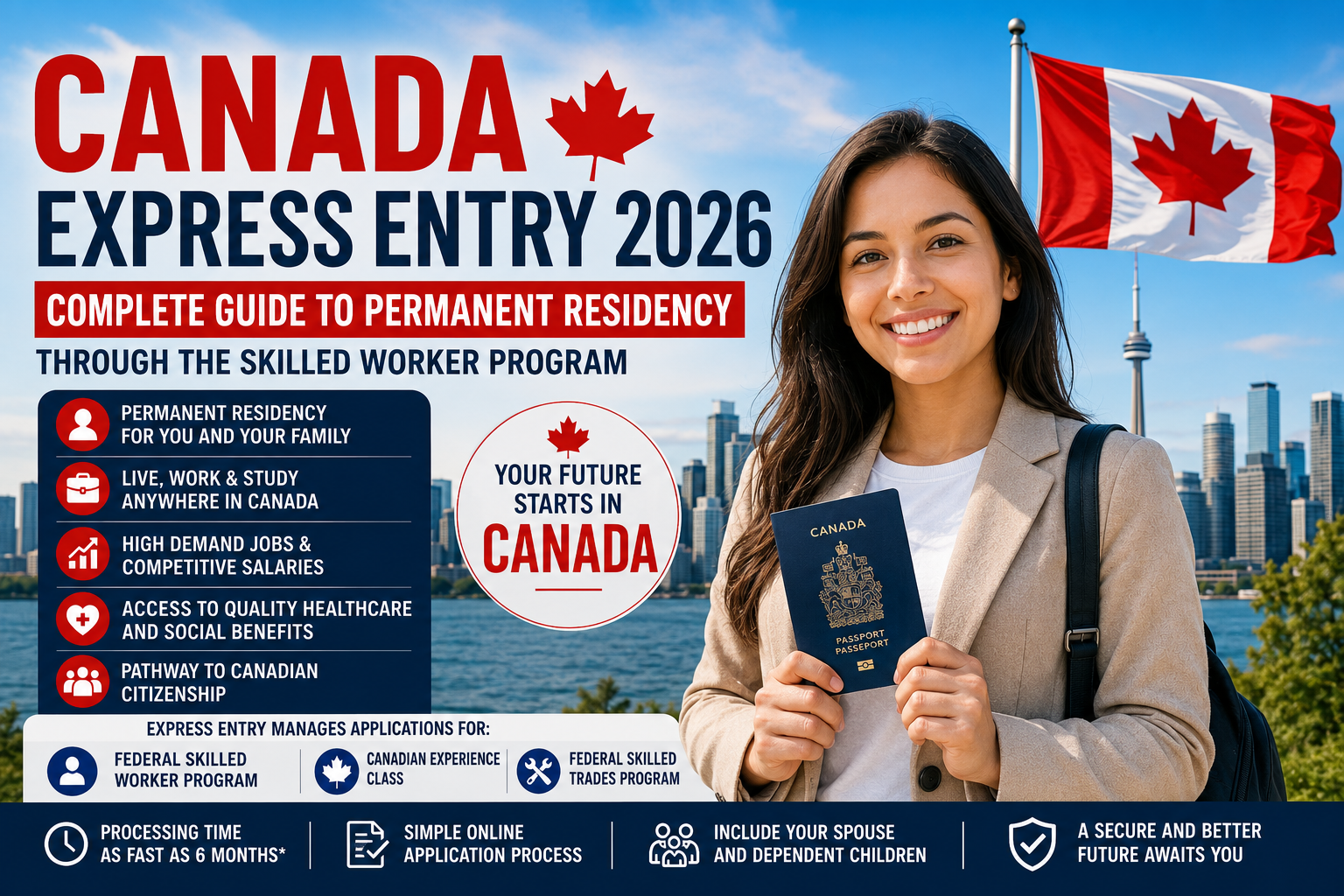
Canada continues to be one of the most attractive destinations for skilled workers looking to build a better future abroad. With its strong economy, high quality of life, excellent healthcare system, and growing demand for qualified professionals, thousands of immigrants receive permanent residency through Canada’s Express Entry system every year.
If you have been dreaming of living and working in Canada, the Canada Express Entry Program could be your fastest pathway to permanent residency. Unlike many immigration programs that require employer sponsorship, Express Entry allows eligible skilled workers to apply based on their education, work experience, language ability, and other factors.
Whether you are a healthcare professional, engineer, IT specialist, accountant, teacher, skilled tradesperson, or another qualified worker, understanding how Express Entry works can significantly improve your chances of successfully immigrating to Canada in 2026.
In this comprehensive guide, you’ll learn everything you need to know about the Canada Express Entry Program, including eligibility requirements, the Comprehensive Ranking System (CRS), required documents, application steps, processing times, estimated costs, salary expectations, and practical tips to help you prepare a competitive application.
Why Canada Remains One of the Best Countries for Skilled Workers
Canada continues to invest in immigration as part of its long-term economic growth strategy. As the country experiences labour shortages across several industries and an ageing workforce, skilled immigrants play an important role in filling critical positions.
This creates excellent opportunities for qualified professionals who want to secure permanent residency while enjoying stable employment and access to world-class public services.
Unlike temporary work permits, successful Express Entry applicants can become permanent residents, giving them the freedom to live and work almost anywhere in Canada.
What Is the Canada Express Entry Program?
Express Entry is Canada’s online immigration system used to manage applications for several economic immigration programs.
Rather than processing applications on a first-come, first-served basis, eligible candidates create an online profile and enter a pool where they are ranked using the Comprehensive Ranking System (CRS).
Applicants with the highest scores are invited to apply for permanent residency during regular invitation rounds conducted by Immigration, Refugees and Citizenship Canada (IRCC).
Immigration Programs Managed Through Express Entry
The Express Entry system currently manages applications for three major immigration programs:
Federal Skilled Worker Program (FSWP)
Designed for skilled professionals with foreign work experience who meet the required education, language, and eligibility criteria.
Canadian Experience Class (CEC)
Intended for individuals who already have qualifying skilled work experience in Canada.
Federal Skilled Trades Program (FSTP)
Created for qualified tradespeople working in occupations such as construction, manufacturing, electrical work, plumbing, welding, and other skilled trades.
Each program has its own eligibility requirements, but all applications are managed through the Express Entry system.
Major Benefits of the Canada Express Entry Program
One reason Express Entry is so popular is the wide range of benefits available to successful applicants.
Some of the key advantages include:
– A direct pathway to Canadian permanent residency.
– The opportunity to live and work in almost any province or territory.
– Access to Canada’s public healthcare system, where eligible.
– The ability to include eligible family members in your application.
– Access to quality education for dependent children.
– Freedom to change employers after becoming a permanent resident.
– A pathway to Canadian citizenship after meeting residency requirements.
– Strong employment opportunities across multiple industries.
These benefits have made Express Entry one of the world’s most respected skilled immigration systems.
Who Can Apply?
Canada welcomes skilled professionals from a wide range of occupations.
Some of the most in-demand professions include:
– Registered Nurses
– Software Developers
– Cybersecurity Specialists
– Civil Engineers
– Mechanical Engineers
– Electricians
– Plumbers
– Welders
– Accountants
– Financial Analysts
– Teachers
– Medical Laboratory Technologists
– Pharmacists
– Construction Managers
– Heavy Equipment Mechanics
– Truck Drivers
– Agricultural Specialists
– Early Childhood Educators
– Physiotherapists
– Occupational Therapists
Having one of these occupations does not automatically guarantee an invitation, but professionals with skills that match Canada’s labour market needs may have stronger opportunities through Express Entry or related immigration pathways.
Canada Express Entry 2026 Eligibility Requirements
Before creating an Express Entry profile, you must meet the eligibility requirements for one of the immigration programs managed under the Express Entry system. While each program has its own criteria, there are several common requirements that every applicant should understand.
Meeting the minimum requirements allows you to enter the Express Entry pool, but receiving an Invitation to Apply (ITA) depends on how competitive your profile is compared to other candidates.
1. Skilled Work Experience
Applicants are generally required to have qualifying skilled work experience in an eligible occupation. Your work experience should fall under Canada’s recognized occupational classifications and must meet the requirements of the immigration program you are applying through.
The more relevant work experience you have, the stronger your profile may become.
2. Educational Qualifications
Education plays a major role in your Express Entry score.
If you completed your education outside Canada, you will usually need an Educational Credential Assessment (ECA). An ECA confirms that your foreign qualification is comparable to Canadian educational standards.
Higher educational qualifications can increase your Comprehensive Ranking System (CRS) score.
3. English or French Language Proficiency
Language ability is one of the most important factors in the Express Entry system.
Applicants must complete an approved language test before submitting their profile.
Accepted English language tests include:
– IELTS General Training
– CELPIP General
For French, approved tests include:
– TEF Canada
– TCF Canada
A higher language score can significantly improve your CRS points and increase your chances of receiving an invitation.
4. Proof of Settlement Funds
Many applicants are required to show that they have enough financial resources to support themselves and their families after arriving in Canada.
The amount required depends on the size of your family and is updated periodically by the Canadian Government.
Applicants who already have a valid job offer, in certain circumstances, or who qualify under specific programs may have different requirements.
5. Medical and Police Clearance
Applicants and accompanying family members must undergo medical examinations and provide police clearance certificates where required.
These checks help ensure that applicants meet Canada’s health and security requirements.
Understanding the Comprehensive Ranking System (CRS)
Once you submit your Express Entry profile, you will receive a Comprehensive Ranking System (CRS) score.
The CRS is a points-based system used to rank candidates in the Express Entry pool.
Points are awarded based on factors such as:
– Age
– Education
– English and/or French language ability
– Skilled work experience
– Canadian work experience (if applicable)
– Spouse or partner qualifications
– Provincial nomination
– Valid job offer (where applicable)
– Additional recognized factors
Candidates with the highest CRS scores are typically invited to apply for permanent residency during Express Entry draws.
Because CRS cut-off scores change from one draw to another, improving your language results, gaining additional work experience, or earning higher educational qualifications may increase your chances of receiving an Invitation to Apply (ITA).
Step-by-Step Application Process
Applying through Express Entry involves several important steps.
Step 1: Confirm Your Eligibility
Determine which Express Entry immigration program best matches your qualifications and work experience.
Step 2: Complete an Approved Language Test
Take an approved English or French language examination and obtain your official test results.
Step 3: Obtain an Educational Credential Assessment (ECA)
If your education was completed outside Canada, arrange for an Educational Credential Assessment through a designated organization.
Step 4: Create Your Express Entry Profile
Submit your online profile with accurate information about your education, work experience, language test results, and other qualifications.
Step 5: Enter the Express Entry Pool
After submitting your profile, you will receive your CRS score and enter the candidate pool.
Step 6: Receive an Invitation to Apply (ITA)
If your CRS score is competitive during an Express Entry draw, you may receive an Invitation to Apply for permanent residency.
Step 7: Submit Your Permanent Residence Application
Once invited, upload all required supporting documents and submit your complete application within the required timeframe.
Carefully reviewing your application before submission can help prevent delays or unnecessary complications during processing.
Required Documents for Canada Express Entry
If you receive an Invitation to Apply (ITA) for permanent residency, you will need to submit several supporting documents to complete your application. Preparing these documents in advance can help you avoid delays.
Commonly required documents include:
– A valid international passport.
– Educational certificates and transcripts.
– Educational Credential Assessment (ECA) report (for foreign education).
– Approved English or French language test results.
– Employment reference letters from current and previous employers.
– Proof of skilled work experience.
– Police clearance certificates.
– Medical examination results from an approved panel physician.
– Proof of settlement funds (where required).
– Marriage certificate (if applicable).
– Birth certificates for dependent children (if applicable).
– Recent passport-sized photographs.
– Any additional documents requested by Immigration, Refugees and Citizenship Canada (IRCC).
Always ensure that the information provided in your application matches your supporting documents.
Canada Express Entry Processing Time
Processing times can vary depending on the volume of applications and the completeness of your submission.
In many cases, permanent residence applications submitted through Express Entry are processed within approximately six months after a complete application is received. However, some applications may take longer if additional verification or documents are required.
Submitting accurate information and responding promptly to any requests from IRCC can help avoid unnecessary delays.
Estimated Application Costs
Applicants should budget for several expenses during the immigration process.
These may include:
– Language test fees.
– Educational Credential Assessment (ECA) fees.
– Government application fees.
– Biometrics fees.
– Medical examination costs.
– Police clearance certificates.
– Document translation or certification (if required).
– Settlement funds required under the applicable immigration program.
Since fees may change over time, applicants should always verify the latest costs before submitting an application.
Average Salaries for Skilled Workers in Canada
Canada offers competitive salaries across many industries, particularly in occupations experiencing labour shortages. Actual earnings depend on your profession, qualifications, years of experience, employer, and province.
Below are estimated average annual salary ranges for some in-demand occupations:
– Registered Nurses – CAD 75,000 to CAD 110,000
– Software Developers – CAD 80,000 to CAD 130,000
– Civil Engineers – CAD 75,000 to CAD 120,000
– Mechanical Engineers – CAD 75,000 to CAD 115,000
– Electricians – CAD 70,000 to CAD 100,000
– Plumbers – CAD 70,000 to CAD 100,000
– Welders – CAD 60,000 to CAD 90,000
– Accountants – CAD 65,000 to CAD 100,000
– Teachers – CAD 65,000 to CAD 105,000
– Construction Managers – CAD 90,000 to CAD 150,000
Many employers also provide attractive benefits such as paid vacation, health insurance, retirement savings plans, parental leave, overtime pay where applicable, and opportunities for career development.
Benefits of Canada Express Entry
One of the biggest advantages of Express Entry is that it offers a direct pathway to permanent residency rather than a temporary visa.
Some of the key benefits include:
– Permanent resident status in Canada.
– Freedom to live and work in most provinces and territories.
– Access to Canada’s publicly funded healthcare system, where eligible.
– The opportunity to include your spouse and dependent children in your application.
– Access to quality education for children.
– The ability to change employers after becoming a permanent resident.
– A pathway to Canadian citizenship after meeting residency requirements.
– Strong employment opportunities across multiple industries.
– Legal protection under Canadian laws and access to many social benefits available to permanent residents.
These benefits make Express Entry one of the most popular skilled immigration pathways in the world.
Tips to Improve Your CRS Score
A higher Comprehensive Ranking System (CRS) score increases your chances of receiving an Invitation to Apply.
Here are a few practical ways to strengthen your profile:
– Improve your English or French language test scores.
– Gain additional skilled work experience.
– Complete a higher educational qualification.
– Ensure your Educational Credential Assessment is accurate and up to date.
– Keep your Express Entry profile updated whenever your circumstances change.
– Explore opportunities for a Provincial Nominee Program (PNP), which can significantly increase your CRS score.
Taking time to improve your profile before submitting or updating your application can make a meaningful difference.
Conclusion
Canada’s Express Entry system remains one of the fastest and most respected immigration pathways for skilled workers seeking permanent residency. While the process is competitive, applicants who meet the eligibility requirements and build a strong CRS profile can significantly improve their chances of success.
If you plan to immigrate to Canada in 2026, start preparing early by completing your language test, obtaining your Educational Credential Assessment, gathering the required documents, and staying informed about the latest Express Entry draws and immigration updates.
Proper planning today could be the first step toward building a rewarding future in Canada.
Disclaimer
This article is provided for general informational and educational purposes only. Immigration policies, Express Entry requirements, CRS cut-off scores, application fees, processing times, and eligibility criteria may change at any time. Applicants should always confirm the latest information through the official Immigration, Refugees and Citizenship Canada (IRCC) website before making immigration decisions. CareerOpportune is not affiliated with the Government of Canada and does not guarantee permanent residency approval or employment in Canada.