
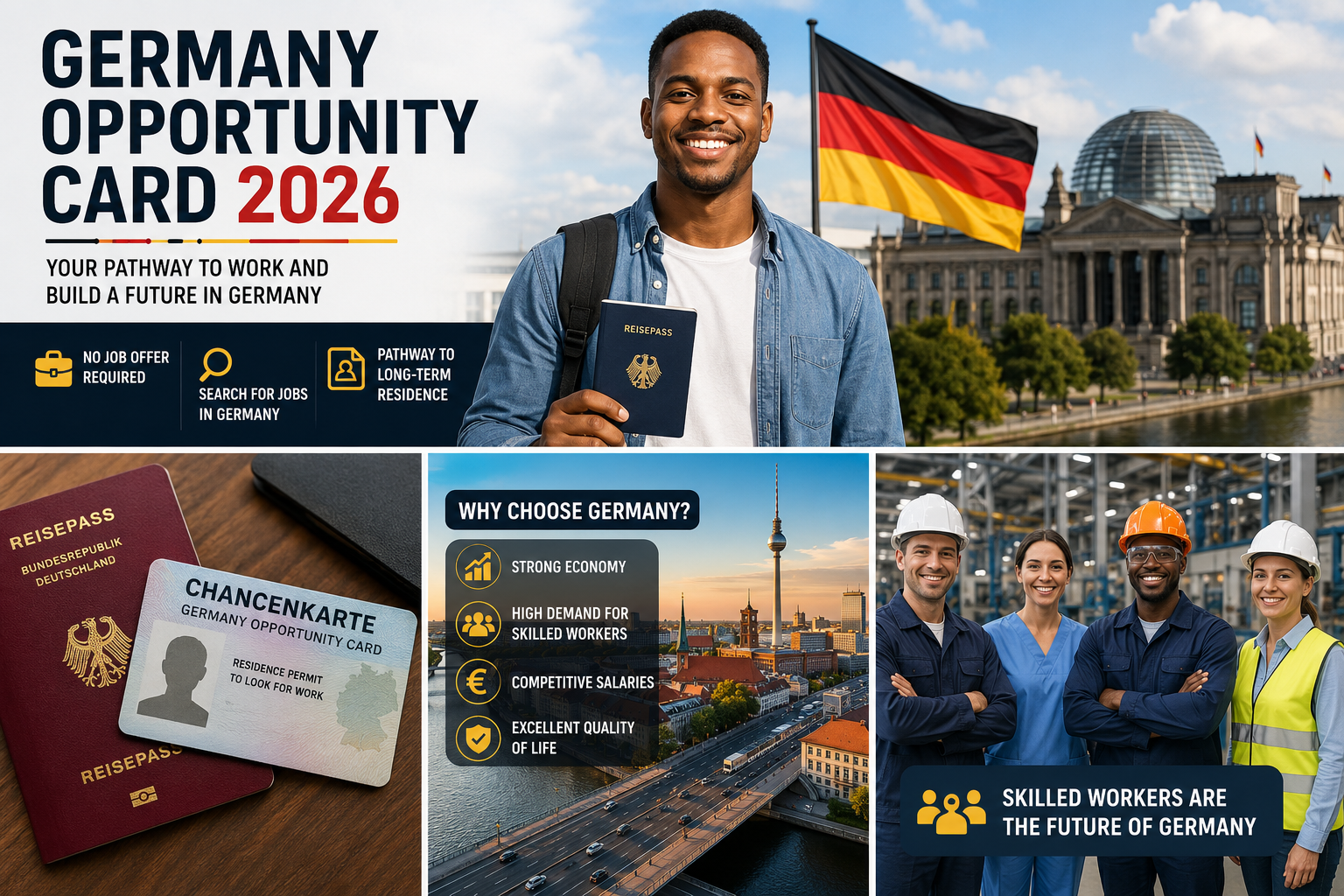
Germany continues to rank among the world’s top destinations for skilled professionals seeking better career opportunities, competitive salaries, and an excellent quality of life. As the country faces an increasing shortage of qualified workers across multiple industries, the German government has introduced several immigration pathways to attract international talent.
One of the most exciting options available in 2026 is the Germany Opportunity Card (Chancenkarte). This program allows qualified foreign professionals to travel to Germany even without a job offer and search for employment while living legally in the country. For many applicants who previously found it difficult to secure a job from abroad, the Opportunity Card provides a more flexible pathway to entering the German labor market.
Whether you are an IT specialist, engineer, healthcare worker, electrician, construction professional, logistics expert, hospitality worker, or skilled tradesperson, the Germany Opportunity Card could become your first step toward building a successful career in one of Europe’s strongest economies.
In this comprehensive guide, you’ll learn everything you need to know about the Germany Opportunity Card in 2026, including eligibility requirements, the points system, required documents, application steps, financial requirements, job opportunities, expected salaries, and practical tips to improve your chances of success.
What Is the Germany Opportunity Card?
The German Opportunity Card, known in German as the Chancenkarte, is a residence permit introduced to attract qualified professionals from countries outside the European Union. Unlike many traditional work visas, this permit allows eligible individuals to enter Germany without first obtaining a full-time employment contract.
Instead of waiting months to secure a job from abroad, successful applicants can relocate to Germany and actively search for suitable employment while residing legally in the country.
This makes the Opportunity Card particularly attractive for skilled professionals who have relevant education and work experience but have struggled to convince employers to hire candidates living overseas.
Once applicants secure a suitable job that meets immigration requirements, they may be able to transition to another residence permit that allows long-term employment and potentially permanent residence in Germany if all conditions are met.
Why Germany Needs Skilled Foreign Workers
Germany’s economy depends heavily on qualified professionals across numerous sectors. However, an ageing population, declining birth rates, and increasing retirements have created significant labour shortages.
As a result, employers continue to seek international talent to fill thousands of vacancies in areas such as:
Information Technology (IT)
Healthcare and Nursing
Engineering
Construction
Manufacturing
Logistics and Transportation
Hospitality and Tourism
Skilled Trades
Renewable Energy
Education
Automotive Industry
The German government estimates that hundreds of thousands of skilled workers are needed annually to support economic growth and maintain essential services.
This growing demand creates excellent opportunities for qualified international professionals willing to relocate.
Benefits of the Germany Opportunity Card
The Opportunity Card offers several advantages compared to many traditional work visa pathways.
Some of the biggest benefits include:
1. No Job Offer Required
Perhaps the most attractive feature is that eligible applicants can move to Germany without first securing employment.
This allows job seekers to attend interviews, network with employers, and better understand the local labour market.
2. Live Legally While Searching for Work
Instead of making repeated short visits, Opportunity Card holders can legally remain in Germany while looking for employment, provided they continue to meet the permit conditions.
3. Better Access to German Employers
Many employers prefer interviewing candidates who are already in Germany because it simplifies recruitment and can speed up the hiring process.
4. Opportunity to Work Part-Time
Depending on the conditions of the permit, Opportunity Card holders may be allowed to take on limited employment or trial work while searching for a permanent position. This can help cover living expenses and provide valuable local work experience.
5. Pathway to Long-Term Residence
Once you obtain qualifying employment, you may become eligible to switch to a work-related residence permit, opening the door to a longer-term future in Germany.
Who Should Consider Applying?
The Germany Opportunity Card is suitable for many categories of skilled workers, including those who:
Hold recognized professional qualifications or university degrees.
Have relevant work experience in their field.
Meet the required language or points criteria.
Can demonstrate sufficient financial resources during their job search.
Wish to live and work in Germany, but do not yet have an employment offer.
It can also be an attractive option for younger professionals looking to gain international experience and build a long-term career in Europe.
Germany Opportunity Card Eligibility Requirements
Before submitting your application, it is important to understand whether you meet the basic eligibility criteria. The Germany Opportunity Card is designed for qualified professionals who have the education, skills, and financial means to support themselves while searching for work in Germany.
To qualify, applicants generally need to meet the following requirements:
Be a citizen of a country outside the European Union (EU), European Economic Area (EEA), or Switzerland.
Hold a recognized university degree or vocational qualification.
Have relevant work experience, depending on the qualification pathway.
Meet the required language or points criteria.
Show proof that they can financially support themselves during their stay in Germany.
Possess a valid passport and meet Germany’s general immigration requirements.
Meeting the minimum requirements does not automatically guarantee approval. Immigration authorities will assess each application individually based on the documents submitted.
Understanding the German Opportunity Card Points System
For applicants whose qualifications are not automatically recognized, Germany uses a points-based assessment to determine eligibility.
The system is designed to identify candidates who are most likely to integrate successfully into the German labour market.
Points may be awarded for factors such as:
Educational Qualifications
Applicants with recognized university degrees or vocational qualifications receive points based on their level of education.
Higher educational qualifications generally improve an applicant’s chances.
Professional Work Experience
Relevant work experience demonstrates practical skills that employers value.
Candidates with several years of professional experience may receive additional points.
German Language Skills
Knowledge of the German language can significantly strengthen an application.
Even basic communication skills show your willingness to integrate into German society and the workplace.
English Language Skills
In some professions, particularly in international companies and the technology sector, English language proficiency may also contribute positively.
Age
Younger professionals often receive additional consideration because they are expected to contribute to Germany’s workforce for a longer period.
Previous Connection to Germany
Applicants who have previously studied, worked, or legally stayed in Germany may also receive additional points under certain circumstances.
Educational Qualification Requirements
One of the most important parts of the application is proving your educational background.
Applicants usually need one of the following:
A recognized university degree.
A recognized vocational qualification.
Professional qualifications accepted under Germany’s recognition framework.
Some qualifications may require an official recognition process before they are accepted.
Applicants are encouraged to verify whether their qualifications are recognized before beginning the visa application process.
Work Experience Requirements
Relevant work experience can strengthen your application considerably.
Although requirements vary depending on your qualification pathway, having practical experience demonstrates that your skills are current and valuable.
Industries currently experiencing strong demand include:
Information Technology
Software Development
Nursing
Elderly Care
Engineering
Construction
Manufacturing
Electrical Installation
Plumbing
Welding
Logistics
Hospitality
Hotel Management
Food Services
Automotive Services
Renewable Energy
Applicants with experience in these sectors may find more employment opportunities after arriving in Germany.
Language Requirements
Unlike some immigration programs, the German Opportunity Card does not always require applicants to be fluent in German.
However, language ability can greatly improve your employment prospects.
Accepted language qualifications may include:
German Language
Knowledge of German at beginner, intermediate, or advanced levels can strengthen an application and improve everyday communication after arrival.
English Language
Many international companies in Germany operate in English, especially in sectors such as:
Information Technology
Engineering
Finance
Research
International Business
Nevertheless, learning German remains highly recommended, as it can increase the number of jobs available and help with long-term integration.
Financial Requirements
Applicants must demonstrate that they can support themselves while searching for employment in Germany.
Immigration authorities generally require evidence that you have sufficient financial resources to cover living expenses during your stay.
Acceptable forms of financial proof may include:
A blocked bank account containing the required amount.
A formal declaration of financial support from an eligible sponsor.
Other forms of proof accepted by the German authorities.
The required amount may change over time, so applicants should always confirm the latest financial requirements before submitting their application.
Documents Required for the Germany Opportunity Card
Preparing complete and accurate documentation can help avoid unnecessary delays.
Applicants are commonly asked to provide:
A valid passport.
Completed visa application forms.
Recent passport-sized photographs.
Educational certificates and transcripts.
Proof of professional work experience.
Curriculum Vitae (CV) or résumé.
Language certificates, where applicable.
Proof of financial resources.
Health insurance coverage.
Proof of accommodation, if available.
Any additional documents requested by the German embassy or consulate.
Ensure that documents requiring translation are translated by an authorized translator where necessary.
How to Apply for the Germany Opportunity Card
The application process is generally straightforward when all documents are prepared in advance.
Step 1: Confirm Your Eligibility
Review the official requirements to ensure you meet the necessary qualification criteria.
Step 2: Gather Supporting Documents
Collect all required documents, ensuring they are complete, accurate, and up to date.
Step 3: Check Qualification Recognition
If necessary, verify whether your educational or vocational qualification is recognized in Germany.
Step 4: Arrange Financial Proof
Prepare evidence showing that you can support yourself financially during your stay.
Step 5: Book a Visa Appointment
Schedule an appointment with the German embassy or consulate responsible for your country of residence.
Step 6: Attend Your Interview
Submit your documents, provide biometric information if required, and answer any questions about your plans to work in Germany.
Step 7: Wait for Processing
After submitting your application, immigration authorities will review your documents and make a decision.
Processing times may vary depending on the country of application, application volume, and whether additional documentation is required.
Best Jobs Available with the Germany Opportunity Card
One of the biggest advantages of the Germany Opportunity Card is that it gives skilled professionals the opportunity to search for employment directly in Germany. While job availability depends on your qualifications, experience, and language skills, some sectors consistently have a high demand for international workers.
Below are some of the industries currently experiencing labour shortages.
1. Information Technology (IT)
Germany’s technology sector continues to expand rapidly, creating opportunities for:
Software Developers
Web Developers
Cybersecurity Specialists
Data Analysts
Cloud Engineers
AI and Machine Learning Engineers
IT Support Specialists
Many international companies use English as their primary working language, making this sector especially attractive to foreign professionals.
Average annual salary: €50,000–€85,000 (depending on experience and role).
2. Healthcare and Nursing
Germany has a growing need for healthcare professionals due to its ageing population.
High-demand roles include:
Registered Nurses
Elderly Care Workers
Medical Technicians
Physiotherapists
Radiographers
Laboratory Technicians
Healthcare professionals with recognized qualifications and German language skills often have excellent employment prospects.
Average annual salary: €38,000–€65,000.
3. Engineering
Engineers remain among the most sought-after professionals in Germany.
Demand is particularly strong for:
Mechanical Engineers
Civil Engineers
Electrical Engineers
Automotive Engineers
Industrial Engineers
Renewable Energy Engineers
Average annual salary: €55,000–€90,000.
4. Skilled Trades
Germany also has a significant demand for experienced tradespeople, including:
Electricians
Plumbers
Welders
Carpenters
HVAC Technicians
Industrial Mechanics
Many employers are actively recruiting qualified tradespeople due to ongoing labour shortages.
5. Logistics and Transportation
Germany’s central location in Europe makes logistics one of its most important industries.
Common vacancies include:
Warehouse Supervisors
Forklift Operators
Supply Chain Coordinators
Truck Drivers (subject to licensing requirements)
Logistics Specialists
6. Hospitality and Tourism
Hotels, restaurants, and tourism businesses frequently recruit international workers for roles such as:
Hotel Receptionists
Chefs and Cooks
Restaurant Supervisors
Housekeeping Staff
Customer Service Personnel
German language skills can be particularly valuable in this sector.
How to Find Jobs in Germany
Finding a legitimate employer is one of the most important steps after arriving in Germany. Focus on trusted sources and avoid anyone who promises guaranteed jobs in exchange for money.
Consider these approaches:
Search reputable online job portals.
Visit the company career pages directly.
Register with recruitment agencies that specialize in international hiring.
Attend job fairs and networking events.
Build a professional profile on networking platforms.
Tailor your CV and cover letter to German standards for each application.
Submitting high-quality applications consistently can improve your chances of receiving interview invitations.
Tips to Improve Your Chances of Success
Competition for skilled jobs can still be strong. These practical tips may help you stand out:
Learn basic or intermediate German before travelling.
Ensure your qualifications are recognized where required.
Prepare a professional CV in a format commonly used in Germany.
Highlight relevant work experience and certifications.
Apply for multiple suitable positions rather than relying on one application.
Research the companies you apply to and prepare thoroughly for interviews.
Stay informed about immigration rules and employer expectations.
Common Mistakes to Avoid
Many applicants experience delays or refusals because of avoidable mistakes.
Avoid the following:
Submitting incomplete application forms.
Providing incorrect or inconsistent information.
Failing to provide sufficient financial proof.
Ignoring qualification recognition requirements.
Using outdated or unofficial documents.
Paying money to fraudulent agents who promise guaranteed visas or jobs.
Applying without understanding the visa conditions.
Taking time to prepare your application carefully can save both time and money.
Frequently Asked Questions (FAQs)
Can I apply without a job offer?
Yes. The Germany Opportunity Card is specifically designed to allow eligible skilled professionals to travel to Germany and search for employment without first securing a job offer.
Do I need to speak fluent German?
Not always. While some jobs require German language skills, others—particularly in international companies and certain IT roles—may accept English. However, learning German can significantly improve your employment opportunities and daily life.
Can I work while searching for a permanent job?
Depending on the conditions attached to your Opportunity Card, you may be permitted to undertake limited employment or trial work while looking for a long-term position.
Can my family join me immediately?
Family reunification depends on your residence status and the applicable immigration rules. If you later transition to another residence permit, you may become eligible to apply for family reunification, subject to the relevant requirements.
Can the Opportunity Card lead to permanent residence?
It can. If you secure qualifying employment and continue to meet Germany’s immigration requirements, you may later become eligible for a longer-term residence permit and, eventually, permanent residence.
Conclusion
The Germany Opportunity Card 2026 provides a valuable pathway for skilled professionals who want to build a future in one of Europe’s strongest economies. By allowing eligible applicants to enter Germany without first securing a job offer, it offers greater flexibility and the chance to connect directly with employers.
Success, however, depends on careful preparation. Understanding the eligibility requirements, organizing the necessary documents, improving your language skills, and applying strategically for jobs can significantly increase your chances of achieving your career goals in Germany.
As immigration policies and application procedures may change, always verify the latest requirements with the appropriate German authorities before submitting your application.
Disclaimer
CareerOpportune provides informational content to help readers understand international jobs, visas, scholarships, and career opportunities. We are not a recruitment agency, immigration consultant, or government body, and we do not guarantee visas, employment, or application approval.
Readers should always verify the latest information through the official German government immigration and visa websites before making any decisions or submitting applications.