
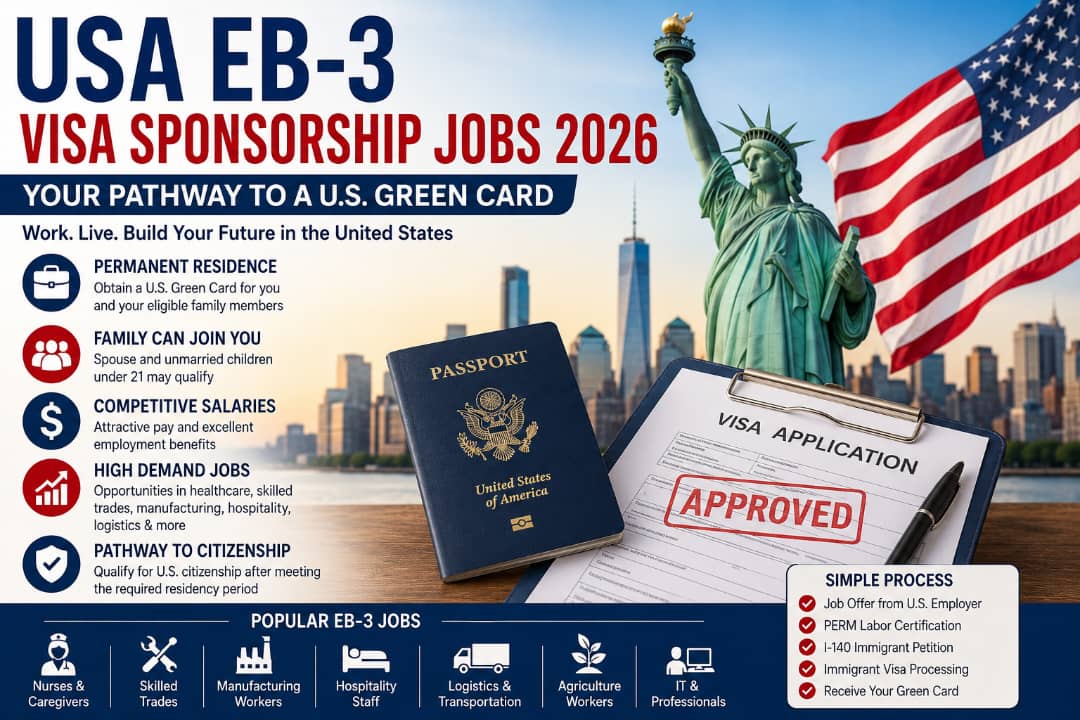
The United States remains one of the world’s most sought-after destinations for skilled professionals, experienced workers, and individuals seeking better career opportunities. With a strong economy, competitive salaries, and employment opportunities across industries such as healthcare, construction, manufacturing, hospitality, transportation, and agriculture, many foreign workers continue to pursue legal pathways to work and settle in the U.S.
One of the most popular employment-based immigration pathways is the EB-3 Immigrant Visa. Unlike many temporary work visas, the EB-3 visa can provide eligible applicants with a pathway to lawful permanent residence (a Green Card) through employer sponsorship.
Every year, U.S. employers experiencing labor shortages sponsor qualified foreign workers for permanent employment under the EB-3 category. Depending on the occupation and employer’s needs, opportunities may be available for skilled workers, professionals, and certain other workers.
If you are planning to relocate to the United States in 2026, understanding how the EB-3 visa works can significantly improve your chances of finding a legitimate employer and completing a successful application.
This comprehensive guide explains everything you need to know about USA EB-3 visa sponsorship jobs in 2026, including eligibility requirements, qualifying occupations, employer sponsorship, application procedures, processing times, estimated costs, and practical tips to avoid common mistakes.
What Is the USA EB-3 Visa?
The EB-3 Visa is an employment-based immigrant visa that allows eligible foreign nationals to obtain permanent residence in the United States through employer sponsorship.
Unlike temporary work visas, the EB-3 category is intended for permanent employment. Once approved and admitted as a permanent resident, successful applicants generally have the right to live and work permanently in the United States, provided they continue to meet applicable immigration requirements.
The sponsoring employer must demonstrate that the position cannot readily be filled by qualified U.S. workers and must complete the required employment certification process before the immigration petition is filed.
EB-3 Visa Categories
The EB-3 visa is divided into three primary categories.
1. Skilled Workers
This category is intended for applicants whose jobs require at least two years of training or relevant work experience.
Examples include:
Electricians
Welders
Plumbers
Carpenters
Heavy Equipment Mechanics
Industrial Maintenance Technicians
Machine Operators
2. Professionals
Applicants in this category generally must possess at least a U.S. bachelor’s degree or an equivalent foreign qualification required for the position.
Common professions include:
Engineers
Accountants
Teachers
Architects
Software Developers
Financial Analysts
Medical Technologists
3. Other Workers
This category applies to certain permanent jobs requiring less than two years of training or experience.
Examples may include:
Caregivers
Housekeepers
Hotel Workers
Food Processing Workers
Warehouse Workers
Agricultural Workers
Cleaners
Eligibility depends on the employer’s position and current U.S. immigration requirements.
Benefits of the USA EB-3 Visa
The EB-3 visa offers several significant advantages for eligible applicants.
Permanent Residency
Successful applicants receive lawful permanent resident status (commonly known as a Green Card), allowing them to live and work permanently in the United States.
Family Benefits
Eligible spouses and unmarried dependent children may also qualify to immigrate with the principal applicant, subject to U.S. immigration laws.
Freedom to Work
Permanent residents are generally not restricted to temporary employment authorization and may enjoy greater employment flexibility after meeting applicable conditions.
Pathway to U.S. Citizenship
After meeting the required period of lawful permanent residence and satisfying other eligibility criteria, many Green Card holders may become eligible to apply for U.S. citizenship.
Competitive Salaries
Many EB-3 occupations offer high wages, particularly in healthcare, skilled trades, engineering, logistics, manufacturing, and construction.
Who Can Apply?
Eligibility depends on the specific EB-3 category and the job being offered. In general, applicants should:
Have a genuine permanent job offer from a U.S. employer.
Meet the education, training, or work experience requirements for the position.
Satisfy applicable medical and background screening requirements.
Be admissible under U.S. immigration law.
Complete the required immigration process before entering the United States as a permanent resident.
Meeting these requirements does not guarantee approval, but it forms the basis of a successful application.
Industries Commonly Offering EB-3 Sponsorship
Demand for foreign workers varies according to labor shortages and employer needs. Industries that have historically sponsored EB-3 workers include:
Healthcare
Nursing Assistants
Caregivers
Medical Technicians
Rehabilitation Assistants
Construction
Carpenters
Electricians
Plumbers
Concrete Workers
Painters
Roofers
Manufacturing
Production Workers
Machine Operators
Welders
Fabricators
Industrial Mechanics
Hospitality
Hotel Staff
Housekeepers
Restaurant Supervisors
Chefs
Bakers
Transportation and Logistics
Truck Mechanics
Warehouse Associates
Logistics Coordinators
Equipment Technicians
Agriculture
Farm Supervisors
Agricultural Equipment Operators
Livestock Workers
Food Processing Employees
Employer Sponsorship Requirement
The EB-3 visa cannot generally be self-sponsored.
Applicants must first receive a permanent job offer from a U.S. employer willing to sponsor them throughout the immigration process.
In most cases, the employer must complete the required labor certification process and file the appropriate immigration petition before the employee can proceed with the immigrant visa or adjustment of status process.
Education and Experience Requirements
The required qualifications depend on the specific EB-3 category.
For example:
Skilled Workers usually need at least two years of relevant training or experience.
Professionals generally require a bachelor’s degree or its foreign equivalent.
Other Workers typically qualify based on the employer’s job requirements for positions requiring less than two years of experience or training.
Applicants should carefully review the requirements listed in the employer’s job offer before applying.
Understanding the PERM Labor Certification Process
One of the most important steps in the EB-3 visa process is the PERM Labor Certification.
Before sponsoring most foreign workers under the EB-3 category, the U.S. employer is generally required to obtain a certified labor certification from the U.S. Department of Labor (DOL). This process is designed to confirm that:
There are not enough qualified, willing, and available U.S. workers for the position.
Hiring a foreign worker will not negatively affect the wages and working conditions of similarly employed U.S. workers.
The employer has followed the required recruitment procedures.
The PERM certification is employer-driven and is not something applicants file on their own.
Step-by-Step EB-3 Visa Application Process
The EB-3 process involves several stages and may take time to complete, depending on individual circumstances.
Step 1: Obtain a Genuine Job Offer
The process begins when a U.S. employer offers you a permanent, full-time position that qualifies under the EB-3 category.
The job offer should clearly state:
Job title
Duties and responsibilities
Salary or wage
Work location
Employment conditions
Always verify that the employer is legitimate before accepting an offer.
Step 2: PERM Labor Certification
If required for the position, the employer completes the PERM Labor Certification process with the U.S. Department of Labor.
This includes advertising the position and documenting recruitment efforts before seeking approval to hire a foreign worker.
Step 3: Employer Files Form I-140
After the labor certification is approved (where applicable), the employer generally files Form I-140, Immigrant Petition for Alien Worker, with the appropriate U.S. immigration authority.
This petition demonstrates that:
The job offer is genuine.
The worker meets the qualifications for the position.
The employer can meet the applicable wage obligations.
Step 4: Wait for Visa Availability
EB-3 visas are subject to annual numerical limits.
Depending on your country of chargeability and the demand for visas, you may need to wait until an immigrant visa number becomes available before proceeding to the next stage.
Step 5: Immigrant Visa or Adjustment of Status
If you are outside the United States, you will generally complete immigrant visa processing through a U.S. embassy or consulate in your country.
If you are already in the United States and meet the legal requirements, you may be eligible to apply for adjustment of status.
The appropriate process depends on your immigration circumstances.
Step 6: Medical Examination and Interview
Applicants are generally required to complete:
A medical examination by an authorized physician.
Background and security checks.
An interview, if required.
Applicants should answer all questions honestly and provide accurate supporting documents.
Step 7: Receive Your Immigrant Visa
If your application is approved, you can complete the immigration process and travel to the United States as a lawful permanent resident.
After admission, eligible applicants receive permanent resident status and may later receive their Permanent Resident Card (Green Card) through the appropriate process.
Documents Required
Although requirements vary depending on individual circumstances, applicants are commonly asked to provide:
Valid passport
Birth certificate
Employment offer letter
Educational certificates and transcripts
Professional licences or certifications (if applicable)
Employment reference letters
Updated CV or résumé
Police clearance certificates (where required)
Medical examination results
Passport-sized photographs
Marriage certificate (if applicable)
Birth certificates for dependent children
Any additional documents requested by the relevant U.S. authorities
All documents should be complete, accurate, and consistent with the information provided in your application.
Processing Time
Processing times for EB-3 applications vary depending on several factors, including:
Labor certification processing
Petition processing
Visa availability
Country-specific visa demand
Administrative processing
Completeness of the application
Because timelines can change, applicants should regularly monitor official immigration updates and avoid making irreversible travel or employment arrangements until their case has been approved.
Can Your Family Immigrate With You?
One of the major advantages of the EB-3 visa is that eligible immediate family members may also qualify to immigrate.
Eligible family members generally include:
Your legally married spouse.
Your unmarried dependent children who meet the applicable age and immigration requirements.
Each family member must complete the required immigration procedures and provide the necessary supporting documentation.
Common Reasons EB-3 Applications Are Delayed or Refused
Although many applications are successful, certain issues can result in delays or denials.
Common reasons include:
Incomplete or inaccurate application forms.
Missing supporting documents.
Failure to meet education or work experience requirements.
Problems during the labor certification process.
Employer unable to satisfy sponsorship requirements.
Medical or admissibility issues.
Providing false or misleading information.
Failure to respond to requests for additional evidence within the required time.
Carefully reviewing every stage of the process can help reduce avoidable delays.
Tips for Finding Legitimate EB-3 Sponsorship Jobs
Unfortunately, immigration scams targeting EB-3 applicants are common. To protect yourself:
Apply through reputable employers and established recruitment channels.
Research the employer before accepting any offer.
Never pay someone who guarantees a visa approval.
Read your employment contract carefully before signing.
Keep copies of all documents and correspondence.
Be cautious of offers that promise unusually high salaries for little or no experience.
Verify that any immigration advice you receive comes from qualified professionals or official government sources.
Living and Working in the United States
The United States offers one of the largest and most diverse job markets in the world. Through the EB-3 visa program, many foreign workers secure permanent employment in industries experiencing labor shortages while enjoying the benefits of lawful permanent residence.
Major employment opportunities are available in states such as Texas, Florida, California, New York, North Carolina, Ohio, Georgia, and Arizona. Demand varies by region, with healthcare, manufacturing, logistics, construction, hospitality, and skilled trades remaining among the strongest sectors.
As a lawful permanent resident, you may have the opportunity to change employers in accordance with U.S. employment and immigration laws after meeting applicable requirements. Permanent residents also enjoy many workplace protections under federal and state labor laws.
Before relocating, research the cost of living in your destination city or state, as expenses such as housing, transportation, healthcare, and childcare can vary significantly.
Average Salary Expectations
Salaries depend on your occupation, location, experience, employer, and industry. The figures below are approximate annual salary ranges for common EB-3 occupations.
Occupation Estimated Annual Salary (USD)
Registered Nurse $70,000–$120,000+
Electrician $55,000–$90,000+
Welder $45,000–$75,000+
Carpenter $50,000–$85,000+
Industrial Maintenance Technician $55,000–$90,000+
Software Developer $90,000–$150,000+
Accountant $60,000–$100,000+
Warehouse Supervisor $50,000–$80,000+
Hotel Supervisor $45,000–$70,000+
Food Processing Worker $35,000–$55,000+
Actual salaries vary based on location, employer, qualifications, overtime opportunities, and market demand.
Can the EB-3 Visa Lead to U.S. Citizenship?
Yes. One of the biggest advantages of the EB-3 visa is that it can lead to lawful permanent residence (a Green Card).
After maintaining permanent resident status for the required period and meeting all applicable legal requirements, many Green Card holders may become eligible to apply for U.S. citizenship through the naturalization process.
Applicants must continue to comply with U.S. immigration laws and satisfy all eligibility requirements at the time they apply.
Tips to Improve Your Chances of Success
A successful EB-3 application starts with careful preparation. Consider the following tips:
Apply only for genuine full-time positions with reputable U.S. employers.
Ensure your qualifications and work experience match the job requirements.
Prepare accurate and complete supporting documents.
Keep copies of all forms, contracts, and correspondence.
Respond promptly to any requests for additional information.
Be honest throughout the application process.
Stay informed about changes to U.S. immigration policies and visa processing procedures.
Never pay individuals who promise guaranteed Green Cards or visa approvals.
Frequently Asked Questions (FAQs)
Can I apply for an EB-3 visa without a job offer?
No. The EB-3 visa generally requires a permanent job offer from a U.S. employer willing to sponsor your application.
Can I include my spouse and children?
Yes. Eligible spouses and unmarried dependent children may qualify to immigrate with the principal applicant, subject to U.S. immigration requirements.
Is IELTS required?
No. There is no general IELTS requirement for the EB-3 visa. However, some employers or licensed professions may require proof of English language proficiency or other professional qualifications.
How long does the EB-3 process take?
Processing times vary depending on labor certification, petition processing, visa availability, administrative processing, and your country of chargeability. Timelines can change, so applicants should consult official government updates.
Can I change employers after receiving my Green Card?
Permanent residents generally have greater employment flexibility than temporary visa holders. However, the original job offer must have been genuine, and applicants should comply with all applicable immigration and employment laws.
Do I need a university degree?
Not always. The EB-3 program includes categories for professionals, skilled workers, and certain other workers. The education or experience required depends on the specific job being offered.
Common Mistakes to Avoid
To improve your chances of approval, avoid these common errors:
Applying through unverified recruiters or fraudulent agencies.
Submitting incomplete or inconsistent documentation.
Accepting job offers without reviewing the employment contract.
Providing false information during any stage of the application.
Ignoring requests for additional evidence from immigration authorities.
Paying large upfront fees to individuals who claim they can guarantee an EB-3 visa.
Always verify the legitimacy of employers and seek information from official government sources when possible.
Conclusion
The USA EB-3 Visa remains one of the most valuable employment-based immigration pathways for foreign nationals seeking permanent career opportunities in the United States. Whether you are a skilled tradesperson, a university graduate, or an eligible worker in another qualifying occupation, the program can provide a route to lawful permanent residence through employer sponsorship.
Success depends on securing a genuine job offer, meeting the qualifications for the position, completing the required immigration process, and submitting accurate documentation. Since immigration policies, visa availability, and processing times can change, applicants should always verify the latest requirements before beginning the process.
With proper planning and realistic expectations, the EB-3 Visa can open the door to long-term career growth and a new life in the United States.
Disclaimer
This article is for informational purposes only and should not be considered legal or immigration advice. U.S. immigration laws, visa availability, processing times, fees, and eligibility requirements may change over time. Applicants should always refer to the official U.S. government immigration resources or consult a qualified immigration professional for the most up-to-date guidance before submitting an application or making travel decisions.