
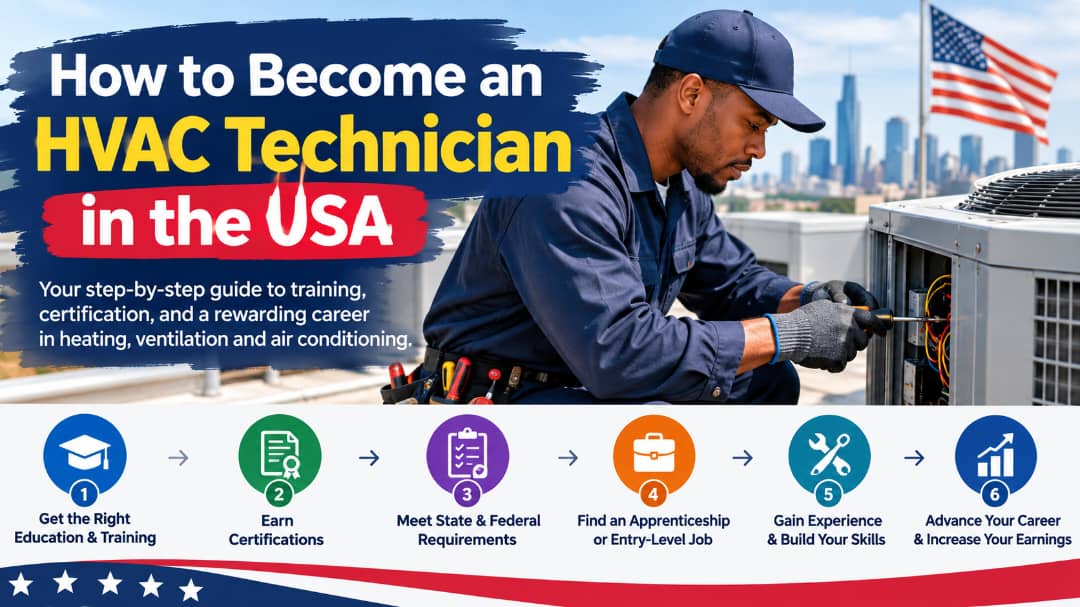
Heating, ventilation, and air conditioning (HVAC) is one of the skilled trades that can provide a practical route into a stable technical career in the United States. HVAC technicians install, maintain, troubleshoot, and repair heating, cooling, and refrigeration equipment used in homes, businesses, schools, hospitals, and other buildings.
For people considering the trade, one of the biggest advantages is that you do not necessarily need a four-year college degree to enter the occupation. The U.S. Bureau of Labor Statistics (BLS) says HVAC technicians typically receive postsecondary nondegree training. However, some people enter the occupation with less formal education and then develop their skills through on-the-job training. Technical schools, trade schools, and community colleges commonly offer HVAC programs lasting about six months to two years.
This guide explains the steps involved so beginners can understand what training to pursue, which certifications matter, how to gain experience, and how to move toward an HVAC technician job in the United States.
What Does an HVAC Technician Do?
An HVAC technician works with systems that control temperature, air movement, and indoor comfort. The exact duties vary depending on whether the technician works in residential, commercial, industrial, or refrigeration settings.
Common responsibilities include:
– Installing heating and cooling equipment
– Inspecting HVAC systems
– Diagnosing mechanical and electrical problems
– Repairing defective components
– Performing preventive maintenance
– Testing system performance
– Working with thermostats and control systems
– Handling refrigerants according to federal requirements
– Replacing worn or damaged components
– Explaining equipment problems and repairs to customers
HVAC technicians may work in houses, apartment buildings, offices, retail stores, schools, hospitals, factories, and other facilities. The work can involve traveling between job sites and working in areas that are hot, cold, cramped, outdoors, or difficult to access.
The occupation therefore combines technical knowledge with practical hands-on work. A technician needs to understand how HVAC equipment operates but also needs the ability to use tools, identify faults, read technical information, and safely carry out repairs.
How Long Does It Take to Become an HVAC Technician?
There is no single timeline that applies to every HVAC technician in the United States.
Some people enter the trade through a technical or community college program, while others begin with an employer and develop their skills through on-the-job training. BLS reports that HVAC programs at technical schools and community colleges generally take approximately six months to two years and can lead to a certificate or associate degree.
For example, a person who already has mechanical experience may need less classroom preparation than someone starting from zero. Someone pursuing a formal HVAC program may spend several months learning refrigeration, electrical systems, heating, cooling, safety, and troubleshooting before entering the workforce.
Hands-on experience is particularly important because HVAC work involves diagnosing real equipment and performing practical tasks that cannot be mastered through theory alone.
Step 1: Earn a High School Diploma or GED
A high school diploma or GED can be an important starting point for someone pursuing an HVAC career.
Not every HVAC position has the same education requirements. BLS notes that some employers consider candidates whose highest level of education is a high school diploma, while many technicians complete postsecondary HVAC training.
High school subjects that can be useful include:
– Mathematics
– Physics
– Computer or technology courses
– Electrical studies
– Mechanical or vocational education
You do not need to become an expert in advanced mathematics before entering HVAC. However, being comfortable with measurements, basic calculations, electricity, and mechanical concepts can make technical training easier.
If you did not attend college, that does not automatically prevent you from entering the HVAC trade. Trade schools, community colleges, apprenticeships, and employer-based training can provide alternative routes into the occupation.
Step 2: Get HVAC Training
After completing high school or obtaining a GED, one of the most practical next steps is to learn HVAC fundamentals.
A formal HVAC program can teach subjects such as:
– Heating systems
– Air-conditioning systems
– Refrigeration principles
– Electrical fundamentals
– Refrigerant handling
– HVAC controls
– Troubleshooting
– Preventive maintenance
– Installation procedures
– Workplace safety
Technical schools and community colleges are among the common places where this training is available. BLS reports that these programs generally range from six months to two years.
However, choosing a training program should not be based solely on how quickly you can obtain a certificate.
Before paying for an HVAC course, check what the program actually teaches, whether students receive hands-on laboratory experience, what equipment they work with, whether the school has relationships with employers, and whether the program prepares students for relevant industry certifications.
A short course that provides little practical experience may not prepare a beginner as well as a slightly longer program with substantial hands-on training.
Step 3: Learn Through an Apprenticeship or On-the-Job Training
Classroom training is only one part of becoming a competent HVAC technician.
HVAC is a hands-on trade, so working under experienced technicians can help a beginner learn how systems behave in real-world conditions.
Depending on the employer and training route, an entry-level worker may begin by assisting experienced technicians, learning how to use tools, observing troubleshooting procedures, helping with installations, performing maintenance tasks, and gradually taking on more responsibility.
BLS states that HVAC technicians typically receive a lengthy period of on-the-job training after being hired to develop competency.
An apprenticeship can therefore be an attractive route for people who want to earn experience while learning the trade.
However, beginners should understand an important distinction concerning refrigerant work.
Step 4: Obtain EPA Section 608 Certification
EPA Section 608 certification is one of the most important credentials for HVAC technicians who work with stationary air-conditioning and refrigeration equipment.
Under Section 608 of the Clean Air Act, technicians who perform covered activities that could release refrigerants must be certified. EPA-approved testing organizations administer the certification examinations.
There are four main certification categories:
– Type I: Servicing small appliances
– Type II: Servicing or disposing of high- or very-high-pressure appliances, excluding small appliances and motor vehicle air-conditioning systems
– Type III: Servicing or disposing of low-pressure appliances
– Universal: Covers all three equipment categories
A technician who wants the broadest Section 608 coverage generally pursues Universal certification. EPA states that Section 608 credentials do not expire.
It is important to understand that EPA certification is not the same thing as an HVAC license.
EPA Section 608 addresses federal refrigerant-handling requirements. State and local governments can have their own licensing or registration requirements for HVAC work. Therefore, someone planning to work as an HVAC technician should check the requirements of the particular state and locality where they intend to work.
What You Should Learn Before Applying for an HVAC Job
A beginner should aim to develop more than the ability to pass a certification examination.
Employers may expect entry-level candidates to have at least a basic understanding of:
Electrical systems
HVAC equipment contains electrical components, controls, motors, capacitors, switches, and other parts. Understanding electrical fundamentals is important for safe diagnosis and repair.
Refrigeration principles
You should understand the basic refrigeration cycle and how components such as compressors, condensers, evaporators, and expansion devices work together.
Heating systems
Depending on the type of HVAC work you pursue, you may work with furnaces, heat pumps, boilers, or other heating equipment.
Troubleshooting
A technician needs to determine why a system is not operating correctly rather than simply replacing parts without identifying the underlying problem.
Tools and safety
Learning how to use HVAC tools correctly and safely is essential. Technicians can face risks from electricity, hot components, moving machinery, refrigerants, heavy equipment, and difficult working environments.
These skills become more valuable as you move from an entry-level helper position toward independent technician work.
The Basic Path to Becoming an HVAC Technician
For someone starting from scratch, the process can be summarized as:
The exact route can differ from one person to another. You do not necessarily need to follow every step in precisely this order, and state or local requirements may change what is necessary before you can perform certain work independently.
The important point is to build the combination of technical knowledge, practical experience, certification, and any required licensing rather than relying on a certificate alone.
Where to Apply for HVAC Technician Jobs
There are several places where aspiring HVAC technicians can look for opportunities in the United States.
1. Trade Schools and Technical Colleges
Trade schools are one of the most common starting points for people who want structured HVAC training.
These programs can provide classroom instruction and hands-on practice in areas such as refrigeration, electrical systems, heating, air conditioning, troubleshooting, installation, and maintenance.
When comparing HVAC programs, look beyond the course title. Check:
– How long the program takes
– Whether practical training is included
– What equipment students use
– Whether the school helps graduates find employment
– Whether the program prepares students for relevant certifications
– Total tuition and additional fees
– Class schedules and attendance requirements
A shorter program is not automatically better. For someone starting from zero, a program with substantial practical training may be more useful than one that focuses mainly on classroom theory.
Community colleges can also offer HVAC certificates or associate-level programs. BLS reports that HVAC programs at technical schools and community colleges commonly take about six months to two years.
2. Apprenticeship Programs
An apprenticeship can be another strong route into the HVAC trade because it combines structured learning with practical experience.
Instead of learning everything in a classroom before looking for work, an apprentice can learn while working under experienced professionals.
Depending on the program, apprentices may learn:
– HVAC installation
– Preventive maintenance
– Electrical troubleshooting
– Refrigeration principles
– Heating systems
– Air-conditioning systems
– Safety procedures
– Tool use
– Equipment diagnostics
The U.S. Department of Labor’s Apprenticeship system is one place to investigate registered apprenticeship opportunities. Registered apprenticeships are designed around paid work, related instruction, and progressive skill development.
However, availability varies by location and occupation, so applicants should search for programs in the state or metropolitan area where they want to work.
3. HVAC Companies
You can also apply directly to HVAC companies.
This can be particularly useful for people who already have some technical training or related experience.
Do not search only for the title “HVAC technician.” Companies may advertise beginner opportunities under titles such as:
– HVAC helper
– HVAC apprentice
– HVAC installer helper
– HVAC installation technician
– HVAC maintenance technician
– Junior HVAC technician
– HVAC service trainee
– Refrigeration helper
– Maintenance technician
These positions can provide a way into the industry when you do not yet meet the requirements for a fully independent technician position.
Large HVAC contractors, residential service companies, commercial mechanical contractors, building maintenance companies, and facilities-management employers can all be potential sources of opportunities.
4. Job Search Websites
Online job boards can help you identify HVAC openings in your area.
When searching, use several related keywords rather than relying on one search phrase.
For example, search for:
– HVAC technician
– Entry-level HVAC technician
– HVAC apprentice
– HVAC helper
– HVAC installer
– HVAC service technician
– Refrigeration technician
– Commercial HVAC technician
– Residential HVAC technician
– Maintenance technician
How to Apply for an HVAC Technician Job
Step 1: Read the Job Description Carefully
Do not apply blindly to every HVAC vacancy.
Look at the requirements and separate them into three categories:
Required qualifications
These are conditions the employer considers necessary for the position.
Preferred qualifications
These can improve your chances but may not automatically disqualify you if you do not have them.
Experience requirements
Some positions may require previous HVAC experience, while others are specifically designed for apprentices, helpers, or entry-level workers.
If the advertisement asks for two years of experience, for example, applying may be less productive than targeting an entry-level opening if you have never worked in HVAC.
Step 2: Prepare an HVAC-Focused Resume
Your resume should make it easy for an employer to see what technical skills you have.
For a beginner, the resume can include:
– Education
– HVAC training
– Technical courses
– Certifications
– Apprenticeship experience
– Mechanical experience
– Electrical experience
– Construction experience
– Maintenance experience
– Relevant tools and equipment
– Safety training
– Driving experience, when relevant
You do not need to pretend that you have professional HVAC experience if you do not.
Instead, emphasize transferable skills and practical training.
For example, someone who has worked in electrical maintenance, plumbing, construction, automotive repair, or building maintenance may already have useful mechanical or troubleshooting experience.
Step 3: Include Relevant Certifications
If you have completed EPA Section 608 certification, list it clearly on your resume.
For example:
EPA Section 608 Universal Certification
Do not claim to hold a certification that you have not actually obtained.
If you are currently studying for a certification, you can state that honestly, but do not present it as completed.
Step 4: Submit the Application
Follow the employer’s instructions.
Some employers require applications through their online career portal, while others may use a recruiting platform.
Complete all required fields carefully and make sure your contact information is accurate.
If the employer requests a resume, upload a clean PDF unless another format is specified.
What Qualifications Do You Need to Become an HVAC Technician?
The requirements vary by employer, job level, state, and type of HVAC work.
However, common qualifications can include:
High School Diploma or GED
A high school diploma or equivalent can be useful and may be required for some training programs and jobs.
HVAC Training
Completing a trade school, technical school, or community college HVAC program can help demonstrate that you understand the fundamentals of the trade.
Hands-On Experience
Employers value practical experience because HVAC work involves diagnosing and working on actual equipment.
Experience can come from:
– Apprenticeships
– Internships
– Entry-level HVAC jobs
– Employer training
– School laboratory work
– Previous mechanical work
EPA Section 608 Certification
If your job involves activities covered by federal refrigerant-handling requirements, EPA Section 608 certification is important.
EPA requires technicians who perform covered service, maintenance, repair, or disposal activities that could release regulated refrigerants to be certified through an EPA-approved testing organization.
State or Local Licensing
This is an area where applicants need to be particularly careful.
There is not one universal HVAC technician license issued by the federal government that applies identically throughout the United States.
States, counties, cities, and other jurisdictions can have their own requirements for HVAC work.
Some locations may require licensing, registration, permits, or specific qualifications depending on the type and scope of work.
Therefore, before accepting an HVAC position or starting independent work, check the requirements of the state and local jurisdiction where you intend to work.
What Certifications Should an HVAC Technician Get?
EPA Section 608 is particularly important for technicians who work with covered refrigerant equipment, but it is not the only credential that can be useful.
Depending on your career goals, you may encounter certifications such as:
– EPA Section 608
– NATE certifications
– HVAC Excellence certifications
– Manufacturer-specific training
– Other industry or employer-recognized credentials
You do not necessarily need every certification available.
A beginner should first focus on developing fundamental HVAC skills and obtaining the credentials that are relevant to the work they actually want to perform.
For example, someone entering residential service may have different training priorities from someone planning to specialize in commercial refrigeration.
Can You Become an HVAC Technician With No Experience?
Yes, it is possible to enter the HVAC trade without previous professional HVAC experience.
The important distinction is between having no HVAC experience and being completely unprepared for HVAC work.
A beginner can improve their chances by obtaining basic training and then targeting positions designed for new workers.
Look for:
– HVAC apprentice positions
– HVAC helper positions
– Installation helper jobs
– Entry-level maintenance positions
– Trainee technician positions
– Apprenticeship programs
Some employers may be willing to train motivated candidates who demonstrate reliability, mechanical ability, willingness to learn, and a commitment to safety.
However, you should not assume that every company will hire someone with zero experience. Some employers specifically require previous field experience, so your search should focus on positions whose requirements match your current level.
What Skills Do Employers Look For?
Technical knowledge matters, but HVAC employers can also look for practical workplace skills.
Mechanical Ability
You should be comfortable working with tools and mechanical equipment.
Electrical Understanding
Basic electrical knowledge is increasingly important because modern HVAC systems rely heavily on electrical components and electronic controls.
Troubleshooting Ability
Good technicians do not simply replace parts. They identify the cause of a problem and determine the appropriate repair.
Communication
HVAC technicians often interact directly with customers, building managers, contractors, and other workers.
Being able to explain a problem clearly and professionally can therefore be valuable.
Physical Ability
HVAC work can involve lifting equipment, climbing ladders, kneeling, bending, working outdoors, and entering confined or difficult spaces.
Reliability
Technicians are often trusted to arrive at job sites on time, follow safety procedures, protect customer property, and complete assigned work properly.
For an entry-level worker, demonstrating reliability can be just as important as claiming to know everything about HVAC.
Types of HVAC Jobs You Can Pursue
The type of HVAC job available to you will depend on your experience, training, location, and qualifications.
Residential HVAC Technician
Residential technicians work primarily on heating and cooling systems in homes and apartments.
Their duties can include:
– Installing air-conditioning systems
– Servicing furnaces
– Maintaining heat pumps
– Diagnosing cooling problems
– Replacing components
– Performing preventive maintenance
– Testing system performance
– Explaining repairs to homeowners
Residential HVAC can be a practical starting point because technicians gain experience working with a variety of systems and customer situations.
Commercial HVAC Technician
Commercial HVAC technicians work on heating and cooling systems used in businesses and larger buildings.
They may work in:
– Office buildings
– Retail stores
– Hotels
– Restaurants
– Schools
– Hospitals
– Warehouses
– Industrial facilities
Commercial systems can be more complex than many residential systems, so technicians may need stronger troubleshooting, electrical, controls, and mechanical skills.
Experience in commercial HVAC can also open opportunities for technicians who eventually want to specialize in larger systems or building automation.
HVAC Installer
An HVAC installer focuses primarily on installing new equipment and replacing existing systems.
Installation work may involve:
– Removing old equipment
– Installing new heating or cooling equipment
– Connecting ductwork
– Installing refrigerant lines
– Connecting electrical components
– Setting up controls
– Testing the completed system
Installation can be a good entry point for people who enjoy hands-on construction and mechanical work.
HVAC Service Technician
Service technicians diagnose and repair equipment that is not operating correctly.
A service call may require the technician to identify the cause of a problem before deciding what repair is needed.
This can make troubleshooting ability extremely important.
As technicians gain experience, they may become increasingly comfortable diagnosing complicated electrical, refrigeration, airflow, and control problems.
Refrigeration Technician
Refrigeration is closely related to HVAC but focuses on systems used to keep products and spaces cold.
Technicians may work with commercial refrigeration equipment in supermarkets, restaurants, food-storage facilities, manufacturing operations, and other businesses.
This can be a useful specialization for technicians who want to move beyond conventional residential heating and cooling.
Building or Facilities Maintenance Technician
Some HVAC technicians work as part of a larger facilities or maintenance team.
Instead of traveling from one customer’s home to another, they may be responsible for maintaining equipment within a particular building or group of buildings.
These positions can be found in:
– Hospitals
– Universities
– Hotels
– Manufacturing plants
– Apartment complexes
– Government facilities
– Commercial properties
The job may include HVAC work alongside electrical, plumbing, mechanical, or general maintenance duties.
Can HVAC Technicians Earn Good Money?
HVAC can provide a solid income, but earnings vary significantly.
According to the U.S. Bureau of Labor Statistics, the median annual wage for heating, air conditioning, and refrigeration mechanics and installers was $61,010 in May 2025.
The BLS reported that the lowest 10% earned less than $40,050, while the highest 10% earned more than $95,210. These figures represent the occupation as a whole, rather than what every beginner can expect to earn. (“bls.gov” (https://www.bls.gov/ooh/Installation-Maintenance-and-Repair/Heating-air-conditioning-and-refrigeration-mechanics-and-installers)
Someone entering the trade for the first time should not assume that their starting salary will immediately approach the national median. Entry-level earnings can be lower while the technician develops experience and qualifications.
On the other hand, experienced technicians with specialized skills, strong troubleshooting ability, certifications, overtime opportunities, or supervisory responsibilities can potentially earn considerably more.
How to Progress From Beginner to Experienced Technician
Your first HVAC job should be viewed as the beginning of your career rather than the final destination.
A possible progression could look like:
HVAC helper → Apprentice → Entry-level technician → Experienced technician → Senior technician → Lead technician → Supervisor or specialized technician
The exact titles differ between employers.
Some technicians may eventually move into:
– Commercial HVAC
– Industrial refrigeration
– Building automation
– HVAC controls
– Heat-pump systems
– System commissioning
– Project management
– HVAC sales
– Service management
– Training and education
– Business ownership
Not everyone needs to become a supervisor. A technician can also build a strong career by becoming highly skilled in a particular technical area.
Common Mistakes People Make When Starting an HVAC Technician Career
Mistake 1: Choosing a Course Because It Is Cheap
The cheapest HVAC course is not necessarily the best choice.
Compare practical training, equipment, curriculum, instructor experience, certification preparation, and employment support before paying tuition.
Mistake 2: Believing a Certificate Automatically Makes You a Technician
Completing a course is useful, but HVAC is a practical occupation.
Employers want people who can apply what they have learned to real equipment.
Continue developing hands-on skills after completing classroom training.
Mistake 3: Ignoring Local Licensing Requirements
Federal refrigerant certification and state or local licensing are different issues.
Do not assume that obtaining EPA Section 608 certification automatically permits you to perform every type of HVAC work in every state.
Always check the rules that apply where you intend to work.
Mistake 4: Applying Only for “HVAC Technician” Positions
A beginner may find it difficult to compete with experienced technicians for fully qualified technician positions.
Expand your search to include:
– HVAC apprentice
– HVAC helper
– Installation helper
– HVAC trainee
– Maintenance technician
– Junior technician
These positions can provide the experience needed to qualify for more advanced roles later.
Mistake 5: Exaggerating Experience
Never claim that you have worked on equipment you have never handled.
HVAC involves electricity, refrigerants, combustion systems, moving machinery, and other hazards. Employers need to know what you can actually do.
Be honest about your skill level and show that you are willing to learn.
How to Avoid HVAC Technician Job Scams
Job seekers should be cautious when applying online.
Be suspicious when a recruiter:
– Guarantees you a job without an interview
– Demands money before offering employment
– Asks you to buy equipment from an unknown supplier
– Requests unnecessary sensitive information immediately
– Uses an unofficial email address while claiming to represent a major company
– Sends you a check and asks you to return part of the money
– Offers unusually high pay for little or no experience
– Refuses to provide verifiable information about the employer
Before accepting an offer, verify the company independently.
Look for an official company website, confirm the company’s contact information, and check whether the job appears on the employer’s legitimate careers page.
Never assume a professional-looking job advertisement is automatically legitimate.
Frequently Asked Questions
Do I need a college degree to become an HVAC technician?
No. A four-year college degree is generally not required to enter the HVAC technician occupation.
Many technicians obtain postsecondary nondegree training through trade schools, technical schools, or community colleges, while others develop skills through on-the-job training or apprenticeship routes.
How long does HVAC training take?
BLS states that HVAC programs at technical schools and community colleges commonly take approximately six months to two years. Apprenticeship and on-the-job training follow different timelines depending on the employer or program.
Can I become an HVAC technician without experience?
Yes. Beginners can look for apprenticeships, helper positions, installation-helper jobs, trainee roles, and other entry-level opportunities.
However, obtaining basic training before applying can make it easier to demonstrate that you understand the fundamentals.
Is EPA Section 608 certification required?
If you perform covered activities involving refrigerants in equipment regulated under Section 608, federal certification requirements apply.
EPA states that technicians who maintain, service, repair, or dispose of appliances that could release regulated refrigerants must be certified, subject to specific exceptions such as qualifying supervised apprentices.
Does EPA certification expire?
EPA states that Section 608 technician certifications do not expire. However, technicians should continue learning because equipment, technology, regulations, and employer requirements can change.
Can I work as an HVAC technician in any state with EPA certification?
EPA Section 608 certification concerns federal refrigerant-handling requirements. States and local jurisdictions can impose additional licensing, registration, or other requirements for HVAC work.
Check the requirements in the state and locality where you intend to work.
How much can an HVAC technician make in the USA?
The BLS reported a median annual wage of $61,010 in May 2025 for heating, air conditioning, and refrigeration mechanics and installers. The lowest 10% earned less than $40,050, and the highest 10% earned more than $95,210.
Is HVAC a good career for someone who does not want a four-year degree?
It can be a good option for people who prefer practical, technical work and want to enter a skilled trade without completing a traditional four-year college program.
Conclusion
Becoming an HVAC technician in the USA does not require everyone to follow exactly the same path. Some people begin with trade-school training, others enter apprenticeships, and some start with an employer and learn through supervised work.
For most beginners, the most sensible approach is to learn the fundamentals, gain practical experience, obtain the certifications required for the work they intend to perform, and check the licensing rules that apply in their location.
If you are willing to learn a practical trade, work safely, solve technical problems, and continue developing your skills, HVAC can offer a pathway into a growing skilled-trades occupation.
2 comments