
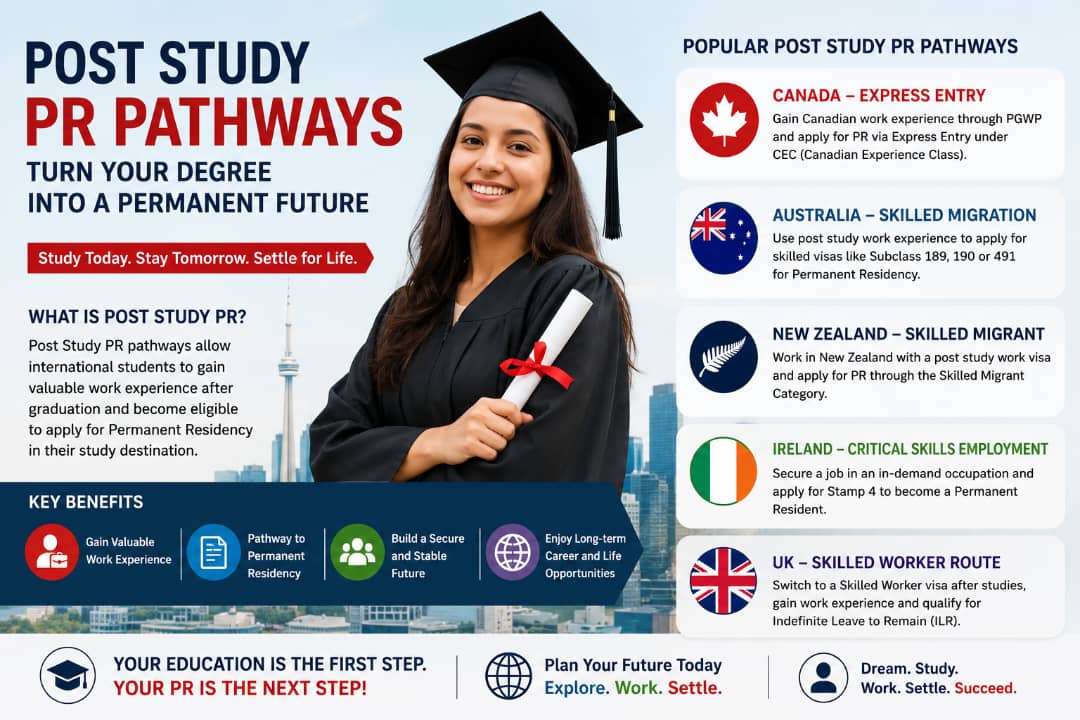
Today, studying overseas is no longer viewed as a short-term academic experience. It is a long-term immigration and financial decision. Tuition fees, living expenses, exchange rates, and opportunity costs force students to think beyond graduation.
This is why permanent residency after study now dominates student searches, visa consultations, and government policy discussions.
The reality many students discover too late is that permanent residence does not magically begin after graduation. It starts from day one of enrollment.
What makes post-study PR pathways so powerful is that governments are actively designing them to retain international graduates. Aging populations, declining birth rates, and severe skills shortages mean countries cannot afford to lose trained talent.
Graduates are already inside the system, paying taxes, contributing to the workforce, and adapting culturally. Permanent residence becomes a logical next step, not an exception.
Why Permanent Residency After Graduation Is the Real Goal
Let us be honest for a moment
International education is expensive.
Tuition is high.
Living costs are rising.
Exchange rates are brutal.
Nobody is spending tens of thousands of dollars just to return home empty-handed.
Post-Study PR Pathways exist because countries like Canada, Australia, the UK, New Zealand, and parts of Europe are facing severe labor shortages, aging populations, and skills gaps that domestic workers cannot fill fast enough.
International students are already inside the system.
They speak the language.
They understand the culture.
They hold local qualifications.
From a government perspective, they are the easiest immigrants to retain.
This is why permanent residence after study has quietly become one of the most powerful immigration routes in the world.
How Post-Graduation Immigration Really Works
This is the part most blogs get wrong
Permanent residence does not start after graduation.
It starts while you are still a student.
Your course selection, study location, internship choices, part-time work, and even your first job offer after graduation all feed directly into post-study PR pathways.
The smartest students are not asking:
Can I study abroad?
They are asking:
What happens after I graduate?
The Hidden Structure Behind Post-Study Permanent Residence
Every country follows the same three-step pattern
First, a post-study work visa
Second, local skilled employment
Third, a permanent residency application
Countries change the names, points systems, and eligibility rules, but the structure is almost identical everywhere.
Understanding this structure early is the difference between smooth PR approval and years of visa stress.
Canada’s Graduate to Permanent Resident System Explained Simply
Canada is the global leader in post-study immigration
Canada’s post-study PR pathways are among the most predictable and generous in the world.
After graduation, international students typically move on to a Post-Graduation Work Permit.
This allows full-time work anywhere in Canada.
Once local work experience is gained, students transition into permanent residence through multiple streams.
Canada rewards:
Local education
Canadian work experience
Youth
English or French proficiency
Graduates are heavily favored under Express Entry, Provincial Nominee Programs, and regional immigration pilots.
The longer you work legally in Canada after graduation, the stronger your PR profile becomes.
Why Provincial Programs Matter More Than Federal Immigration
This is a high-impact insight many students miss
Canada’s provinces compete with each other for talent.
Smaller provinces offer faster PR routes because they struggle to retain graduates.
This means studying outside major cities can dramatically improve permanent residence chances.
Post-study PR pathways in Canada are not just federal.
They are provincial, regional, and sometimes employer-driven.
Students who plan location strategically often secure PR faster than those chasing big cities.
Australia’s Graduate to Permanent Residency Strategy
Australia is selective but extremely rewarding
Australia’s post-study PR pathways rely heavily on skills demand and regional incentives.
After graduation, students typically transition to a temporary graduate visa, allowing full-time employment.
From there, skilled migration points, employer sponsorship, or state nomination open the door to permanent residence.
Australia strongly rewards:
STEM degrees
Healthcare qualifications
Engineering and construction skills
Regional study
Graduates who work in designated regional areas often receive extra points and priority processing.
Australia’s system favors long-term planning over shortcuts.
Why Course Choice Controls Australian PR Outcomes
This is critical
Not all degrees lead to the same permanent residency opportunities.
Courses aligned with skills shortage lists dramatically increase PR success.
Students who choose courses purely for interest often struggle later.
Students who align education with immigration strategy move faster and safer.
Post-study PR pathways in Australia are engineered around workforce demand, not academic prestige.
The United Kingdom’s Quiet Shift Toward Graduate Retention
The UK is changing faster than many realize
The Graduate Route allows international students to stay and work after completing a degree.
While it does not directly grant permanent residence, it creates a bridge to Skilled Worker sponsorship.
Once sponsored by an approved employer, graduates begin a countdown toward settlement.
The UK now actively depends on international graduates in healthcare, tech, engineering, education, and finance.
Post-study PR pathways in the UK are employer-driven, not points-driven.
Choosing the right employer matters more than choosing the right university.
Why UK Sponsorship Is Easier Than Before
The labor shortage is real
Hospitals, care providers, tech firms, and infrastructure companies are struggling to hire.
Graduates with UK qualifications have a massive advantage over overseas applicants.
Once sponsorship begins, the route to permanent residence becomes clear and structured.
Consistency and lawful stay matter more than speed.
New Zealand’s Graduate to Residence Options
Small country, big opportunity
New Zealand values graduates who commit long-term.
Post-study work visas allow graduates to gain local experience.
From there, skilled employment leads to residence pathways based on occupation demand.
New Zealand prioritizes:
Healthcare professionals
Construction workers
Engineers
ICT specialists
Graduates who work outside Auckland often experience faster PR processing.
Post-study PR pathways here reward lifestyle flexibility and commitment.
Europe’s Emerging Graduate Residency Routes
Europe is quietly opening doors
Countries like Germany, Ireland, and the Netherlands are expanding graduate retention policies.
After graduation, students receive job-seeking or work visas.
Once employed in skilled roles, they transition toward long-term residence.
Germany, in particular, values technical graduates and vocational skills.
Post-study PR pathways in Europe are less advertised but highly effective for those who understand them.
The Role of Employers in Permanent Residency After Study
Employers are gatekeepers
In many countries, employer sponsorship accelerates permanent residence.
Graduates who understand this position see themselves as long-term hires, not temporary workers.
Employers prefer graduates already in-country because visa risk is lower.
The smartest graduates focus on:
In-demand roles
Hard-to-fill positions
Industries facing talent shortages
Post-study PR pathways favor practicality over prestige.
Mistakes That Kill Permanent Residency Chances
Avoid these at all costs
Ignoring the immigration strategy while studying
Choosing courses with no labor demand
Working in unrelated jobs after graduation
Delaying work experience accumulation
Assuming PR is automatic
Permanent residence after graduation is earned, not given.
Post-study PR pathways reward discipline, planning, and alignment.
How Early Planning Multiplies Success
Timing is everything
Students who plan in their first year often secure PR faster than those who wait until graduation.
Every year of relevant experience adds weight to your profile.
Every strategic job choice compounds your advantage.
Post-study PR pathways are predictable if approached methodically.
Why Governments Want International Graduates to Stay
This is about economics
Graduates already contribute:
Tuition revenue
Local spending
Taxes
Skilled labor
Governments lose money when graduates leave.
That is why immigration systems increasingly favor post-study transitions.
Permanent residence is not a gift.
It is a retention strategy.
High-Earning Careers That Align With Permanent Residence
Income matters more than many admit
Higher-paying roles often receive faster sponsorship and priority processing.
Healthcare, technology, engineering, finance, and skilled trades dominate post-study PR pathways globally.
Graduates who target these sectors face fewer visa obstacles.
Economic contribution equals immigration leverage.
The Long-Term Payoff of Permanent Residence
This is where everything changes
Permanent residence unlocks:
Unrestricted employment
Business opportunities
Access to social systems
Pathways to citizenship
The return on education investment multiplies after PR approval.
Post-study PR pathways transform education into lifetime stability.
Countries are competing for educated talent.
Students who understand the system win.
If you treat graduation as the finish line, you struggle.
If you treat graduation as the midpoint, you thrive.
When you understand how post-study PR pathways truly work, you stop guessing and start building a future that actually lasts.
Frequently Asked Questions
Do Post-Study PR Pathways start only after graduation
No, post-study PR pathways effectively start from the moment a student chooses a course and destination. Course relevance, study location, part-time work, internships, and early career decisions all influence permanent residence eligibility.
Which countries offer the best Post-Study PR Pathways
Countries like Canada, Australia, the United Kingdom, New Zealand, and Germany are known for strong post-study PR pathways. These countries actively retain international graduates due to labor shortages and aging populations.
Is permanent residency guaranteed through the Post-Study PR Pathways
Permanent residency is not guaranteed, but post-study PR pathways significantly increase the chances when followed correctly. Success depends on factors like field of study, work experience, language proficiency, and immigration compliance.
How does work experience affect Post-Study PR Pathways
Local work experience is one of the most important factors in post-study PR pathways. Many immigration systems reward graduates who gain skilled employment after graduation.
Do all degrees qualify for Post-Study PR Pathways?
Not all degrees offer the same permanent residency potential. Post-study PR pathways favor qualifications linked to labor market demand such as healthcare, engineering, IT, construction, education, and skilled trades.
Can a regional study improve the Post-Study PR Pathways chances
Yes, studying and working in regional or less populated areas often improves post-study PR pathways outcomes.
How important is employer sponsorship in Post-Study PR Pathways
Employer sponsorship plays a critical role in many post-study PR pathways, especially in the UK and Australia.