
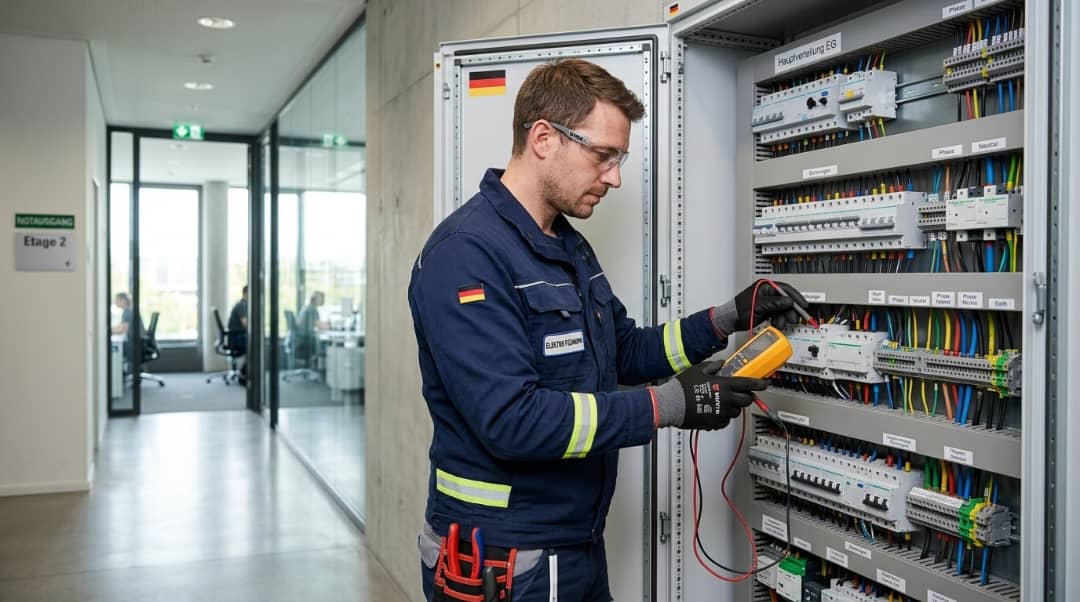
Germany offers employment opportunities for qualified electricians in building construction, industrial production, electrical maintenance, and energy systems. Employers need workers who can install, maintain, and repair electrical equipment, although the qualifications and experience required vary by position.
For electricians applying from outside Germany, the main challenge is finding an employer whose requirements match their training and experience, then meeting the applicable qualification and work-visa conditions. Learning German can also make a significant difference when applying for practical, safety-sensitive jobs.
This guide explains electrician salaries in Germany, the types of jobs available, and the qualifications employers commonly look for.
How Much Do Electricians Earn in Germany?
Electrician salaries depend on the type of work, experience, location, and employer. Industrial electricians, building electricians, and maintenance technicians may receive different pay even when their job titles appear similar.
According to Germany’s Federal Employment Agency, the median gross monthly salary for skilled workers in building electrical installation occupations was €3,935. The reported lower and upper quartiles were €3,335 and €4,738 per month, respectively.
These figures provide a useful benchmark, but they are not guaranteed starting salaries or a promise of what an overseas applicant will earn.
| Salary measure | Gross monthly pay |
|---|---|
| Lower quartile | €3,335 |
| Median | €3,935 |
| Upper quartile | €4,738 |
Source: Federal Employment Agency’s Entgeltatlas. Figures are gross, before taxes and social contributions, and refer to the occupation group rather than every electrician vacancy.
Your actual offer may be lower or higher depending on your experience, region, shift arrangements, overtime, and any applicable collective agreement. Always compare the gross salary and working hours in the employment contract rather than relying on advertised maximum earnings.
Types of Electrician Jobs Available in Germany
Electricians can pursue different roles depending on their technical background. When searching for vacancies, use the job title that best matches your experience.
1. Building Electrician
Building electricians install and maintain electrical systems in homes, offices, commercial buildings and construction projects.
Typical duties include:
- Installing cables, sockets, switches and distribution boards.
- Reading electrical drawings and wiring diagrams.
- Testing circuits and identifying faults.
- Maintaining electrical installations in line with applicable safety standards.
German search terms include Elektriker and Elektroinstallateur.
2. Industrial Electrician
Industrial electricians work in factories, production facilities, and industrial plants. Their work often involves machinery, control systems and electrical equipment.
Typical responsibilities include:
- Maintaining motors and industrial electrical systems.
- Troubleshooting electrical faults on production lines.
- Carrying out inspections and preventive maintenance.
- Working with control panels and technical documentation.
Search terms include Industrieelektriker and Betriebselektriker.
3. Electrical Maintenance Technician
Maintenance technicians help keep electrical equipment and facilities operating safely. Employers may seek candidates with experience in troubleshooting, planned maintenance, and equipment testing.
These positions can be suitable for electricians who have worked in factories, commercial facilities or large buildings.
4. Energy and Building Technology Electrician
This role focuses on electrical systems used in modern buildings, including lighting, power distribution, building controls and energy-related installations.
Depending on the employer, the work may involve smart-building technology, energy management systems and connections to renewable-energy equipment.
Relevant German job titles include Elektroniker für Energie- und Gebäudetechnik.
Requirements for Electrician Jobs in Germany
There is no single set of requirements for every electrician vacancy. Employers assess the duties involved, the candidate’s training, and whether the person can legally work in Germany.
The following are common requirements to prepare for.
1. Electrical training or a relevant qualification
Many skilled electrician positions require completed vocational training or an equivalent technical qualification.
Useful evidence includes:
- An electrician or electrical installation diploma.
- A technical college or vocational training certificate.
- An apprenticeship completion certificate, where applicable.
- Records showing the subjects studied and practical training completed.
A short course certificate alone may not satisfy the requirements for a skilled position. Employers need to understand the level and content of your training.
2. Relevant work experience
Some employers accept newly qualified applicants, while others prefer candidates with practical experience.
Experience in electrical installation, industrial maintenance, fault diagnosis, wiring, testing or equipment repair can strengthen an application. Describe the actual systems and tasks you have handled rather than simply stating that you have worked as an electrician.
3. German language skills
German is valuable for understanding safety instructions, communicating with supervisors and coordinating work with other tradespeople.
The language level required depends on the employer and position. Basic German may be sufficient for some roles, while others require stronger communication skills. English-speaking vacancies exist, but applicants should not assume that English alone will be enough.
If you are applying from abroad, learning German before applying can improve your prospects.
4. Electrical safety knowledge
Employers may assess your understanding of safe working practices, equipment testing, fault isolation and the correct use of tools.
You may also need to learn German technical terminology and workplace procedures. Do not assume that a certificate from your home country automatically authorizes you to perform every electrical task in Germany.
5. A valid route to employment
If you are a citizen of a country outside the EU or EEA, you will generally need the appropriate permission to live and work in Germany.
The route depends on your circumstances, qualifications, experience and job offer. Before accepting a position, confirm the relevant requirements through the official Make it in Germany work-visa guidance.
Do Foreign Electricians Need Qualification Recognition?
This is an important question for applicants trained outside Germany.
The answer depends on the specific occupation, the qualification you hold, and the residence route you intend to use. Some electrical occupations are not regulated in the same way as professions such as nursing, but recognition or an assessment of your qualification may still be relevant to a work visa or a particular position.
For example, Germany’s official recognition portal explains that industrial electrician qualifications can be assessed for equivalence, even where recognition is not compulsory for every employment situation.
Before paying for a recognition procedure, check your occupation and personal circumstances through the official Recognition in Germany portal.
This helps you determine which documents are needed and whether your qualification must be formally assessed. A foreign diploma should not be assumed to be automatically equivalent to German vocational training.
Where to Find Electrician Jobs in Germany
If you are applying from Nigeria or another country outside the EU, start with reputable job portals and employers’ official careers pages. Search using both English and German job titles because many German employers advertise technical vacancies in German.
1. Make it in Germany
The German government’s official skilled-worker portal has a job exchange for people looking for employment in Germany.
Search for electrician vacancies: Make it in Germany Job Listings
Try terms such as Elektriker, Elektroniker für Energie- und Gebäudetechnik, Industrieelektriker and Betriebselektriker. Read each vacancy carefully to check the required training, language skills, experience and application method.
2. Federal Employment Agency
Germany’s Federal Employment Agency provides a job-search service with vacancies across different occupations and regions.
Search for jobs: Federal Employment Agency Job Search.
The portal is primarily in German, so you may need a translation tool. Search by job title and location, then read the employer’s requirements before applying. If the vacancy provides an employer contact or application link, use the details stated in the original advertisement.
3. EURES
EURES is the European employment network. It provides access to job vacancies and information about working in European countries.
Explore vacancies: EURES Job Search
Use Germany as your target country and search for electrical installation, maintenance, or industrial electrical roles. Check whether each vacancy accepts applications from outside the EU and whether the employer can accommodate the necessary immigration process.
4. Apply directly through employers
You can also search the careers pages of electrical contractors, industrial manufacturers, building-services companies and facility-management businesses.
This approach allows you to check the employer’s actual requirements and submit your application through its official recruitment system.
Search for phrases such as Elektriker Stellenangebote, Industrieelektriker Jobs and Elektroniker Energie Gebäudetechnik. These German search terms can help you find vacancies that may not appear when you search only in English.
Important: A vacancy advertised in Germany does not automatically include visa sponsorship. Before proceeding, ask whether the employer considers applicants living outside Germany and whether the position can support the work-permit route applicable to your circumstances.
How to Apply for Electrician Jobs in Germany
Applying from abroad requires more preparation than sending a short CV. Follow these steps to improve your chances of reaching employers whose requirements match your background.
Step 1: Choose the right electrician role
Identify the work you can demonstrate through your training and experience.
For example, an electrician with experience installing domestic wiring should focus on relevant building-electrical vacancies. Someone who has maintained factory machinery may be a stronger match for industrial electrical maintenance positions.
Use the job description to decide whether your experience is relevant rather than applying for every vacancy with the word “electrician” in its title.
Step 2: Check your qualification requirements
Before applying, determine whether your foreign qualification needs formal recognition or another form of assessment for the intended job and visa route.
Start with the official Recognition in Germany portal. It helps you identify the relevant German occupation and the authority responsible for assessing your qualification.
Recognition requirements vary. Do not assume that every electrician must follow the same procedure or that a foreign certificate is automatically equivalent to a German vocational qualification.
Step 3: Prepare a clear CV
Your CV should make it easy for an employer to understand your technical background.
Include:
- Your electrical qualification and training institution.
- Previous employers, job titles and dates of employment.
- The electrical systems and equipment you have worked with.
- Installation, maintenance, testing and troubleshooting experience.
- Relevant safety training and technical certificates.
- Your German and English language abilities.
- Your current location and contact details.
Describe practical achievements where possible. For instance, specify the type of equipment you maintained or the installations you completed instead of writing only “responsible for electrical work.”
Step 4: Write a targeted cover letter
Explain which vacancy you are applying for, how your experience matches its requirements, and why you are interested in the position.
If you live outside Germany, be transparent about your location. State that you would need the appropriate immigration permission and ask whether the employer considers overseas applicants.
Avoid sending the same generic letter to every employer. A short, relevant application is more useful than a lengthy letter filled with broad claims.
Step 5: Submit your application through the official channel
Follow the instructions in the vacancy. Some employers use an online application form, while others request documents by email.
Attach the requested CV, certificates and supporting documents. If your certificates are not in German, check whether the employer or recognition authority requires certified translations.
Keep a record of the employer, job title, application date, and response. This will help you follow up professionally without submitting the same application repeatedly.
Step 6: Prepare for the interview
Employers may ask technical questions about wiring, electrical testing, fault diagnosis, maintenance procedures, and safety practices.
Be ready to explain your actual experience and how you approach electrical work safely. If the interview is conducted in German, practice describing your training, previous duties, and technical skills in German.
Do not claim to hold a qualification or license you do not have. Employers may ask for evidence during recruitment or qualification assessment.
Step 7: Confirm the employment and visa arrangements
If you receive an offer, examine the job title, duties, gross salary, working hours, probation period and other contract terms.
Next, check which residence and work-permit route applies to you. The official Make it in Germany visa guidance explains the skilled-worker route and related requirements.
Depending on your circumstances, you may need a recognized qualification or other proof of vocational training. A job offer alone does not guarantee a visa.
Documents to Prepare Before Applying
The precise documents depend on the employer, your qualification and your visa route. These are useful items to organize in advance:
- Valid passport: Check that it will remain valid for the intended application and travel period.
- Electrical qualification certificates: Provide your diploma, trade certificate or apprenticeship records.
- Academic or training transcripts: These may help an authority assess the content and duration of your training.
- Employment references: Obtain letters that confirm your roles, dates, and relevant electrical duties.
- CV and cover letter: Tailor both documents to the vacancy.
- Language certificates: Include them if requested or if they support your application.
- Qualification-recognition documents: Provide an assessment or recognition decision if required for your route.
- Translations: Arrange translations in the format required by the relevant employer, authority or consulate.
- Visa documents: Prepare the application form, employment offer, and any additional evidence required by the responsible German mission.
Do not pay for unnecessary documents or translations before checking the relevant requirements.
Read also: If you are building a career in the German technical sector, explore our related guides on Mechanical Engineering Jobs in Germany and Automotive Engineer Jobs in Germany once their published URLs are available.
Skills German Employers Look for in Electricians
Your qualification matters, but employers also want to know whether you can carry out electrical work safely, diagnose faults and follow technical instructions.
The most useful skills depend on the position, but the following are relevant to many electrician jobs in Germany.
Electrical installation and maintenance
Employers may look for experience installing wiring, connecting electrical equipment, maintaining distribution systems and carrying out repairs. Industrial positions may require additional experience with motors, control panels and production machinery.
Explain which systems you have worked with and what you were responsible for. Specific examples make your application stronger than a general claim that you are a skilled electrician.
Fault diagnosis and electrical testing
Electricians need to identify faults, investigate their causes, and check that installations or equipment operate correctly. Experience using electrical testing instruments and following documented testing procedures can be valuable.
Never exaggerate your practical abilities. Employers may assess your knowledge during an interview or practical test.
Reading electrical drawings
The ability to interpret wiring diagrams, circuit plans and technical documentation can help you understand installations and communicate with other technicians.
If you have experience with industrial schematics, building plans or control-system diagrams, mention it in your CV when it is relevant to the vacancy.
Workplace safety
Electrical work involves risks, so employers need workers who understand safe isolation, appropriate protective equipment and established work procedures.
German workplace rules and technical standards may differ from those in your home country. Be prepared to learn the applicable requirements before undertaking tasks that you are not authorised or trained to perform.
German language and communication
German language skills can help you understand instructions, read workplace documentation and communicate with colleagues. The level required depends on the employer and job.
Learning technical German alongside general conversation can be particularly useful. Start with electrical components, tools, safety instructions, and common maintenance terminology.
Common Mistakes to Avoid When Applying
A well-prepared applicant can still lose opportunities by overlooking basic recruitment requirements.
Applying without checking the qualification requirements: Read the vacancy carefully and investigate whether your training matches the position. Where formal recognition is required, establish the correct procedure before making expensive commitments.
Using one generic CV for every vacancy: Tailor your application to the job. An industrial maintenance employer needs to see relevant machinery and troubleshooting experience, while a building-services employer may focus more on installations and wiring.
Ignoring German-language requirements: Do not assume every employer will accept English. Check the stated language requirements and improve your German where necessary.
Assuming every employer offers visa sponsorship: A company advertising an electrician vacancy may expect applicants to already have permission to work in Germany. Ask about overseas applications and work-permit arrangements before investing too much time in the recruitment process.
Accepting an unclear employment contract: Check the salary, working hours, job duties, location and deductions. Make sure you understand whether the advertised salary is gross or net.
How to Avoid Electrician Job Scams in Germany
People searching for overseas employment can encounter fake recruiters and misleading job advertisements. Be careful if an offer sounds unusually attractive or someone pressures you to pay immediately.
Watch for these warning signs:
- A recruiter guarantees a German job or visa before assessing your qualifications.
- You are asked to pay a large recruitment fee to secure an offer.
- The supposed employer uses an unofficial email address and cannot be independently verified.
- You receive a contract without a proper interview or clear job description.
- Someone asks you to pay into a personal account for a promised work permit.
- The recruiter refuses to identify the actual employer or explain the recruitment process.
Verify vacancies through the employer’s official website or a recognized job portal. Contact the company independently if you are unsure whether an offer is genuine.
For immigration information, use the official Make it in Germany website and the German Embassy in Abuja. A genuine job offer does not automatically guarantee a visa, and you should not make major payments based solely on a recruiter’s promise.
Frequently Asked Questions
Can I get an electrician job in Germany from Nigeria?
Yes. You can apply to German employers while living in Nigeria. Your prospects depend on your training, experience, language skills, and whether an employer has a suitable vacancy. You must also meet the requirements of the applicable immigration route before working in Germany.
Do I need to speak German to work as an electrician in Germany?
The required level varies by employer and position. Some jobs may accept English-speaking candidates, but German is useful for understanding safety instructions and communicating at work. Check the vacancy instead of assuming that a particular language level is compulsory for every electrician job.
How much can an electrician earn in Germany?
Pay varies by occupation, experience, location and employer. Germany’s Federal Employment Agency reports a median gross monthly salary of €3,935 for skilled workers in building electrical installation occupations, with a lower quartile of €3,335 and an upper quartile of €4,738. These are occupational statistics, not guaranteed salaries for every vacancy.
Official source: Federal Employment Agency Entgeltatlas.
Is a Nigerian electrician certificate valid in Germany?
It depends on the qualification, the intended occupation, and the requirements of the job and visa route. Do not assume that a certificate is automatically equivalent to a German qualification. Check the official Recognition in Germany portal to find out whether recognition or an assessment is necessary in your circumstances.
Can I apply without work experience?
Some employers recruit newly qualified workers, but others require previous experience. If you have little experience, look for suitable junior positions or vocational training opportunities rather than applying only for jobs that demand several years of independent electrical work.
Does an electrician job offer guarantee a German work visa?
No. A job offer is only one part of the process. You must satisfy the conditions of the residence and work-permit route applicable to your qualifications and circumstances.
Check the official German skilled-worker visa guidance before accepting an offer on the assumption that you can automatically relocate.
Conclusion
Electrician jobs in Germany may offer opportunities for qualified workers with relevant practical skills, but a successful application requires more than finding a vacancy online.
Identify the right type of electrical work, prepare a clear CV, check qualification and language requirements, and apply through reputable recruitment channels. If you are applying from outside Germany, confirm the immigration requirements before making financial commitments.
Start with the Federal Employment Agency job portal and the official Make it in Germany website. These are sensible starting points for finding vacancies and understanding the rules for working in Germany.
Boss, the three parts are now drafted. Before publishing, we should do a final fact-check of the salary figures, confirm the official links, and add the exact internal URLs for your existing Germany job articles. Then we’ll prepare the SEO title, meta description, and a concise disclaimer.